
GOSP: Accelerating Churn Analysis through Goal-Oriented Sequential Patterns
Goal-oriented sequential pattern for network banking churn analysis
This paper introduces the Goal-Oriented Sequential Pattern (GOSP) algorithm, a data mining approach designed to predict customer churn in network banking. By focusing on specific target events (e.g., service termination) and employing a "reversed sequence" strategy, the method efficiently identifies the chain of behavioral triggers leading to customer loss.
TL;DR
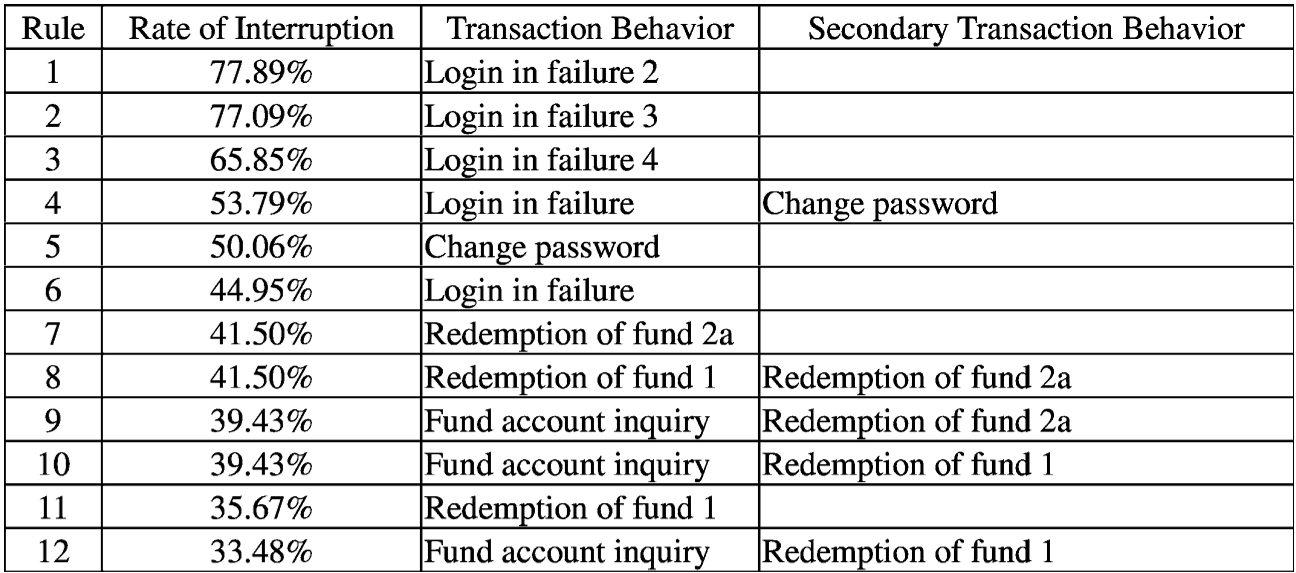
Predicting customer churn is a race against time. This paper presents the Goal-Oriented Sequential Pattern (GOSP) algorithm, a specialized data mining technique that targets specific outcomes (like service termination) rather than mining all possible sequences. By using a clever reversed sequence strategy, the authors achieved a 10x+ speedup over traditional Apriori methods while uncovering high-precision triggers for banking churn—such as the "Login in failure 2" rule which predicts loss with 77% accuracy.
The "Needle in a Haystack" Problem in Churn Prediction
In customer relationship management (CRM), it is well-known that retaining an existing customer is five times cheaper than acquiring a new one. However, traditional data mining algorithms like Apriori and Sequential Pattern Mining often fail in practical business settings because:
- Information Overload: They generate thousands of rules, most of which are irrelevant to the specific "goal" (e.g., loss).
- Computational Waste: They scan the entire database for all possible patterns, consuming massive CPU and memory resources.
- Lack of Context: They often ignore the frequency of specific failures, treating three consecutive password errors the same as three isolated errors over a year.
Methodology: The Goal-Oriented Innovation
The authors' core "insight" is that if you know what the end result is (the "Goal"), you should search backward from that point.
1. Normalization & Time Windows
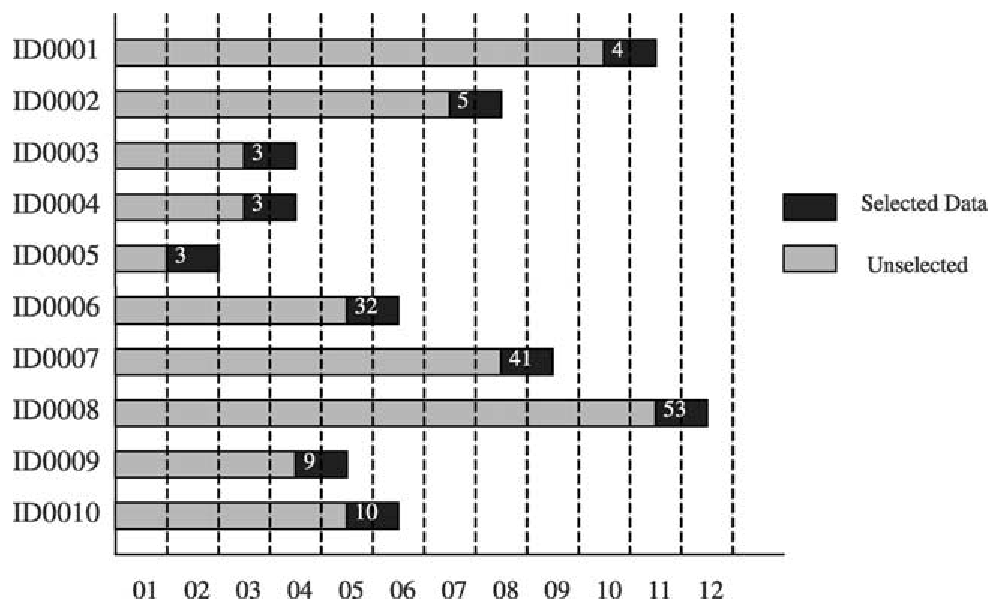
Instead of using a fixed calendar month, the authors anchored the data to each customer's last transaction date. They look back one month from that specific "datum point." This ensures that the patterns captured are indeed current "pre-loss" behaviors.
2. Virtual Labels
To solve the granularity problem, the paper introduces Virtual Labels. For example, two repeated "login failure" events are combined into a single label: Login failure 2. This preserves the intensity of the behavior which is often a stronger signal of frustration than a single event.
3. The Reverse Strategy
This is GOSP's engine. By reversing the sequence (moving the outcome to the front), the algorithm can prune any candidate sequence that does not start with the goal item. This drastically reduces the search space. Once the mining is complete, the sequence is re-reversed to its original chronological order.
Experimental Performance vs. Apriori
The authors tested GOSP against the standard Apriori algorithm on a dataset from a major Taiwanese bank.
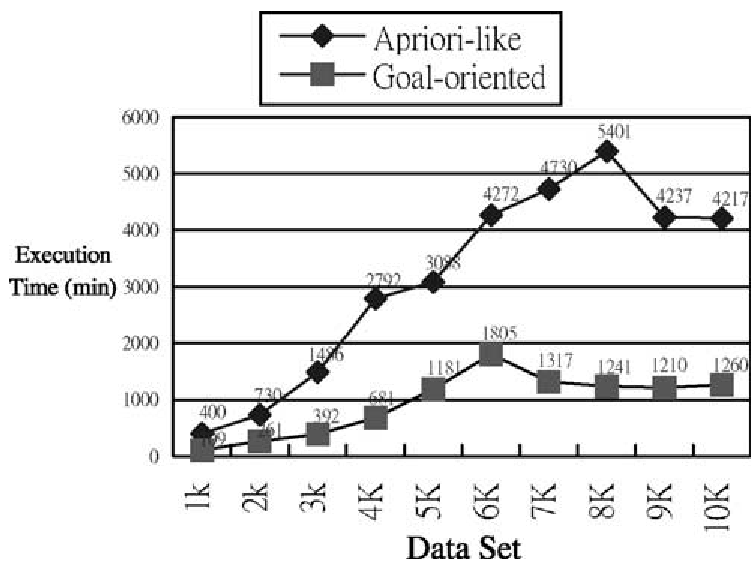
- Efficiency: As shown in the performance charts, GOSP maintains stable execution times even as the "Minimum Support" threshold drops, whereas Apriori's computation time explodes exponentially.
- Readability: GOSP produced a manageable number of rules specifically tied to "Transaction Inquiry" or "Termination," whereas Apriori produced a "noisy" set of rules that required manual filtering.
Real-World Impact: The "Incorrect PIN" Trap
The most striking discovery was that Login failure 2 (entering an incorrect PIN twice) was the #1 predictor of churn.
- The Logic: In many banking systems, three failures result in a locked account.
- The Churn Trigger: Customers who fail twice often get frustrated or fear a lockout, leading them to abandon the online service entirely.
- Business Action: The authors suggest that if customer service contacts a user proactively after the second failure, they can prevent the "death spiral" of churn.
Critical Analysis & Conclusion
While this paper was published in a specific era of data mining (early 2000s), its core logic—Goal-Oriented Pruning—remains a fundamental principle in modern ML engineering and feature selection.
Takeaway: The GOSP algorithm proves that in the era of Big Data, "more" is not better. By restricting the mining process to a specific target and using normalized time windows, businesses can move from reactive reporting to proactive interventions, ultimately saving millions in customer acquisition costs.