
GoldenCrops: Simulating the Viral DNA of Social Networks
GoldenCrops: A software tool for analysis of a social network
This paper introduces GoldenCrops, a Java-based software tool designed to simulate and analyze the evolution and graph-theoretic properties of social networks. By implementing invitation-based growth algorithms, the tool successfully recreates the exponential expansion patterns observed in real-world platforms like Facebook and Twitter.
TL;DR
Social networks seem chaotic, but their growth follows predictable mathematical patterns. GoldenCrops is a new software tool that simulates this growth from scratch. By using stochastic algorithms to model how users invite friends and accept requests, the tool replicates the exponential growth curves of giants like Facebook and Twitter, offering a sandbox for graph-theoretical analysis.
Problem & Motivation: The "Black Box" of Social Data
Why do we need a simulator? Real-world social network data is often proprietary or so massive that "replicating" it for research is computationally prohibitive. Furthermore, researchers rarely have access to the "Day Zero" data of a platform—the early evolution remains a mystery.
The authors identify two key challenges:
- Scale: Handling millions of users and unlimited connections.
- Sampling: The inability to draw early-stage samples from established platforms.
The GoldenCrops tool bridges this gap by allowing researchers to generate synthetic social graphs where every "invitation" and "friendship" is tracked from the moment the first administrator joins.
Methodology: The Engine of Growth
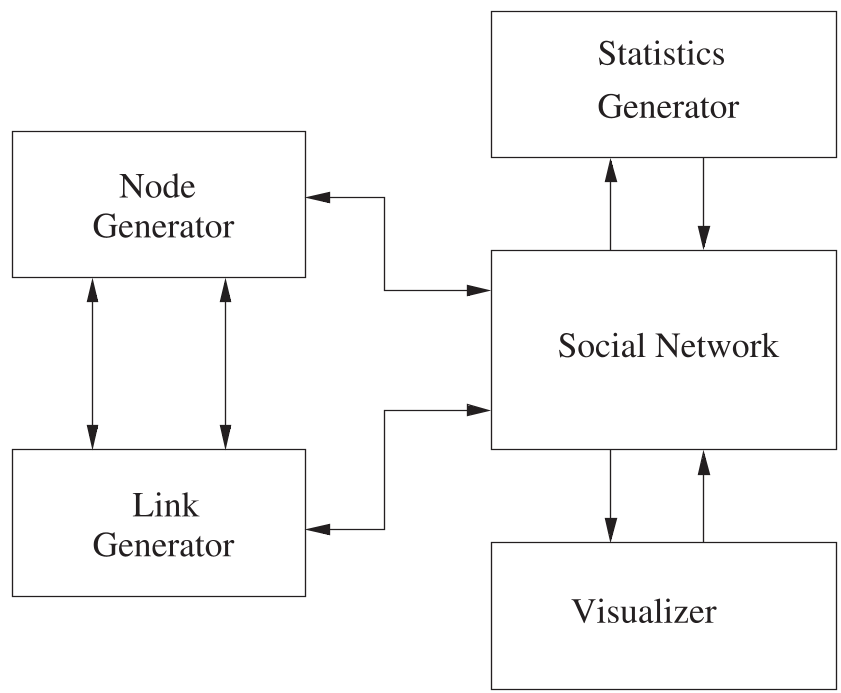
GoldenCrops is built on a modular Java architecture designed to mimic human social behavior through probability.
1. The Architecture
The tool consists of four pillars:
- Node Generator: Spawns users.
- Link Generator: Creates the "edges" or friendships.
- Statistics Generator: Calculates the math (degrees, clustering).
- Visualizer: Maps the graph for human interpretation.
2. The Invitation Algorithm
The growth isn't just random; it is invitation-driven. A member invites to people. The time delay for acceptance is generated randomly, mimicking real-world human latency. This creates a recursive loop where new members immediately become potential inviters, leading to the "viral" effect.
Experimental Results: Matching Reality
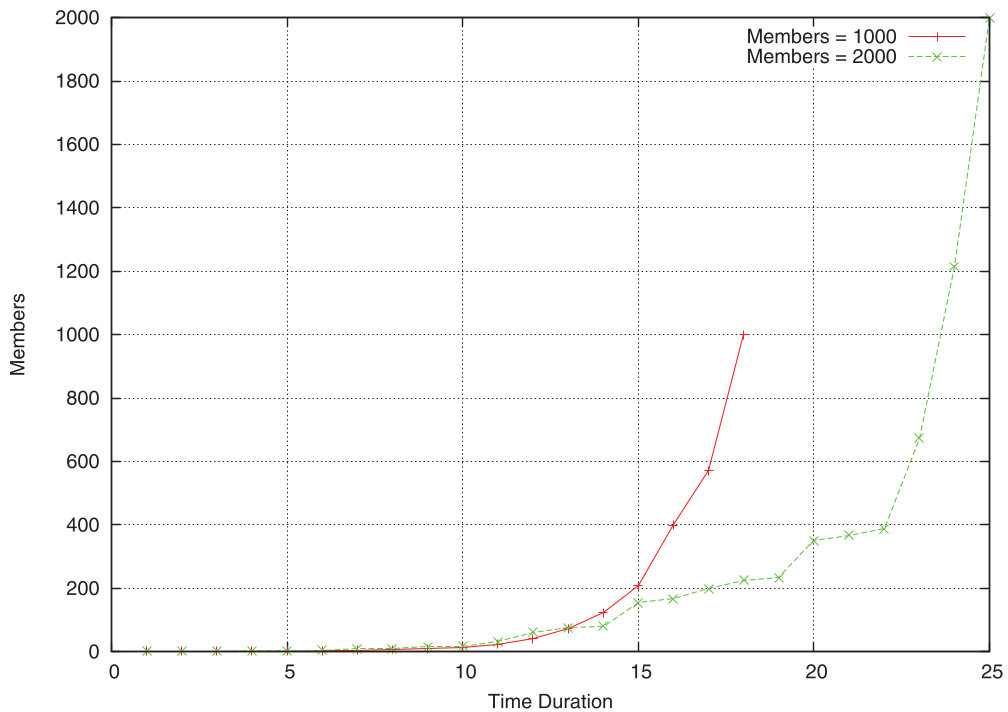
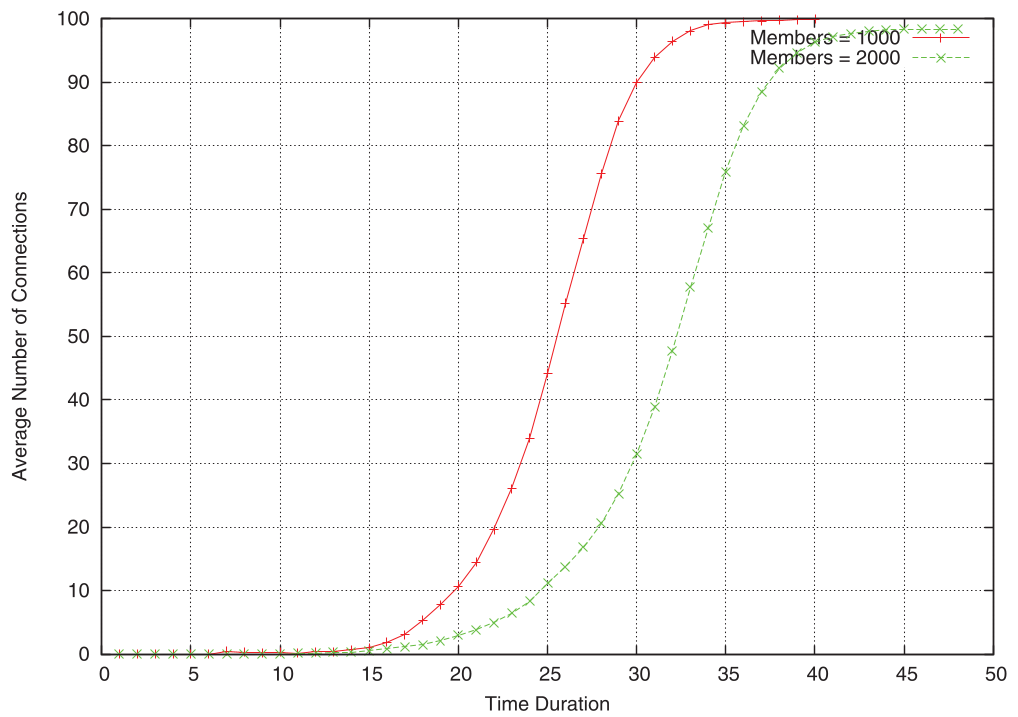
The authors tested GoldenCrops by simulating networks of 1,000 and 2,000 nodes. The findings were striking in their alignment with real-world OSNs.
Exponential Evolution
Both the number of members () and the cumulative connections grew exponentially according to the formula: where represents the rate of growth. This matches the early-stage growth trajectories recorded for Facebook and Twitter.
The Gaussian Peak
The study discovered that incremental connections (new connections per time unit) follow a Gaussian Distribution. Initially, growth is slow, reaches a fever pitch as the network gains "critical mass," and then tapers off as the pool of potential new connections within a specific circle is exhausted.
Graph Metrics: Degree & Clustering
- Degree Distribution: Most nodes stay near the "average" number of friends, suggesting a balanced social structure in this model.
- Clustering Coefficient: The paper uses the "Factor of Transitivity" to measure how likely it is that "a friend of my friend is also my friend." Experiments showed that as the network size increased (from 1k to 2k), the connectivity became more dense, reducing the variance in clustering coefficients.
Critical Insight & Conclusion
The core value of GoldenCrops lies in its validation of simplicity. It proves that complex social structures can emerge from basic "Invite & Accept" localized rules.
Takeaway: For developers and researchers, GoldenCrops provides a way to stress-test social algorithms (like recommendation engines or trust protocols) in a controlled, evolving environment before deploying them on real-world datasets.
Limitations: The model currently assumes a fairly uniform growth rate. Future iterations would benefit from modeling "Super-nodes" (influencers) who have a significantly higher than average users, which would likely shift the degree distribution from Gaussian toward a Power Law (Scale-Free) distribution.