
Google+ Communities as Plazas and Topic Boards: Why Some Groups Socialize and Others Just Broadcast
Google+ Communities as Plazas and Topic Boards
This research provides a mixed-method analysis of Google+ Communities, classifying them into two distinct archetypes: "Plazas" (socializing spaces/communities of practice) and "Topic Boards" (information-driven interest groups). By analyzing membership rosters of over 429,000 public communities, the authors demonstrate how graph density and engagement metrics distinguish these two types of social structures.
TL;DR
Not all online communities are created equal. This study reveals that Google+ Communities (at its peak) functioned in two distinct ways: as Plazas, where the goal is to meet like-minded people and forge new social ties, and as Topic Boards, where the primary value is the high-quality content stream. By analyzing edge density—how many members actually follow each other—the researchers found that small, dense groups drive individual engagement, while massive, sparse groups drive collective discussion.
Problem & Motivation: The OSN vs. Community Paradox
Before the rise of modern social networks, online communities (like Usenet or BBS) were the primary way to interact with strangers over shared interests. Today, Online Social Networks (OSNs) like Facebook or Twitter use a "follow" graph. When Google+ introduced "Communities," it created a hybrid environment.
The authors identified a key friction point: Do users join communities to expand their social graph (make new friends), or to bypass the graph to find content they can't get from their existing circles? Prior work often blurred these lines, but understanding this distinction is critical for designing platforms that actually feel like "home" rather than "broadcast towers."
Methodology: Finding the "Social" in Social Networks
The researchers combined qualitative user feedback with massive-scale data mining.
- Qualitative Insight: They discovered that users cite "finding people" and "finding content" as separate motivations.
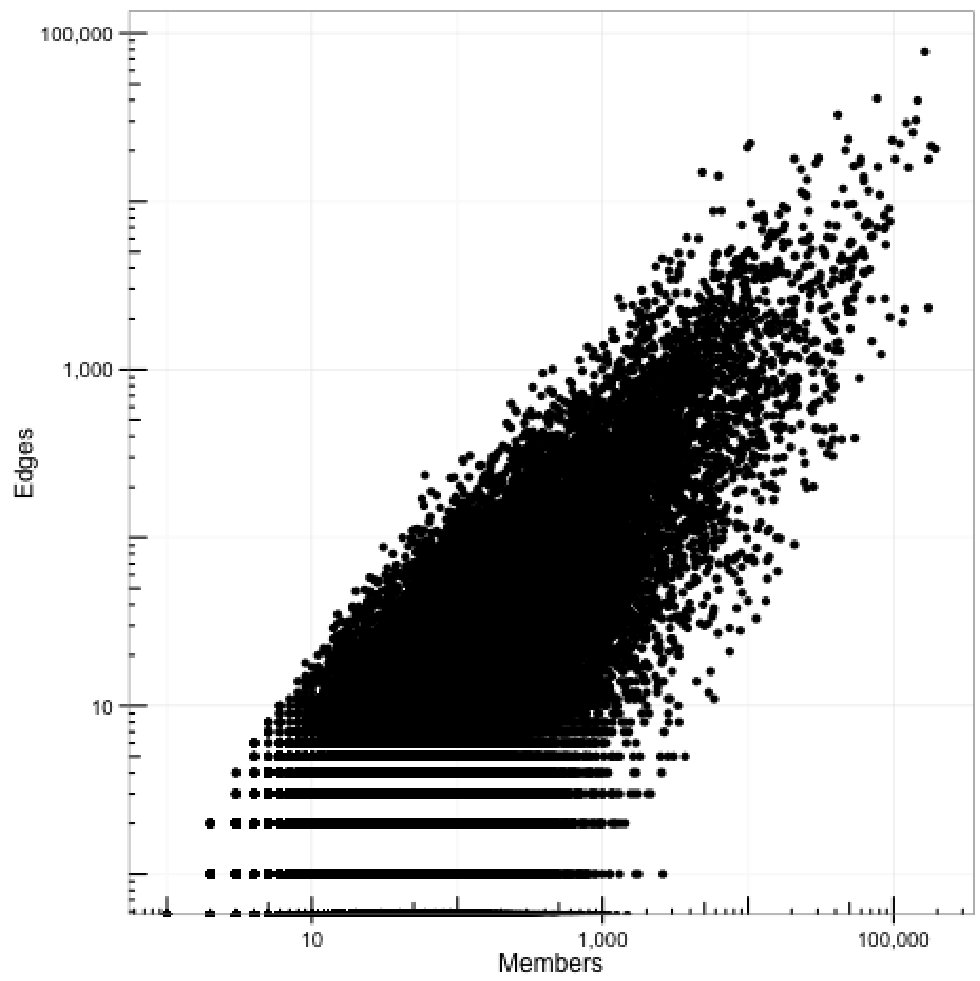
- Quantitative Modeling: They mapped the relationship between the number of members () and the number of follow-edges () between those members.
- The Residual Analysis: They didn't just look at who had the most edges; they looked at which communities had surprisingly many or surprisingly few edges compared to what their size would predict.
The Core Archetypes
The study identified two extremes on a spectrum:
1. The Plaza (High Density)
Plazas are "Virtual Third Places." They are characterized by:
- High Engagement: More posts and comments per member.
- Identity-Driven: Groups like "Landscape Photography" or national groups (e.g., "Indonesia").
- Socialization: Members often introduce themselves and are encouraged to "circle" (follow) each other.
- Moderation: Active mods who set a "family-like" tone.
2. The Topic Board (Low Density)
Topic Boards function like digital newspapers or pin-boards.
- Scale: Often much larger than plazas (e.g., "Harry Potter" or "Gaming").
- Content-Driven: Users are there for the "Joke of the Day" or "Breaking News."
- Passive Following: Members rarely follow one another; they follow the stream.
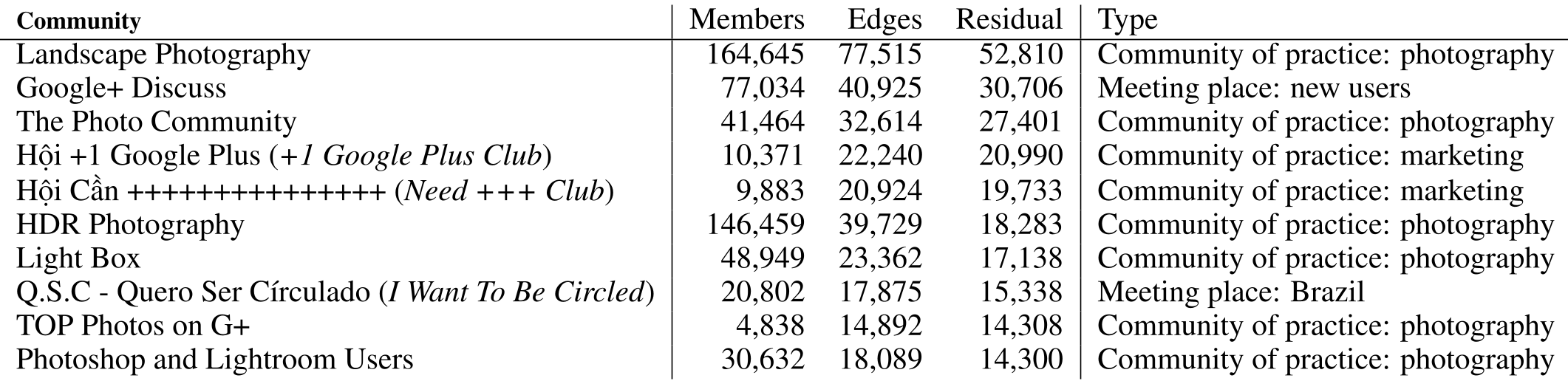 (Table 1: Examples of "Plazas" like Landscape Photography and Google+ Discuss showing high residual edges.)
Experiments & Critical Results
The data confirmed that while Topic Boards are larger (Median members ~70k vs. Plaza ~25k), Plazas are much more "lively" on a per-person basis.
- Posts per Member: Plazas saw 0.79 posts/member vs. 0.26 for Topic Boards.
- Comments per Post: Interestingly, Topic Boards had more comments per post (2.7 vs 1.4).
- The "Diffuse Attention" Effect: In a massive Topic Board, even if you don't know anyone, the sheer volume of members ensures that someone will eventually comment on your post.
 (Figure 3: Plazas see significantly higher posts and comments per member.)
Takeaway & Future Outlook
The "Plaza vs. Topic Board" framework suggests that social platforms should adapt their UI based on the community's type.
- For Plazas: Platforms should recommend "people to follow" within the group to strengthen social ties.
- For Topic Boards: Platforms should focus on content discovery, searchability, and "hot" post rankings.
Critical Analysis: While the data is based on Google+ (a platform no longer with us), the physics of online social interaction remains the same. Whether it's a "Subreddit" (Topic Board) or a "Discord Server" (Plaza), understanding whether a space is built for nodes (people) or bits (content) is the key to building sustainable digital communities.
Limitations: As the authors note, this study focused on public communities. Private communities likely skew even further toward the "Plaza" archetype, as exclusivity naturally breeds intimacy.