
HeyStaks: Transforming Web Search from a Solitary Act into a Social Synergy
Google shared. A case study in social search
The paper introduces HeyStaks, a social search platform implemented as a browser plugin that overlays collaborative features onto mainstream search engines like Google. It utilizes "Search Staks" (collaborative folders) to organize search history and provide personalized recommendations based on the collective knowledge of a community.
TL;DR
Despite the dominance of Google, search remains a remarkably lonely experience. HeyStaks is a browser-integrated platform that turns search into a team sport by allowing users to create "Staks"—collaborative folders that store, tag, and rank search results. By leveraging the search history of your peers, it injects "peer promotions" directly into your Google results, significantly improving re-finding efficiency and discovery.
The Missing Social Link in Information Retrieval
Modern search engines are marvels of engineering, but they are fundamentally blind to your social context. We often search for things our colleagues have already found, or we struggle to return to a page we visited last week. Research shows:
- 30% of searches are attempts to re-find previously seen information.
- 70% of searches involve topics that your friends or colleagues have already explored.
Existing solutions either focus on individual personalization or purely algorithmic ranking (like PageRank). HeyStaks identifies an "Information Gap" where the collective intelligence of a small, trusted group is more relevant than the global popularity of a webpage.
Methodology: How HeyStaks Works
HeyStaks operates as a lightweight client-side toolbar paired with a robust back-end server. The magic happens in the Recommendation Engine, which uses a three-stage pipeline:
- Stak Indexing: Every time a user clicks a result, tags a page, or votes, that "evidence" is indexed. A page is defined by its query terms, tags, votes, and shares:

- Retrieval & Ranking: When you search, the system uses Lucene's TF*IDF to find candidates in your active Stak (Primary) and other related Staks (Secondary).
- Evidence-Based Filtering: To prevent "noise" (e.g., searching for a personal gift while in a work stak), the system applies thresholds. Tagging and voting carry more weight than a simple click.
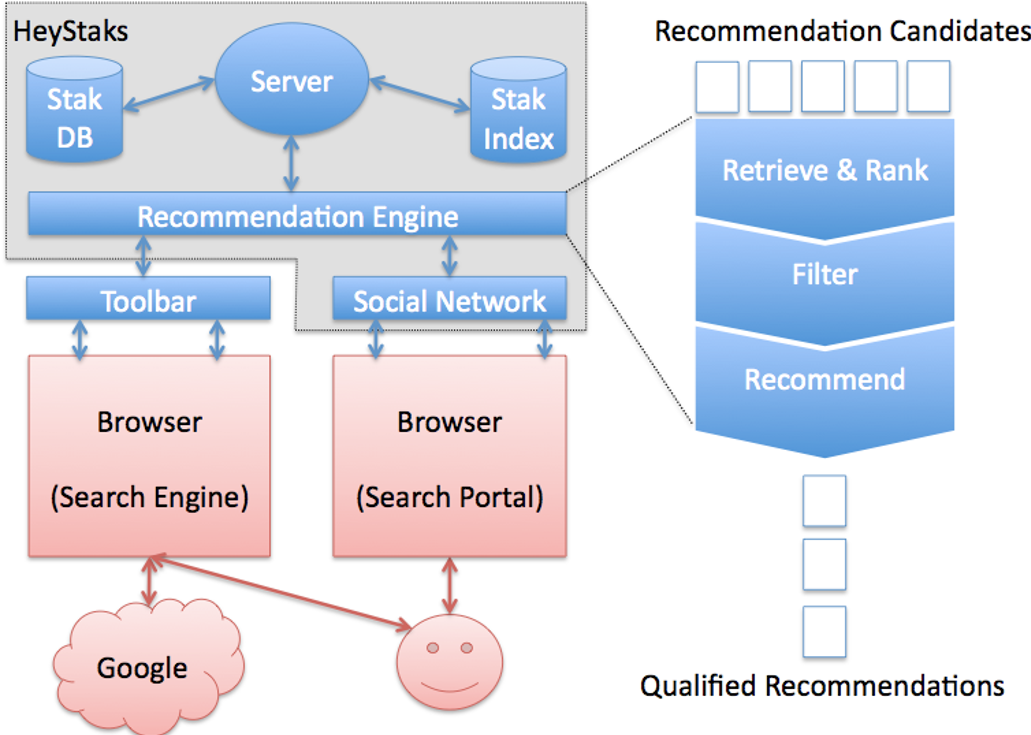 The architecture combines a browser plugin with a centralized server to manage social indexes.
Real-World Impact: The Beta Results
The authors tracked 95 active users over several months. The data shattered the "90-9-1" rule of social media (where only 1% create and 9% contribute).
- The 50% Contribution Rate: Remarkably, half of all users became "Producers" of search knowledge. This is because search knowledge production is implicit—just by finding a good link for yourself, you've helped your team.
- Peer-Powered Discovery: While 66% of selected promotions were "Self-Promotions" (re-finding), 34% were Peer-Promotions. This means a third of the time, users found valuable information they would have otherwise missed, thanks to their network.
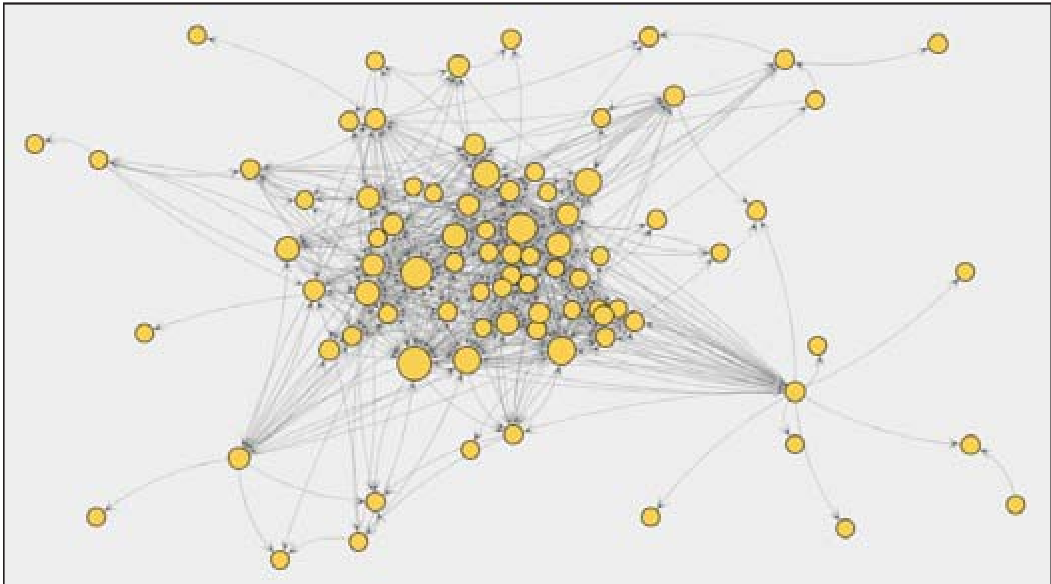 Visualizing the collaboration: 85% of users were interconnected through the production and consumption of search results.
Critical Insight: The Future of Collaborative Intelligence
The genius of HeyStaks isn't just in the ranking algorithm; it's in the UX of least resistance. It doesn't ask users to go to a new search engine. It sits on top of Google, adding value only when the community has something better to offer.
Limitations: The study notes that "stak noise" remains a challenge—if a user forgets to switch staks, irrelevant results can pollute the group index. However, the use of evidence-based filtering (ranking tags and votes higher than clicks) significantly mitigates this.
Conclusion
HeyStaks proves that search is not just about words and algorithms; it’s about people and trust. As we move into an era of AI-generated content, the value of a "vouched-for" link from a trusted colleague will only increase. HeyStaks laid the groundwork for what we now see in modern enterprise "knowledge graphs" and collaborative research tools.