
DEvOTION: Activating the Silent Majority through Targeted Influence
"Got to have faith!": The DEvOTION algorithm for delurking in social networks
This paper introduces DEvOTION, the first computational framework for "delurking" in social networks (SN). By framing delurking as a Targeted Influence Maximization (TIM) problem under the Linear Threshold (LT) model, the authors successfully maximize the "delurking capital"—the cumulative lurking scores of activated silent users.
TL;DR
Silent users, or "lurkers," represent up to 90% of social media audiences. While they hold significant social capital, they rarely contribute. This paper proposes DEvOTION, a first-of-its-kind algorithm that treats delurking as a mathematical optimization problem. By using a Targeted Influence Maximization approach, it identifies the best "seed users" to persuade these silent observers to become active participants.
The "Participation Inequality" Debt
In every online community, a few "super-contributors" drive conversations while the crowd watches. This imbalance threatens long-term community sustainability. Historically, "delurking" was a social science concept involving rewards or welcomes. However, these methods don't scale. The technical challenge lies in Targeted Influence Maximization (TIM): How do we choose users who have the structural power to "activate" (delurk) those with the highest lurking scores?
Methodology: The Delurking Capital
The core innovation is the shift from maximizing spread (number of people) to maximizing Delurking Capital (DC).
1. Defining the Target
The algorithm doesn't just look for anyone; it targets users with high LurkerRank scores. These scores indicate how much a user "consumes" vs. "emits."
2. The Linear Threshold (LT) Model
The authors choose the LT model because it reflects the cumulative effect of influence. A lurker doesn't change status because of one post (Independent Cascade); they change because their social circle provides enough collective validation to exceed their "threshold" of reticence.
3. Efficiency via Backward Exploration
Searching all paths in a graph with millions of edges is impossible. DEvOTION uses a backward visit strategy:
- Start from the target lurkers.
- Explore paths backwards toward potential seeds.
- Prune paths using a threshold where the probability of influence becomes negligible.
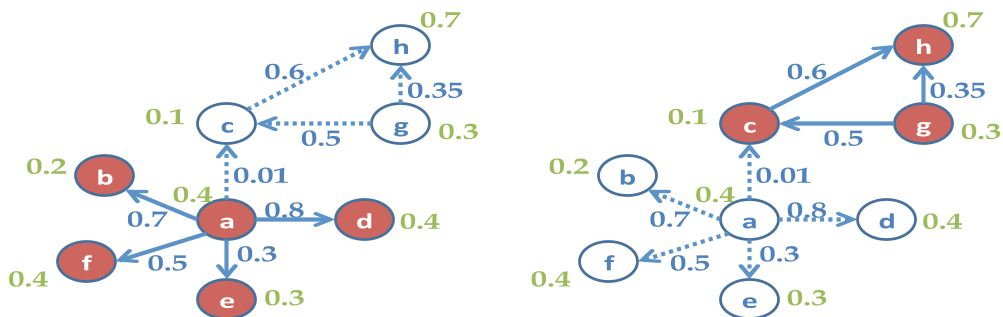 Figure 1: Comparison between classic IM (maximizing count) and Targeted IM (maximizing lurking capital).
Experimental Battleground
The researchers tested DEvOTION on Instagram, Google+, and FriendFeed datasets.
- Effectiveness: DEvOTION consistently yielded higher Delurking Capital than picking popular users (LargestDegree) or active users (Bottom-LR). This proves that being "popular" doesn't necessarily mean you can influence "lurkers."
- Scalability: By adjusting the pruning parameter , the execution time dropped from hours to seconds with almost zero loss in delurking effectiveness.
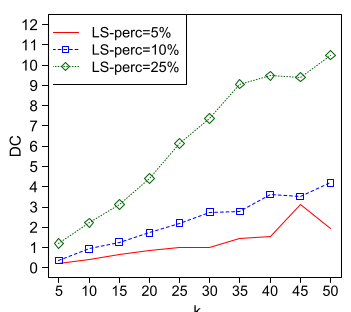 Figure 2: Delurking capital growth in function of seed set size (k) on Google+ and FriendFeed.
Critical Insight & Conclusion
The "magic" of DEvOTION is its mathematical proof of Submodularity. In layman's terms, this means that while adding more seeds helps, the marginal benefit of each additional seed decreases. This allows a greedy algorithm to find a solution that is guaranteed to be within ~63% of the absolute mathematical optimum.
Takeaway: If you want to revitalize a dead community, don't just blast a message to everyone. Use DEvOTION-like logic to find the specific "bridges" to your most valuable silent members.
Limitations
The model assumes that influence is a "positive" force for activation. It does not account for "negative influence" or "information fatigue," where too much pestering might cause a lurker to leave the platform entirely rather than contribute. Future work should integrate sentiment and user "etiquette" into the thresholds.