
Decoding Multimodal Memory: A New Framework for Predicting Peak GPU Usage
GPU Memory Prediction for Multimodal Model Training
This paper introduces a specialized framework for predicting peak GPU memory usage in multimodal model training (e.g., LLaVA). By decomposing heterogeneous architectures into modules and layers, it addresses the unique memory dynamics of Vision-Language Models, achieving a high prediction accuracy with approximately 8.7% Mean Absolute Percentage Error (MAPE).
TL;DR
With the rise of Agentic AI, Multimodal Models (VLMs like LLaVA) have become standard, yet their training is frequently plagued by Out-of-Memory (OoM) errors. This paper proposes a layer-grained "factorization" framework that analyzes model architecture and training behavior to predict peak GPU memory usage with an impressive 8.7% margin of error, outperforming traditional unimodal-focused estimation methods.
The "Multimodal Gap" in Memory Prediction
Why can't we just use existing scripts to predict LLaVA's memory usage? The answer lies in heterogeneity.
Current SOTA methods for memory prediction typically fall into two camps:
- Profiling-based: Running a "test lap" of training. This is slow and consumes the very resources we are trying to save.
- Formulation-based: Mathematical models designed for specific transformers.
These fail for multimodal agents because they treat the model as a monolith. A model like LLaVA-1.5 contains a frozen CLIP vision encoder, a trainable MLP projector, and a Vicuna language decoder. Each of these responds differently to hyperparameters: some produce gradients, some don't; some store activations for backprop, others are used only for forward passes.
Methodology: The Factorization Approach
The proposed framework breaks down the complexity of multimodal training into a systematic pipeline.
1. Model Parsing & Decomposition
The system uses the PyTorch API to reflectively analyze the model, identifying disparate modules based on modality. It then drills down to the layer level (e.g., nn.Linear, nn.Embedding).
2. Four-Factor Prediction
Instead of guessing a total number, the framework calculates four distinct memory "buckets" for every single layer :
- : The weights and biases.
- : Optimizer-specific states (like momentum and variance in Adam).
- : Local derivatives calculated during backprop.
- : Intermediate activations saved to support the chain rule.
The Secret Sauce: Unlike unimodal predictors, this framework checks the training status of the module. If a vision encoder is frozen (a common practice in Stage 2 fine-tuning), the framework intelligently sets and to zero for those specific layers, preventing overestimation.
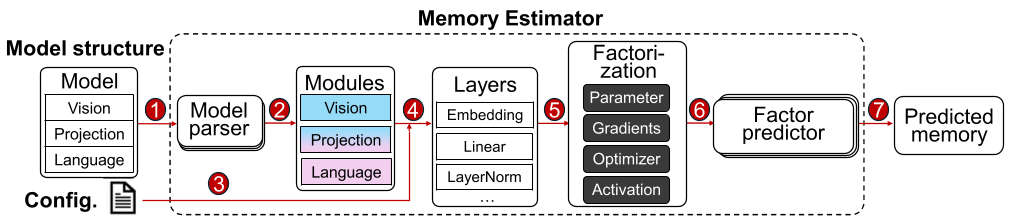 Figure 1: The framework decomposes the model into modules and layers to calculate consumption per factor.
Experiments & Real-World Performance
The researchers tested their framework on an 8x NVIDIA H100 cluster using LLaVA-1.5 (7B). They utilized DeepSpeed ZeRO-2, which complicates memory prediction because weights and optimizer states are partitioned across GPUs.
Key Findings:
- High Accuracy: In a scenario with a Sequence Length of 2048 and Micro-Batch Size (MBS) of 8, the framework achieved a MAPE of 8.7%.
- Robustness: The prediction remained stable even as Data Parallelism (DP) scaled from 1 to 8 GPUs.
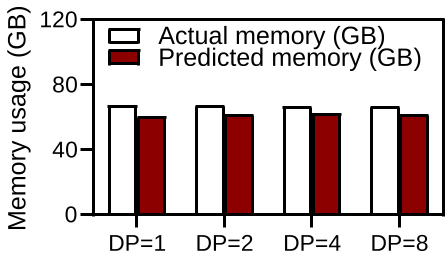 Figure 2: Prediction vs. Ground Truth across varying Data Parallelism degrees (SeqLen=2048).
Critical Insight: Why This Matters for Agentic AI
As we move toward agents that use tools and "think" via multi-turn reasoning, training configurations become highly dynamic. The ability to predict memory requirements without expensive profiling runs means developers can:
- Maximize GPU Utilization: Pack batches as tightly as possible without hitting the "OoM wall."
- Optimize Parallelism Strategies: Decide between ZeRO-2/3 or tensor parallelism before the job starts.
Limitations & Future Work
While highly accurate, the current version focuses on standard training. The authors noted that future extensions are needed for Parameter-Efficient Fine-Tuning (PEFT) like LoRA and Kernel Fusion, which can change the activation memory footprint in non-linear ways.
Conclusion
This work fills a critical gap in the MLOps pipeline for multimodal systems. By moving from "black-box profiling" to "white-box factorization," the framework provides a scalable, accurate way to manage the massive memory demands of the next generation of AI agents.