
Graceful Degradation: Saving Vehicle Platoons When Communication Fails
Graceful Degradation of Cooperative Adaptive Cruise Control
This paper introduces a "Graceful Degradation" strategy for Cooperative Adaptive Cruise Control (CACC) to handle wireless communication failures. It proposes a Degraded CACC (dCACC) mode that estimates a preceding vehicle's acceleration using onboard sensors, maintaining superior string stability compared to conventional ACC fallbacks.
TL;DR
CACC (Cooperative Adaptive Cruise Control) allows vehicles to drive closely together safely, but it breaks down when wireless signals drop. This paper proposes dCACC (Degraded CACC), a fallback strategy that uses onboard radar and Kalman filters to "guess" the lead vehicle's moves. It cuts the required safety gap by over 60% compared to standard Cruise Control fallbacks, keeping traffic moving even when the network is jammed.
The Problem: The "Communication Or Bust" Dilemma
In the world of automated platooning, String Stability is the holy grail. It ensures that if the lead vehicle brakes, the reaction isn't amplified down the line, preventing "phantom traffic jams."
CACC achieves this by sharing acceleration data over V2V (Vehicle-to-Vehicle) links. But wireless links are fickle—latency and packet loss are inevitable in dense traffic. When communication dies, the system usually defaults to ACC (Adaptive Cruise Control). The problem? ACC is much less stable. To keep it safe, the time gap between cars must leap from roughly 0.6s to 3.0s+. In a highway setting, this sudden expansion causes the very shockwaves CACC was designed to prevent.
The Solution: dCACC and Acceleration Estimation
The researchers from TNO and Eindhoven University of Technology asked: What if we don't just give up on the feedforward loop when communication fails?
1. Estimating the Invisible
The core of the "Graceful Degradation" strategy is the Singer acceleration model. Instead of receiving the preceding vehicle's intended acceleration via Wi-Fi, the follower vehicle observes the relative distance and velocity using radar and estimates the acceleration () using a Kalman Filter.
2. Synchronization and Phase Lag
One major technical hurdle is that estimators introduce phase lag. If you react to an estimated signal that is "old," you might actually make the platoon less stable. The authors solved this by filtering the local vehicle's acceleration to match the lag of the estimated signal, ensuring the control logic is synchronized.
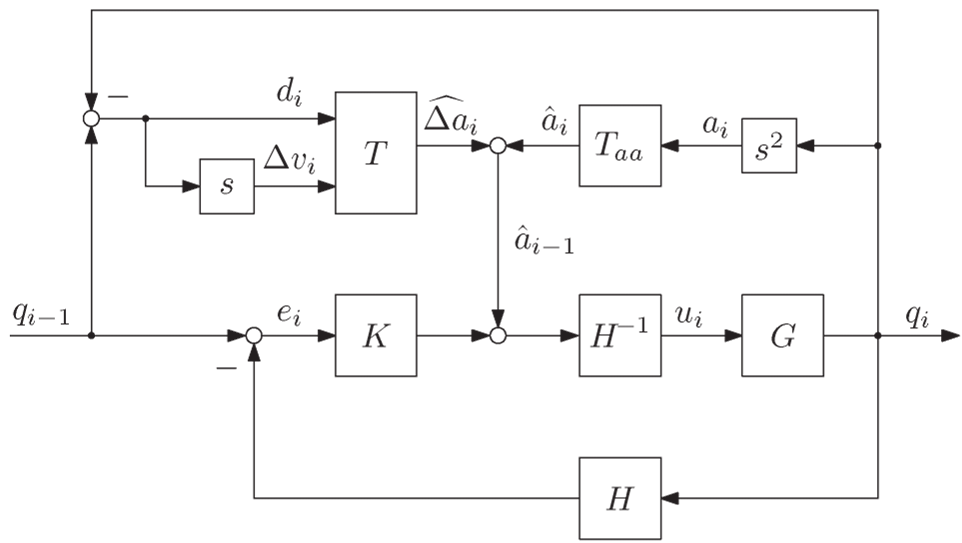 Figure: The dCACC control architecture, showing how estimated acceleration replaces the communication link.
Experimental Results: Real-World Proof
The team didn't just run simulations; they took three Toyota Prius test vehicles onto the track.
- The Breakdown Threshold: They discovered that while CACC is king at low latency, there is a "Breakeven Point." If wireless latency exceeds 0.44 seconds, it is actually safer to switch to the dCACC estimation mode than to rely on the delayed wireless data.
- Time Gap Efficiency: Under dCACC, the platoon remained stable with a time gap of 1.23s. While not as tight as pure CACC (0.6s), it is vastly better than the 3.16s required by standard ACC.
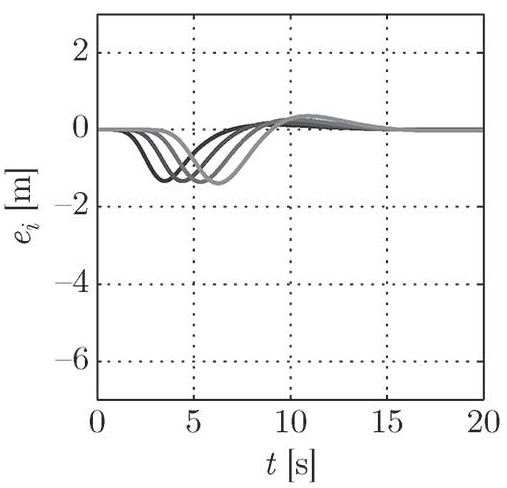 Figure: String Stability Comparison. Note how dCACC (dashed) maintains much better damping than ACC (gray).
Critical Insight: The Comfort-Stability Tradeoff
The paper highlights a sophisticated trade-off involving the maneuver time constant (). A higher makes the system more responsive and string-stable but results in a "jittery" ride for passengers. The authors recommend a range of to balance safety with ride comfort—a crucial consideration for consumer-facing automotive tech.
Conclusion
This work provides a vital safety net for the future of automated highways. By proving that sensor-based estimation can partially replace V2V communication, it ensures that a momentary glitch in the 5G network doesn't turn a synchronized platoon into a chaotic traffic jam. The next step for the industry will be integrating these "graceful" fallbacks into standardized safety protocols for Level 3 and Level 4 autonomous driving.