
GAPIS: Bridging the Gap Between Gradient-Based Optimization and Importance Sampling
A GRADIENT ADAPTIVE POPULATION IMPORTANCE SAMPLER
The paper introduces Gradient Adaptive Population Importance Sampling (GAPIS), a novel Monte Carlo method for efficient Bayesian inference. By integrating first and second-order derivatives into a population-based sampling framework, GAPIS achieves State-of-the-Art (SOTA) performance in handling complex multimodal target distributions.
Executive Summary
TL;DR: GAPIS (Gradient Adaptive Population Importance Sampling) is a sophisticated Monte Carlo scheme that treats proposal adaptation as a dynamical system. By utilizing the target's Gradient for mode seeking, the Hessian for scale adaptation, and a Repulsion Force for exploration, it solves the long-standing issue of "bad initialization" in Importance Sampling.
Contextual Positioning: In the landscape of Monte Carlo methods, GAPIS sits at the intersection of Population Monte Carlo (PMC) and Hamiltonian MCMC. While it maintains the parallelizable nature of Importance Sampling (IS), it borrows the geometric awareness of gradient-based MCMC to achieve superior convergence in multimodal landscapes.
The Motivation: Why Standard AIS Fails
Adaptive Importance Sampling (AIS) aims to iteratively transform a proposal distribution into the target distribution . However, standard methods suffer from a "chicken and egg" problem: to adapt the proposal effectively, you need samples from high-probability regions; but to get those samples, you already need a well-placed proposal.
Current SOTA methods like APIS or PMC often get "stuck" if the initial proposals are far from the target's modes, as they lack a mechanism to "pull" the proposals toward the modes without pre-existing samples.
Methodology: The GAPIS Engine
The core innovation of GAPIS is its three-pronged adaptation strategy, which operates independently of the sampling weights.
1. Mean Adaptation: Attraction + Repulsion
The mean of each proposal evolves not just by following the gradient of the log-target (gradient ascent), but also by interacting with other proposals:
abla \log \pi(\boldsymbol{\mu}_{i}^{(t-1)}) + \sum_{j=1}^{N} \mathbf{r}_{i,j}^{(t-1)} $$ * **Gradient Term**: Explicitly pulls proposals toward local maxima. * **Repulsion Term ($\mathbf{r}_{i,j}$)**: Inspired by physical particles, it prevents proposals from collapsing onto the same mode, forcing the "cloud" to explore the entire state space. ### 2. Covariance Adaptation: The Hessian Geometry Instead of estimating covariance from sample moments (which is noisy), GAPIS uses the analytical **Inverse Hessian** of the log-target ($H^{-1}$). This aligns the shape of the proposal with the local curvature of the target, ensuring that the "width" of the sampler perfectly matches the mode it is covering.  *Figure 1: The update equation illustrating the synergy of gradient ascent and inter-proposal repulsion.* ## Experiments: Overcoming "Bad Initializations" The authors tested GAPIS against a 5-mode Gaussian mixture. Critically, ellos initialized the proposals in a "bad area" where the target density was nearly zero. ### Performance Comparison Comparison with **MIS**, **PIS**, **PMC**, and **APIS** showed that GAPIS is in a league of its own: * **Accuracy**: GAPIS achieved an MSE of **0.0008**, whereas APIS (previous SOTA) lagged at **0.0185** under similar conditions. * **Robustness**: While baseline methods failed completely when the scaling parameter $\sigma$ was small (MSE > 100 for PMC), GAPIS remained stable (MSE $\approx$ 0.002). 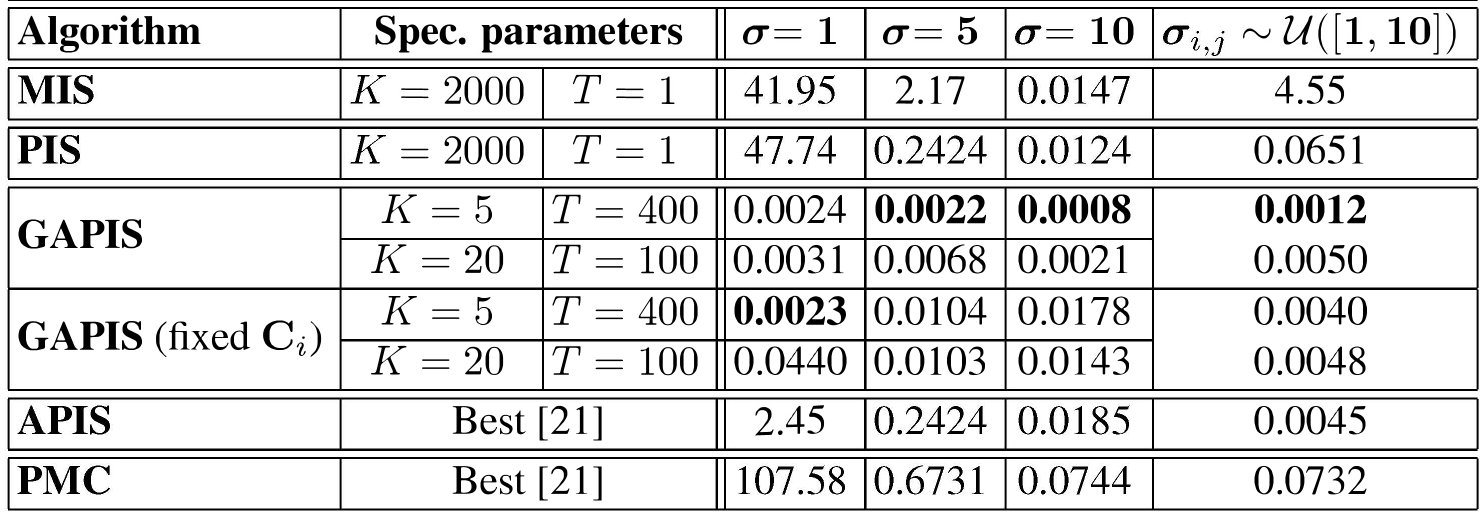 *Table 1: Quantitative comparison demonstrating GAPIS's superiority across different initialization variances ($\sigma$).* ### Convergence Speed The MSE evolution plot reveals that GAPIS exhibits a much sharper "elbow" in its convergence curve compared to APIS, indicating that the gradient information allows it to find modes significantly faster. 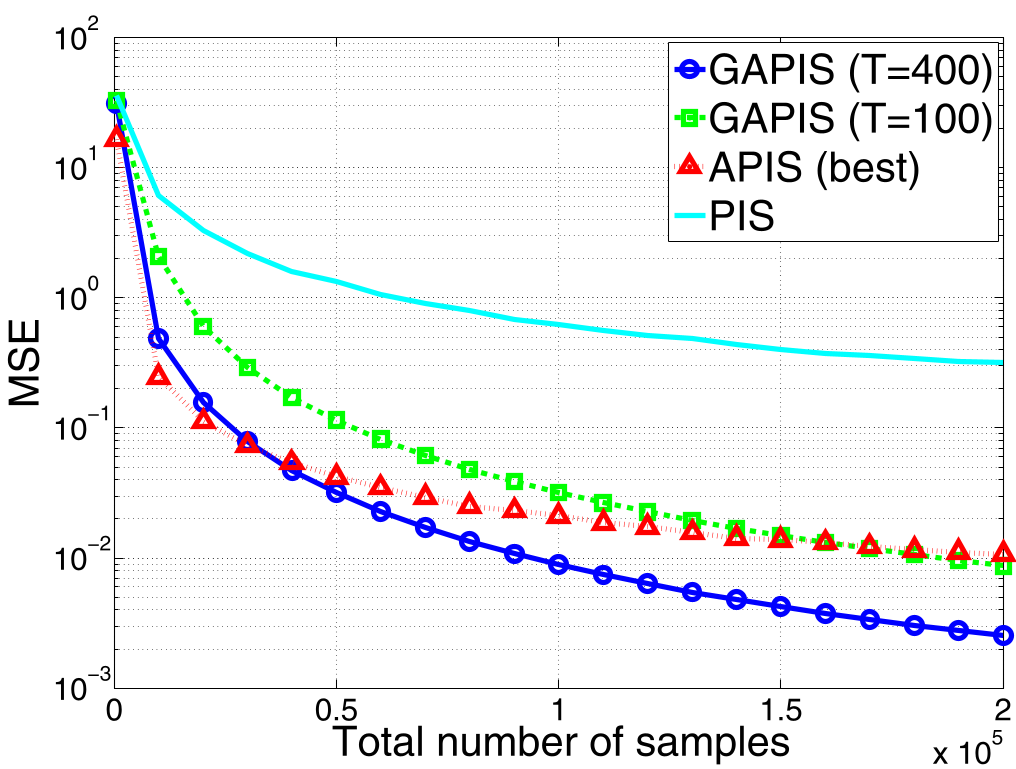 *Figure 2: MSE over total samples. GAPIS (T=400) reaches lower error levels much faster than its competitors.* ## Critical Analysis & Conclusion **Summary**: GAPIS proves that "looking at the map" (using derivatives) is far more efficient than "stumbling in the dark" (purely sample-based adaptation). The introduction of a repulsion term is a brilliant touch that provides a systematic way to handle multi-modality without the need for complex clustering algorithms or heuristics. **Limitations**: * **Computational Cost**: Calculating the Hessian matrix can be expensive in very high dimensions ($O(n^2)$). * **Gradient Availability**: The method requires the target distribution to be differentiable, which might not hold for black-box models or certain discrete-variable problems. **Future Outlook**: GAPIS paves the way for "Geometry-Aware Importance Samplers." Future iterations might utilize Quasi-Newton methods (like BFGS) to approximate the Hessian, bringing these performance gains to higher-dimensional machine learning applications where explicit Hessians are unavailable.