
Scaling the Crowd: A Gradual Approach to Requirements Engineering for Academic Social Networks
A gradual approach to crowd-based requirements engineering: The case of conference online social networks
This paper proposes a gradual approach to crowd-based Requirements Engineering (RE) through the utilization of "micro-crowds" (MCs). By iteratively expanding from small, cohesive researcher communities to larger populations, the authors aim to build an Online Social Network (OSN) for academic conferences that promotes high-level user engagement and collaborative knowledge sharing.
TL;DR
Building a social network that people actually use is notoriously difficult, especially in specialized fields like academia. This paper argues that instead of treating the "crowd" as a massive, anonymous monolith, we should build requirements gradually using Micro-Crowds (MCs). By iteratively engaging small, cohesive groups, the authors aim to solve the chronic problem of low user engagement in Crowd-based Requirements Engineering (Crowd-RE).
The Engagement Trap in Crowd-RE
Crowdsourcing requirements sounds efficient on paper: you get data from thousands of users without being in the same room. However, the reality is often disappointing. Most participants fall into the "consumption level" of the participation ladder—they read, but they don't contribute.
In the context of academic researchers, the problem is intensified. While researchers use sites like LinkedIn or ResearchGate for profile-building, they find general platforms "fluffy" and lacking professional depth. The authors’ initial prototype at ECIS 2014 confirmed this: researchers liked the idea but remained passive. The gap between valuing a system and engaging with it is the primary pain point this research addresses.
Methodology: The Gradual Expansion Model
The core insight of this work is that social capital matters more than crowd size in the early stages of RE. The authors propose a "Gradual Approach" represented by concentric circles of requirements.
1. The Micro-Crowd (MC) Strategy
Rather than a global launch, the process starts with an MC—typically a workshop or a small research niche where people already know and trust each other. These groups have a "shared vision" and a "shared language," which are essential for high-quality requirements.
2. Evolving Folksonomies
A key feature of the methodology is the evolution of a tag cloud.
- Iteration 1: Initial tags are extracted from paper keywords.
- Iteration 2+: As new MCs join, they add their own terminology, turning a static taxonomy into a living folksonomy. This creates a shared language that makes the system feel "professional" rather than "fluffy."
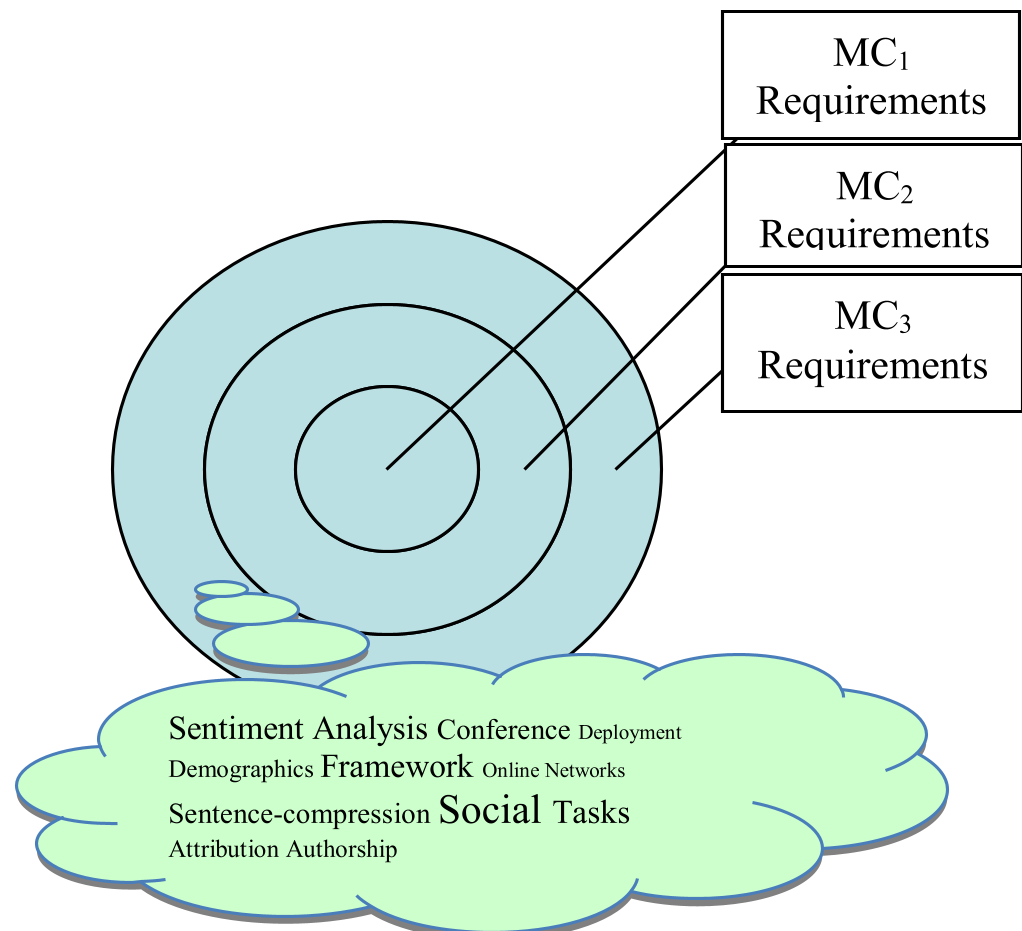
Figure 1: The Gradual Approach. Each ring represents a new Micro-Crowd contributing to the core set of requirements and the shared tag cloud.
Architecture of the Conference OSN
The prototype, built on an open-source WordPress foundation and hosted on the cloud, focuses on three pillars:
- Automated Profiling: Scanning PDFs to extract affiliations and keywords, reducing the "onboarding friction" for busy academics.
- Discussion Facilitation: Automatically linking papers to discussion forums where authors are notified of comments.
- Folksonomy Engine: A managed tag cloud that allows users to categorize their research interests dynamically.
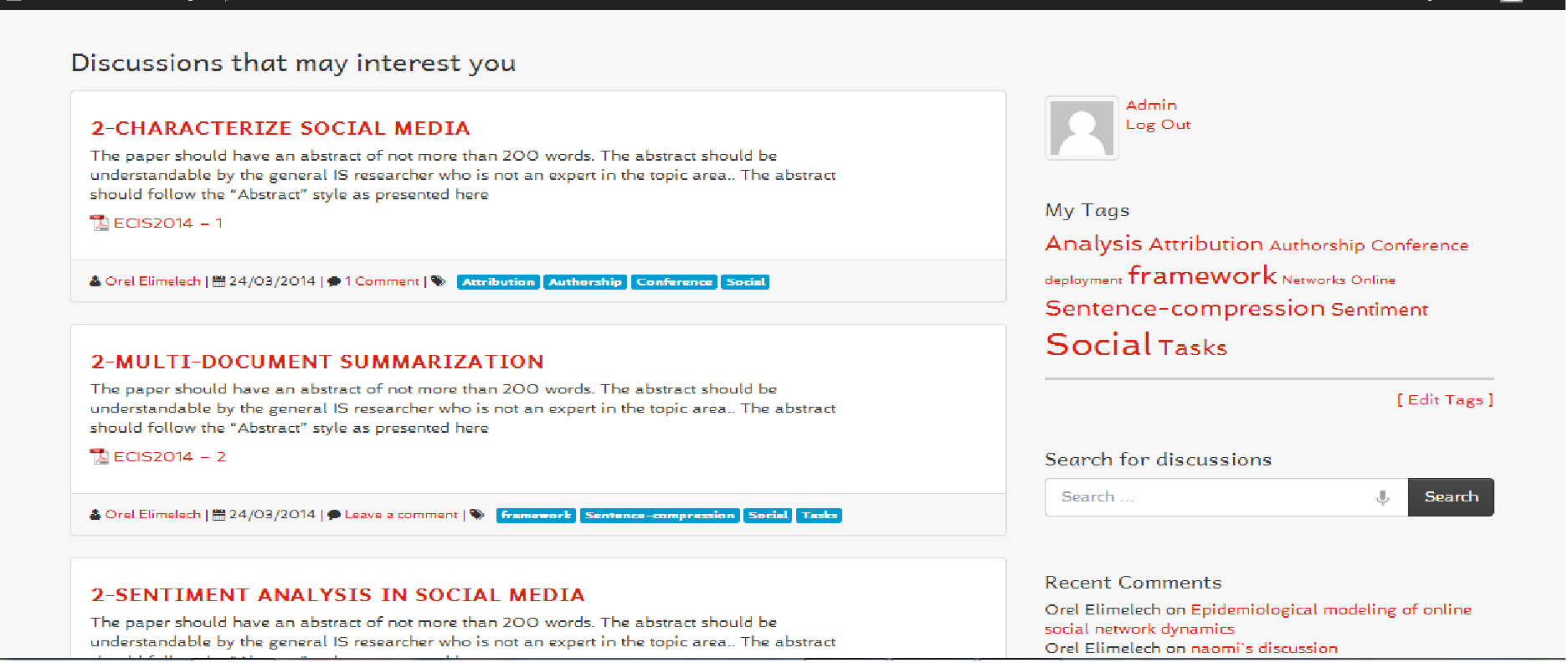
Appendix 1: The user interface focuses on bridging the gap between digital interaction and physical conferences.
Results & Strategic Insights
The authors’ shift from a general large-scale approach to the MC approach yielded several key insights:
- Cohesion Breeds Content: Users are more likely to move from "reading" to "contributing" when they recognize the other participants (Heavyweight Collaboration).
- Iterative Growth: By building the OSN version-by-version with different workshops, the technical issues (bugs, missing features) are ironed out in a low-risk environment before reaching the "entire population."
- Motivation via Reputation: For researchers, the primary motivator isn't money; it's professional reputation. The OSN leverages this by publicizing "core contributors."
Critical Analysis & Conclusion
This paper provides a pragmatic answer to the "cold start" problem in social platforms. By emphasizing cohesion over scale, the authors offer a repeatable framework for Crowd-RE in specialized domains.
Limitations: The primary risk remains the coordination overhead. Managing dozens of mini-iterations with different MCs requires significant manual intervention by the RE team.
Future Outlook: The gradual approach suggests that the future of RE for large-scale systems might not be "big data" mining, but "small community" nurturing. For developers building B2B or specialized social tools, the lesson is clear: find your first Micro-Crowd, build their language into the system, and expand only when the social capital is secure.