
DGFN: Bridging Granular Computing and Functional Networks for Social Link Prediction
A Granular Functional Network with delay: Some dynamical properties and application to the sign prediction in social networks
The paper introduces a Granular Functional Network with delay (DGFN), a hybrid architecture combining Functional Networks (FNs) with Information Granularity and time-delay dynamics. It provides a formal stability analysis and demonstrates SOTA-level performance in sign prediction tasks for large-scale social networks.
TL;DR
The researchers have proposed a Delayed Granular Functional Network (DGFN) that enhances traditional Functional Networks by incorporating Information Granularity and Time-Delay dynamics. By replacing raw data processing with fuzzy granules, the model achieves superior transparency and lower computational overhead, delivering high-accuracy sign prediction in massive social networks like Slashdot and Epinions.
Problem & Motivation: Beyond the Black Box
In the realm of social networks, understanding the "sign" of a relationship—whether a link represents trust (positive) or distrust (negative)—is a complex dynamical problem. Existing approaches often fall into two traps:
- The Black Box Problem: Standard Neural Networks (NNs) offer high performance but lack architectural transparency.
- Ignoring History: Many models treat interactions as instantaneous, ignoring the inherent delays (past behaviors influencing future states) that characterize human social systems.
The authors' insight is to combine Functional Networks (FNs)—where neurons represent unknown functions rather than simple weights—with Granular Computing. By processing data as "granules" (favorable clusters of information), the model becomes more robust to noise and computationally leaner.
Methodology: The Granular Framework
The core contribution is the transition from a standard discrete-time delayed network to a Granular version.
1. Information Granulation
The model uses fuzzy partitions (implemented via Cubic B-splines or Bernstein Polynomials) to transform precise input points into information granules. This allows the network to handle "coverage" and "specificity" simultaneously, refining how the model perceives input features like node degrees and clustering coefficients.
2. Architecture & Learning
The DGFN consists of three layers: An input layer for temporal data (), a granular layer for fuzzy processing, and an output layer. Learning is framed as a Constrained Least Squares (CLS) problem: Subject to: and . This ensures that the weights remain interpretable as probabilities or membership influences.
 Figure 1: The standard scheme of the proposed Granular Functional Network.
3. Stability and Bifurcation
A unique highlight of this paper is the rigorous dynamical analysis. The authors analyze a two-neuron network to identify stability boundaries. Using the Jacobian matrix and characteristic equations, they demonstrate how the model transitions into a Neimark–Sacker bifurcation (a discrete-time equivalent of the Hopf bifurcation) when parameters like the delay-spacing are varied.
Experiments: Solving Social Network Signs
The model was tested on the Slashdot and Epinions datasets to predict whether a directed edge from user to user is positive or negative.
Key Findings:
- Accuracy (ACC): The DGFN matched or surpassed the Time-Delay Neural Network (TDNN) across various subnetwork sizes (2000 to 8000 nodes).
- Efficiency: The ratio of running time () showed that the DGFN often requires less than 60% of the training time required by standard TDNNs.
- Error Rate: The Mean Squared Error (MSE) settled at a significantly lower magnitude (order of ) compared to non-granular baselines.
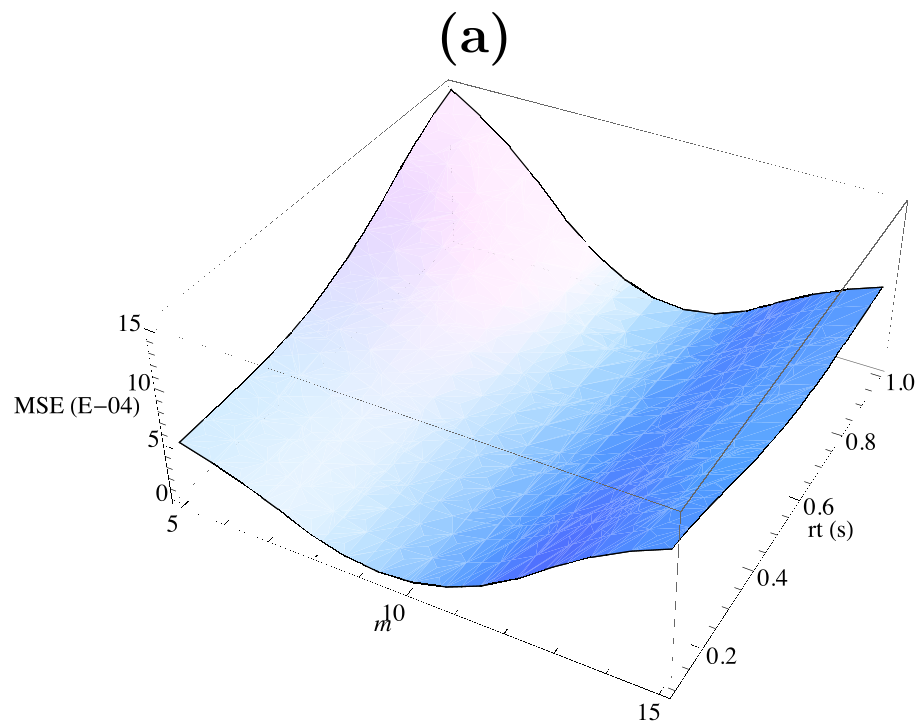 Figure 2: Ratio of MSE and running time (DGFN vs TDNN). Notice the consistently lower computational cost (dotted line).
Critical Insight & Conclusion
The value of this work lies in its structural efficiency. While deep learning often solves problems through sheer scale, DGFN solves them through mathematical refinement. By using functional neurons and information granules, the authors have created a model that is:
- Provable: We know exactly when it will become unstable.
- Fast: The CLS learning is significantly faster than backpropagation for these specific tasks.
- Transparent: The granules allow for the extraction of "If-Then" rules that describe the social dynamics.
Limitations: The stability analysis is currently restricted to smaller neuron counts (n=2, n=3). Scaling the theoretical proofs to a full n-neuron system remains a challenge for future researchers.