
Granular Recursive Fuzzy Meta-Clustering: Profiling Social Networks via Iterative Soft Memberships
A granular recursive fuzzy meta-clustering algorithm for social networks
This paper introduces a Granular Recursive Fuzzy Meta-clustering algorithm designed to create associated profiles of networked entities in social networks. By leveraging Fuzzy C-Means (FCM) and the principles of granular computing, the method recursively updates the representation of "granules" (objects) based on the fuzzy memberships of their connected neighbors, achieving a more nuanced social profile than traditional crisp clustering.
TL;DR
In social networks, you are defined by the company you keep. This paper formalizes this intuition by proposing a Recursive Fuzzy Meta-clustering algorithm. By combining Fuzzy C-Means (FCM) with Granular Computing, the authors allow an object's profile to evolve based on the fuzzy cluster memberships of its connections. Applied to mobile call data, it successfully identifies nuanced "Sociability" and "Popularity" metrics that traditional algorithms miss.
Problem & Motivation: Beyond "Us vs. Them"
Most clustering tools are "crisp"—they force an object into a single bucket. However, real-world data is messy and vague. In a mobile network, a user might behave like a "Business User" during the day but an "SMS Socializer" at night.
The core challenge isn't just the vagueness (which Fuzzy logic handles) but the connectivity. Previous works often treated a node’s attributes as static. The authors argue for a Recursive Logic: if I primarily call people in "Cluster A," my own profile should dynamically reflect that association.
Methodology: The Recursive Loop
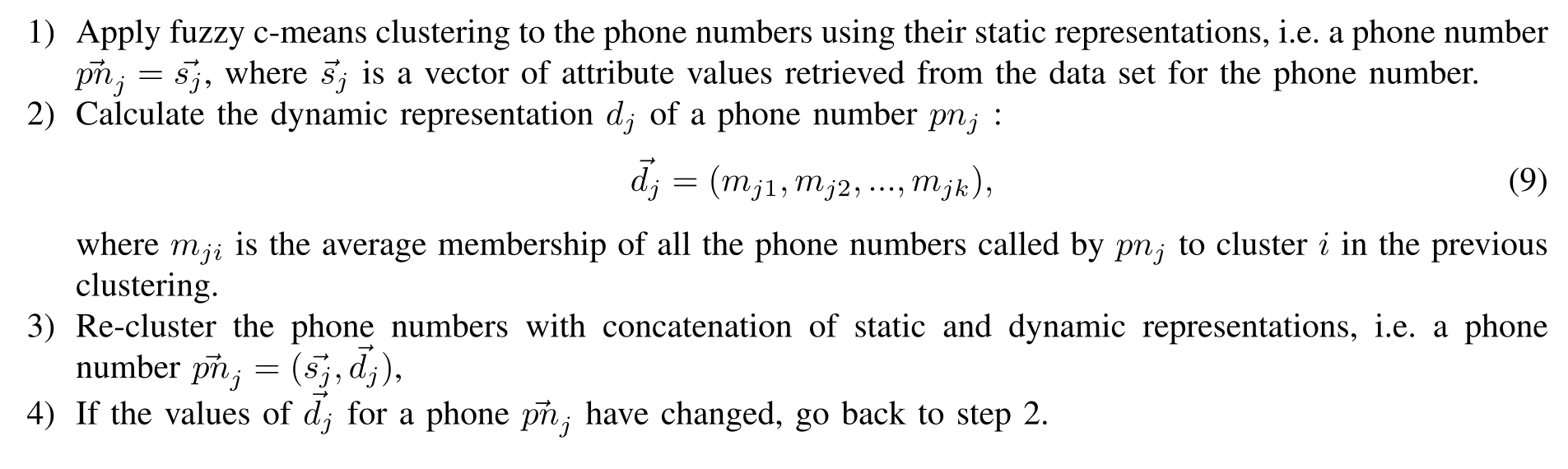
The innovation lies in the representation of an information granule (e.g., a phone number). Every granule is split into two parts:
- Static Part (): Fixed attributes like call duration, daytime vs. nighttime ratio, and SMS frequency.
- Dynamic Part (): A vector representing the average fuzzy membership of all destinations called by .
The Granular Architecture
The algorithm follows an iterative "Meta-clustering" workflow:
- Initial Seed: Cluster the data using only static attributes.
- Dynamic Update: For every user, calculate the average fuzzy cluster membership of their contacts based on the previous iteration.
- Re-cluster: Run Fuzzy C-Means on the augmented dataset (Static + Dynamic).
- Convergence: Repeat until the dynamic memberships stabilize.
Experiments: Real-World Mobile Mining
The authors tested this on a dataset of ~182,000 calls. By using the Davies-Bouldin (DB) Index, they determined that 5 clusters was the optimal granularity.
"Sociability" vs. "Popularity"
One of the most profound insights from the results is the distinction between how a cluster interacts with others:
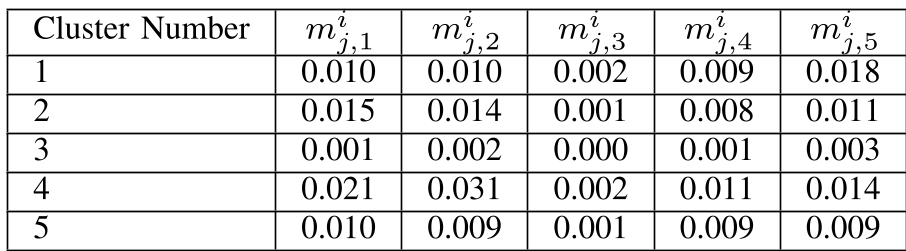
- Sociability (Row-wise): Does Cluster A frequently communicate with a wide variety of other clusters? A "Social" cluster has high values across its dynamic attributes.
- Popularity (Column-wise): Do other clusters frequently call into Cluster B? If a specific dynamic dimension is high across many clusters, that target cluster is a "Popular" hub.
 Above: Table II shows the static profiles, while Table III (below) reveals the dynamic behavior of these clusters.
Critical Analysis & Conclusion
The transition from Crisp to Fuzzy meta-clustering is not just a mathematical tweak; it is a step toward capturing the "spectral" nature of social identity.
Strengths:
- Inductive Bias: It correctly assumes that in a network, features and topology are inseparable.
- Interpretability: Labels like "Sociability" provide actionable insights for businesses (e.g., targeted marketing for "hubs").
Limitations:
- Closed System Assumption: As the authors noted, the performance drops when many calls are made to numbers outside the dataset (external noise).
- Computational Complexity: Recursive clustering on massive graphs requires significant overhead compared to single-pass algorithms.
Future Outlook: This methodology is a precursor to modern Node Embeddings in Graph Machine Learning. Integrating this fuzzy recursive logic into deep learning architectures could provide more explainable AI for social media moderation and fraud detection.