
A Granular Space Model: Bridging Granular Computing and Ontology Learning
A Granular Space Model for Ontology Learning
The paper introduces a "Granular Space Model" for Ontology Learning, leveraging Granular Computing (GrC) to represent domain ontologies at varying hierarchical levels. It defines formal structures for concept granules and granular worlds, achieving a systematic framework for multi-granular data mining and automated knowledge acquisition.
TL;DR
Building ontologies manually is a slow and expensive process. This paper presents a Granular Space Model that applies the principles of Granular Computing (GrC) to automate ontology learning. By transforming concepts into "granules" that can be mathematically composed or decomposed, the authors provide a framework for describing knowledge at multiple levels of abstraction—from specific instances to broad, domain-wide categories.
Background: The Knowledge Acquisition Bottleneck
In the world of the Semantic Web and Knowledge Engineering, an Ontology is the backbone that allows machines to understand concepts and their relationships. However, the bottleneck has always been the construction phase. Existing methods based on Rough Set Theory or basic clustering lack the semantic depth to handle the dynamic nature of domain knowledge. The authors argue that human-like problem-solving—which naturally thinks in "granules" (clusters of similar entities)—is the key to more efficient ontology learning.
Problem & Motivation: Beyond Discrete Rough Sets
Traditional models of Granular Computing, specifically those rooted in Rough Set Theory, face two major limitations:
- Data Rigidity: They are primarily designed for discrete data.
- Semantic Blur: It is often difficult to distinguish a "meaningful" information granule from a simple statistical cluster.
The motivation for this study is to create a model where granules aren't just data points, but Concept Granules that carry both Intension (the definition of the concept via attributes) and Extension (the actual members of that concept).
Methodology: The Granular Space Model (DOGS)
The core of the paper is the formalization of the DOGS (Domain Ontology Granular Space).
1. Concept Granules
A concept granule is defined as :
- Intension (): The set of attributes that describe the concept.
- Extension (): The set of objects that fall under this description.
2. Granular Worlds and Hierarchy
Knowledge is organized into "Granular Worlds." A -level world represents raw data instances, while higher-level worlds represent more abstract generalizations.
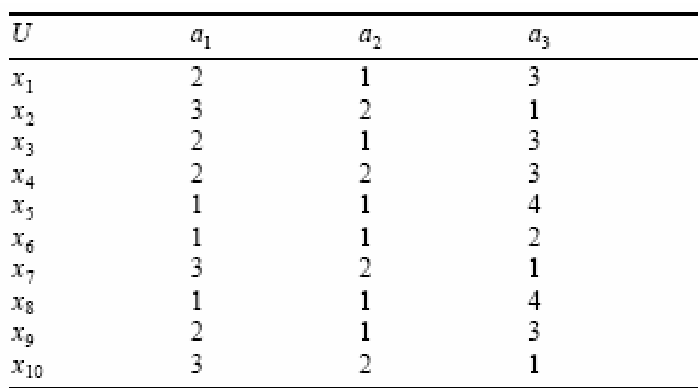 Table 1: An example information system showing how objects ( to ) are categorized by attributes ().
3. Composition and Decomposition
The paper introduces two critical operations:
- Composition (): Merging specific granules into a coarser, more abstract concept. For example, merging "Golden Retriever" and "Poodle" into "Dog."
- Decomposition (): Refining a broad concept into specific sub-parts.
The mathematical beauty of this model lies in the proof that these operations satisfy Commutative and Associative laws, making the granular space a robust computational environment.
Experiments: Hierarchical Transformation
The authors use a sample dataset (Information Table 1) to demonstrate how granules evolve.
- Initial Granules: 10 individual objects.
- G1 (Low Abstraction): Grouped by three attributes, resulting in 5 granules.
- G2 (Medium Abstraction): By reducing the attribute set (e.g., focusing only on and ), the model automatically merges similar concepts into 4 granules.
- G3 (High Abstraction): Further reduction to a single attribute results in 3 broad granules.
This demonstrates a clear, objective path for moving from data-heavy instances to knowledge-rich ontologies.
Critical Analysis & Takeaways
The Power of Granularity
The "Granular Space Model" is a significant step toward automated knowledge engineering. By quantifying the "abstract degree" of a concept (Definition 7), the model allows software to navigate a knowledge hierarchy programmatically.
Limitations
While the formal logic is sound, the paper focuses heavily on the framework and less on the computational complexity of performing these operations at scale (e.g., in a Big Data context). Furthermore, the mapping function that generates extensions from intensions remains a complex component that requires specific implementation strategies (like machine learning or statistical rules) to be fully automated.
Future Outlook
This work lays the groundwork for more advanced Ontology Learning algorithms. Future iterations could see this granular approach integrated with Large Language Models (LLMs) to verify and structure the sprawling knowledge extracted from the web, turning "noisy" data into "granular" wisdom.