
The Granularity Axis: Mapping the Hidden Social Scale of LLMs
The paper introduces the "Granularity Axis," a discovered latent direction in Large Language Models (LLMs) that encodes the social scale of prompted roles, ranging from individual (micro) to institutional/national (macro). By analyzing Qwen3-8B and Llama-3.1-8B, the authors demonstrate that this axis dominates the geometric representation of social roles and can be causally manipulated.
TL;DR
When you tell an LLM to "act like a worried parent" versus a "central bank governor," is it just changing its vocabulary, or is there a structural shift in its "brain"? This paper uncovers the Granularity Axis: a dominant, one-dimensional latent direction in LLM activation space that organizes social roles from micro (individual experience) to macro (institutional strategy). It’s not just a descriptive find—it’s a causal one. By pushing activations along this axis, we can force a model to stop giving "personal advice" and start providing "systemic policy."
Background: The Problem of "Granularity Confusion"
LLMs are increasingly used as "social simulators"—playing the roles of voters, consumers, or leaders. However, a major risk is Granularity Confusion. In many simulations, a "Global Strategist" agent might end up reasoning with the same short-term, personal bias as an individual "Shopkeeper" because the model's internal representation of these roles collapses into a single "role-playing" template. If the internal representation doesn't distinguish between the scale of these roles, the simulation's validity is compromised.
Methodology: Mining the Axis
The researchers from HKU and HIT didn't just look at a few prompts. They built a rigorous pipeline:
- Taxonomy: 75 roles mapped to 5 levels (Individual, Group, Organization, Institution, Nation).
- Data Collection: 91,200 responses across various prompt templates and questions.
- The Axis: They defined the "Granularity Axis" as the vector difference between high-level (macro) and low-level (micro) hidden states.
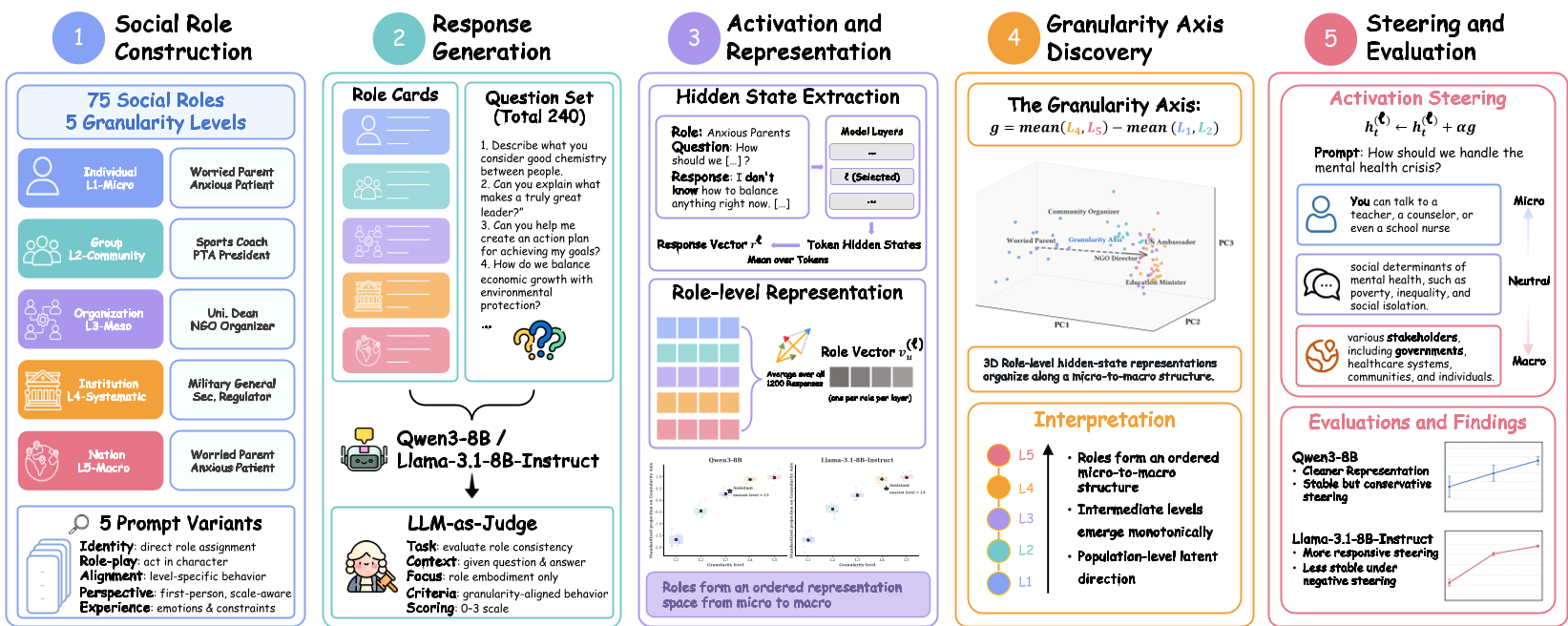 Figure 1: The pipeline involves constructing roles, collecting activations, and projecting them onto a singular axis.
Key Insight: A Geometric Masterpiece
The most startling discovery is the geometric clarity. In Qwen3-8B, this manually defined "Granularity Axis" aligns with the model's first principal component (PC1) with a staggering 0.972 cosine similarity.
This means that out of all the ways social roles could differ (tone, topic, sentiment), social scale (micro vs. macro) is the single most dominant factor in how the model internally organizes these personas.
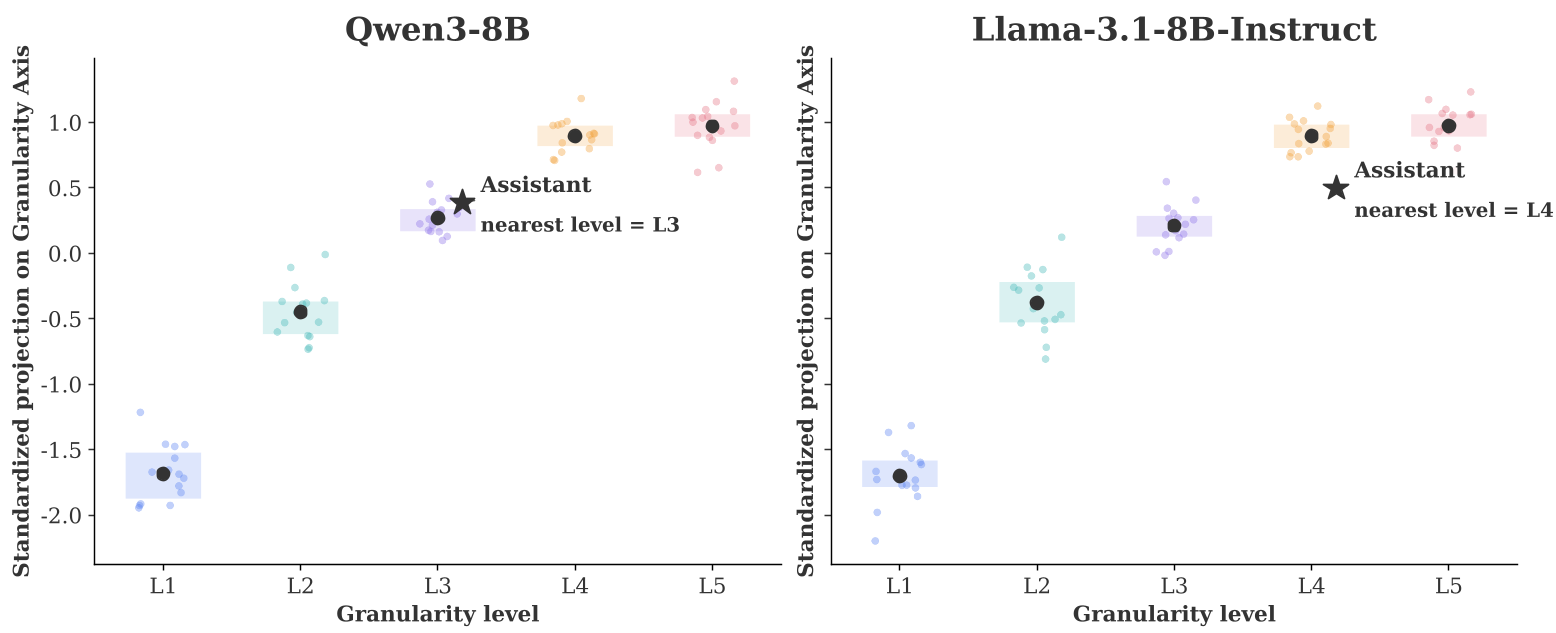 Figure 2: Role projections rise monotonically from L1 (Individual) to L5 (Macro), showcasing a coherent internal spectrum.
Causal Control: Steering the Social Scale
The paper goes beyond observation. By applying activation steering (adding or subtracting the axis vector during inference), the authors could "slide" the model's perspective.
- Negative Steering (-α): A model asked about housing costs shifts from talking about "market supply" to "tips for talking to your landlord."
- Positive Steering (+α): A model shifts from "saving money" to "global economic frameworks and regulatory reform."
Interestingly, the models showed a "ceiling effect." Qwen3's default persona is already quite macro-leaning, making it harder to push higher without specific targeting. Llama-3.1 was more responsive but also more fragile, sometimes degenerating into repetition when steered too hard.
Critical Analysis & Takeaways
This work repositions "social role" from a stylistic surface phenomenon to a representational primitive.
Why it matters:
- Auditability: We can now check if an LLM agent in a simulation is actually "at the right level" of reasoning.
- Controllability: We can suppress an institutional, "preachy" voice in personal support bots or amplify systemic thinking in policy-making assistants.
Limitations: The study identifies a potential "collapse" at the highest levels (L4 and L5)—LLMs seem to treat "Institutions" and "Nations" as representationally similar. Furthermore, the axis likely captures a bundle of correlated features like "time horizon" and "abstraction," which might need further disentanglement in future research.
Conclusion
The discovery of the Granularity Axis proves that LLMs don't just "mimic" roles; they map them onto a sophisticated, internal social geometry. By understanding this axis, we move one step closer to reliable, multi-scale social AI that understands the difference between the "worries of a parent" and the "responsibilities of a state."