
Tuning the Social Hive: Optimizing Friend Recommendations with Artificial Bee Colony
Graph-Based Friend Recommendation in Social Networks Using Artificial Bee Colony
This paper introduces a graph-based friend recommendation system that leverages network topology and the Artificial Bee Colony (ABC) optimization algorithm. By extracting local subgraph features and optimizing their weighted combination, the method achieves a 36% return rate on YouTube social network data, outperforming traditional Genetic Algorithms and standard machine learning classifiers.
TL;DR
The challenge of suggesting new friends in online social networks is essentially a needle-in-a-haystack problem. This paper presents a novel solution that treats recommendation as an optimization task. By combining four specific graph-theory metrics with the Artificial Bee Colony (ABC) algorithm, the researchers achieved a 36% return rate on real-world YouTube data—surpassing classic methods like SVM and Genetic Algorithms.
Motivation: The Complexity of Social Topology
In modern social networks, the search space for potential links grows exponentially with every new user, making "perfect" recommendation an NP-hard problem. While most platforms use a "Friends of Friends" (FOF) heuristic, this is often too broad. The core research intuition here is that not all "friend-of-friend" connections are equal; the strength of a potential link is hidden in the density and overlap of the surrounding sub-graph.
The authors argue that by finding the mathematical "sweet spot"—the optimal weights for different graph metrics—they can predict accepted friendships with much higher precision.
Methodology: From Filtering to the "Nectar" of Data
The proposed pipeline consists of two critical phases:
1. Filtering (The Search Space Reduction)
To avoid processing millions of irrelevant nodes, the system focuses on a sub-graph of users within three degrees of separation from the "root" user. This effectively prunes the graph while keeping the most probable candidates.
2. Ordering (The Topological DNA)
Instead of relying on a single metric, the system calculates four distinct parameters for every candidate node () relative to the root ():
- (Mutual Friends): Simple count of common neighbors.
- (Clustering of Mutual Friends): How well localized the common friends are among themselves.
- (Union Density): The connectivity of the joint friendship circle.
- (Common Groups): Shared interests represented by group memberships.
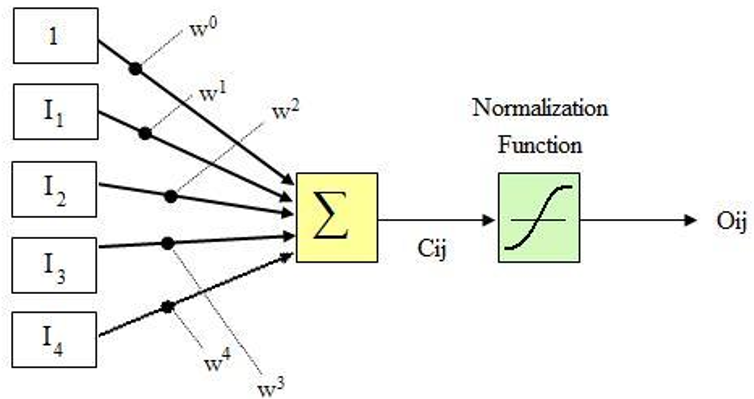 Fig 1: The architecture for generating weighted indices from topological parameters.
The ABC Optimization
The "magic" happens in the weight assignment. Traditionally, these weights are manual or evolved via Genetic Algorithms (GA). Here, the Artificial Bee Colony algorithm—inspired by the foraging behavior of honeybees—is used. Employed bees, onlookers, and scouts collaborate to find the global optimum for the weights ( to ) in the following scoring function:
Experiments and Superior Results
The authors tested their model using a 1,000-node crawl of YouTube users. To simulate real-world performance, they removed 20% of existing links and tasked the system with "re-finding" them.
Performance Comparison
The ABC-based system notably outperformed both traditional machine learning and previous evolutionary approaches:
| Method | Return Rate | Accuracy |
|---|---|---|
| ABC (Proposed) | 36% | 77% |
| Genetic Algorithm (GA) | 32% | 66% |
| SVM | 22% | 78% |
| MLP (Neural Net) | 21% | 52% |
| FOF (Heuristic) | 24% | 37% |
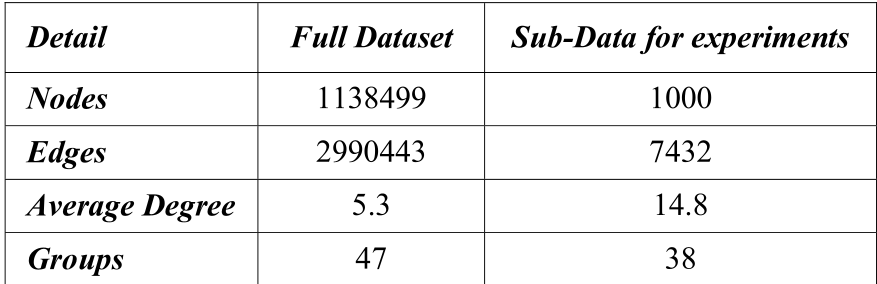 Table 1: Comparison of YouTube dataset characteristics and performance metrics.
Critical Insight: Why ABC?
The success of ABC over GA in this context likely stems from its superior exploration-exploitation balance. While GA can suffer from premature convergence (getting stuck in local optima), the "scout bee" mechanism in ABC allows the system to abandon exhausted solutions and explore new areas of the weight-space. This results in a more robust set of importance weights for the four topological parameters.
Conclusion & Future Directions
The paper successfully demonstrates that swarm intelligence can refine social recommendations. However, a major limitation is that the current model is purely structural. It does not account for user content (what videos they watch) or temporal dynamics (how friendships change over time).
The next frontier for this research involves integrating Social-based features (metadata like sports, location, and education) into the ABC optimizer, potentially creating a hybrid recommender that understands both the "shape" and the "substance" of a social network.