
Graph-Based Learning on Sparse Data: Leveraging the Power of Trust in Recommendations
Graph-Based Learning on Sparse Data for Recommendation Systems in Social Networks
This paper introduces a graph-based supervised learning framework for social network recommendation systems, specifically targeting Collaborative Filtering. It proposes two distinct feature matrix construction methods—one leveraging the explicit "Web of Trust" (WoT) and another using SVD-derived implicit user similarities—to perform rating prediction as a regression task on sparse data.
TL;DR
Recommender systems in social networks often battle the "sparsity demon," where missing data makes predictions difficult. This paper explores whether we should rely on explicit trust (people you say you trust) or implicit similarity (people who rate like you). Using the Epinions dataset, the authors demonstrate that an explicit Web of Trust (WoT) provides a far more accurate foundation for regression-based recommendations, achieving a 46% lower error rate than similarity-based methods.
Problem & Motivation
In a typical social network, the overlap between users and items is minuscule—this is the Sparsity Problem. While Collaborative Filtering (CF) is the industry standard, it often fails when the user-item matrix is mostly zeros.
The authors' core insight is that social networks aren't just collections of ratings; they are graphs. These graphs contain two types of intelligence:
- Explicit Intelligence: The "Web of Trust" (WoT) created when users manually flag others as trustworthy.
- Implicit Intelligence: The "Subconscious Intelligence" hidden in rating patterns, which can be extracted via dimensionality reduction.
The challenge lies in determining which "intelligence" layer serves as a better feature source for regression models when data is highly sparse.
Methodology: The Two Paths to Prediction
The paper formalizes the recommendation task as a regression problem. Instead of just predicting a "category," the system predicts a continuous rating (1-5).
1. The Explicit Approach: Web of Trust
The algorithm filters the dataset to identify only those users specifically trusted by the target user. A feature matrix is built where column vectors represent these trusted peers. This captures the "expert influence" directly.
2. The Implicit Approach: SVD-based Similarity
For cases where a user has no explicit trust network, the authors use Singular Value Decomposition (SVD). They decompose the rating matrix into . By extracting the eigenvectors (), they calculate the Euclidean distance between users: The system then selects the top-α most similar users to build the feature matrix.
 Note: The calculation of distance between user eigenvectors allows for finding "neighbors" even without explicit social links.
Experiments & Results
The authors tested six different regressors, ranging from Linear Regression to Multilayer Perceptrons (MLP).
Performance Comparison
The results were conclusive: Trust is a stronger signal than Similarity.
| Feature Type | Best Model | MAE (Lower is Better) | RMSE |
|---|---|---|---|
| Web of Trust (WoT) | Additive Regression | 0.30 | 0.96 |
| Implicit Similarity | Additive Regression | 0.56 | 1.14 |
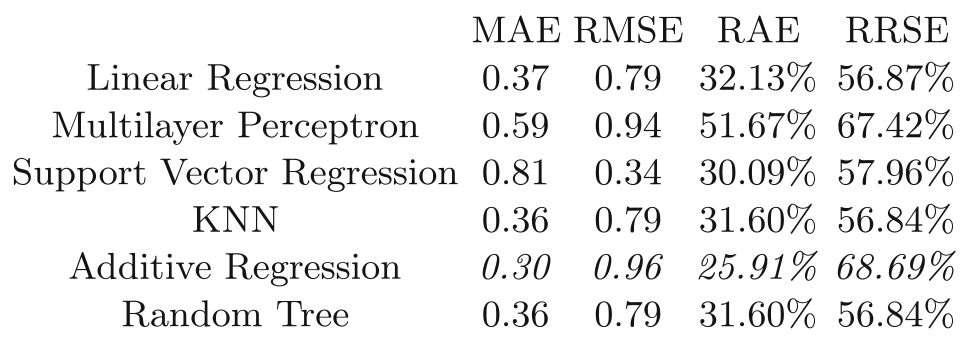 Table 1: Performance using Web of Trust features. Additive Regression shows the best MAE at 0.30.
Key Observations:
- Additive Regression (which fits models to residuals iteratively) consistently outperformed individual models like MLP or KNN.
- The KNN (K=1) approach performed surprisingly well on WoT data, suggesting that in trusted networks, the "nearest neighbor" is highly representative.
- The high error in the Similarity-based approach (MAE 0.56+) suggests that SVD-based distancing in sparse matrices may lose some nuances that explicit trust captures perfectly.
Critical Analysis & Conclusion
Takeaway
This work highlights that for social-aware recommender systems, incorporating the Social Graph (Trust) is more effective than latent factor similarity alone. The algebraic representation of trust as a feature matrix provides a robust inductive bias that helps models overcome data sparsity.
Limitations
- Scalability: The SVD and distance calculations for the implicit method are computationally expensive ( or ). Managing this for millions of users would require stochastic approximations or distributed graph processing.
- Cold Start: While the similarity method handles users without a "Web of Trust," it still requires some initial ratings to perform SVD. A truly "cold" user still remains a challenge.
Future Outlook
The next logical step, as hinted by the authors, is deeper integration with Sparse Representation (SR) theory. Moving from traditional regression to Graph Neural Networks (GNNs) could allow for multi-hop trust propagation, potentially combining both explicit and implicit signals into a single embedding space.