
Graph-Powered Persuasion: Re-engineering Recipe Recommendations with Social Insight
Using graph-based models in a persuasive social recommendation system
The paper presents a Persuasive Social Recommendation System (implemented in "receteame.com") that leverages graph-based models to recommend recipes. It integrates domain-specific nutritional data with social network metrics such as trust, reputation, and tie strength to provide explainable and highly personalized recommendations.
TL;DR
This paper introduces a Social Recommendation System for recipes that moves beyond simple similarity scores. By adopting a Graph-Based Model, the authors integrate nutritional science with social influence metrics (Trust, Reputation, Tie Strength). The resulting system, receteame.com, doesn't just suggest a meal; it uses "Persuasive Argumentation" to explain why a recipe fits both your health needs and your social circle's preferences.
Problem & Motivation: The "Black Box" of Traditional Recommendations
Traditional recommenders often operate as black boxes, providing a list of items without context. The authors identify three critical pain points:
- The Cold Start Gap: New users with no history receive poor suggestions.
- Lack of Transparency: Users trust recommendations more when they understand the "Why."
- Data Scalability: Relational databases struggle with the explosive, interlinked growth of social networks where relationships (the "edges") are more important than the content (the "nodes").
The insight here is simple but powerful: If your best friend recommends a dish because it fits your specific allergy, you are far more likely to cook it than if a generic algorithm suggests it based on an abstract popularity score.
Methodology: Fusing Social Graphs with Domain Knowledge
1. Architecture of the Graph Model
The system uses a NoSQL Graph Database (Neo4J) instead of traditional SQL. This allows the system to treat a user's "Like" on Facebook, a specific food allergy, and an ingredient's protein content as interconnected nodes in a single, traversable web.
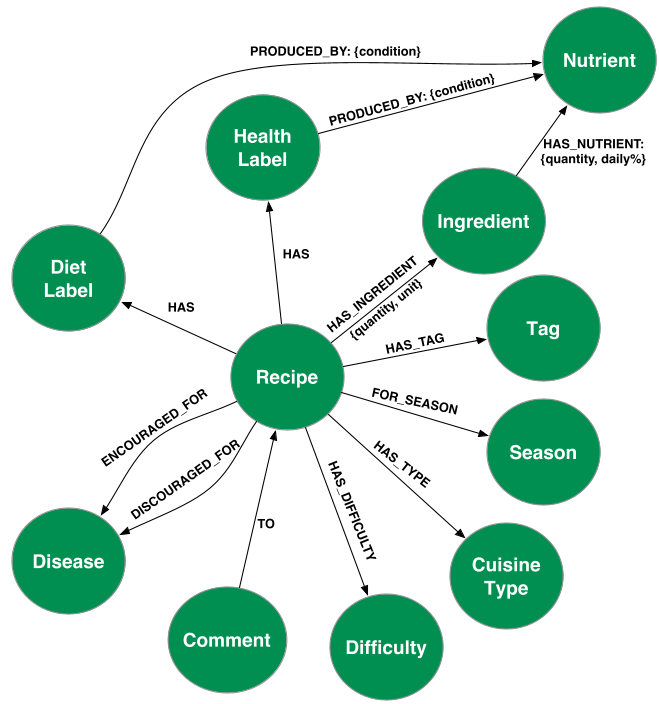 Figure: The specialized Recipe model graph integrating ingredients, difficulty, and nutritional labels.
2. High-Dimensional Data Fusion
The authors extracted data using two clever methods:
- Social Mining: Using OAuth 2.0 to access Facebook data (with an impressive 80% user opt-in rate) to calculate "Tie Strength"—a measure of how close two friends actually are.
- Microformats (Semantic Web): Crawling recipes using
h-recipeandSchema.orgtags to automatically extract preparation times, instructions, and allergens.
3. Persuasive Logic
Instead of a single score, the algorithm weighs four social criteria:
- Direct Trust: Your personal history with the recommender.
- Reputation: The recommender's global authority in the system.
- Tie Strength: Frequency and depth of social interaction.
- Similarity: Alignment of food tastes.
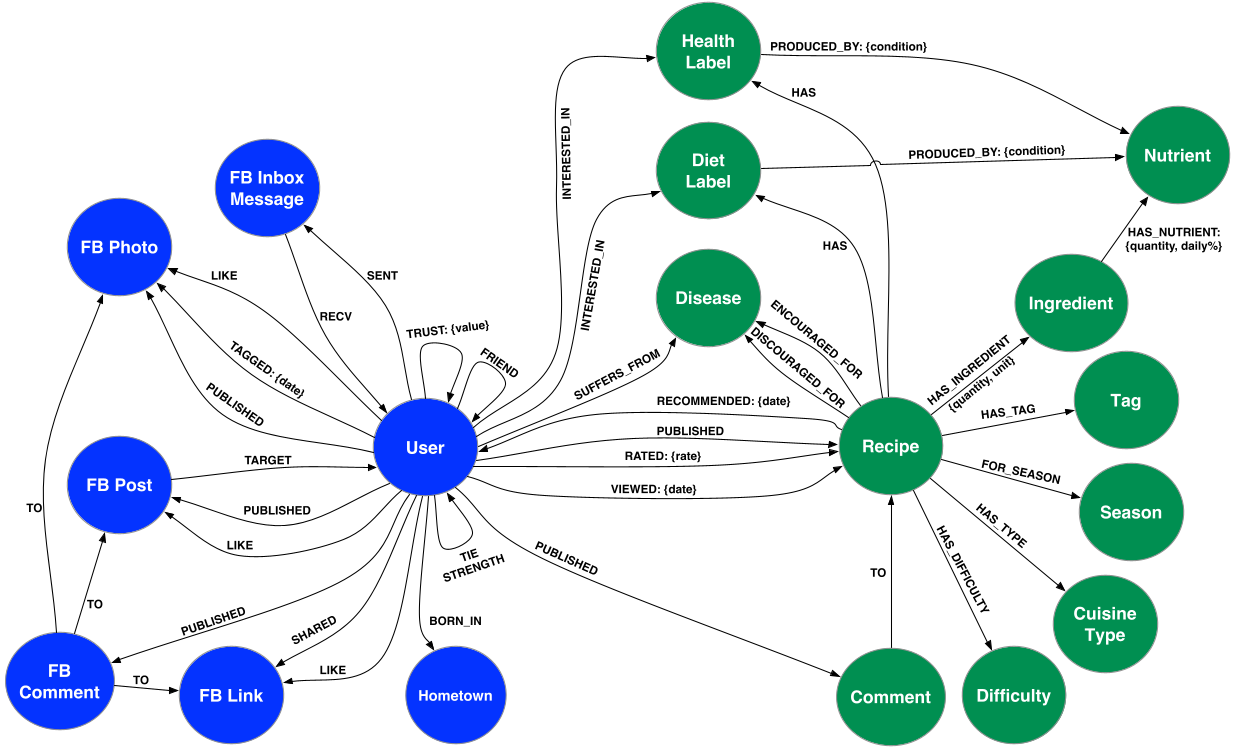 Figure: The integrated graph showing the intersection of Social Data (Users) and Recipe Data.
Experiments & Results: Efficiency and Intent
The system demonstrates that graph queries are exceptionally efficient for complex social filtering. For instance, finding a recipe that a close friend rated highly, which also matches the user's hometown traditions but excludes their specific allergens, can be executed in a single, readable query (Listing 1 in the paper).
Key Findings:
- Scalability: Successfully managed 10,000+ recipes and hundreds of thousands of social nodes.
- Flexibility: The "BASE" (Basically Available, Soft state, Eventual consistency) approach allowed for a more dynamic and responsive user experience than strict ACID databases.
- User Acceptance: The high permission rate (80%) suggests that when users see immediate value (personalized health-specific recipes), they are willing to share social data.
Critical Analysis & Conclusion
Takeaway
The true innovation of this work is the shift from Product-Centric to Relationship-Centric recommendation. By modeling the system as a graph, the authors created a "social substrate" where data is not just stored but contextualized.
Limitations
While the system is robust, it relies heavily on the availability of Microformats on external websites, which remains a bottleneck for automated data collection. Furthermore, the "Persuasion" aspect, while conceptually strong through argumentation, requires continuous user feedback to refine "Trust" scores effectively.
Future Outlook
The path forward lies in Multi-User Recommendations—for example, generating a weekly menu that satisfies the dietary restrictions and taste preferences of an entire family or a group of friends attending a dinner party. This work sets the structural foundation for AI that understands not just what we eat, but who we eat with.