
Beyond Simple Nodes: Securing Citizen Data via Hypergraph Anonymization
A graph based approach for privacy preservation of citizen data in e-governance applications
This paper introduces a hypergraph-based framework for privacy preservation in e-governance, proposing the Sequential Rank-Label Anonymization (SRLA) method. It identifies a new vulnerability called the rank-label attack, which outperforms traditional rank-based methods in protecting high-dimensional citizen data on social platforms.
TL;DR
As e-governance moves to social media to track the diffusion of services, the underlying data structures have become increasingly complex. This paper argues that simple graphs are insufficient to model community relationships and proposes Hypergraph modeling. More importantly, it introduces the Rank-Label Attack, a potent threat that bypasses standard protections, and presents Sequential Rank-Label Anonymization (SRLA) as a superior solution for preserving utility while ensuring citizen privacy.
The Problem: The "Super-Dyadic" Relationship Gap
In traditional social network analysis, we use edges to connect two nodes. However, e-governance often involves groups — families getting subsidies, communities using health services, or students in a specific program. These are super-dyadic relationships.
While hypergraphs (where an edge can connect any number of nodes) represent these better, they also create "structural signatures." If an attacker knows your "rank" (how many people are in your groups) and your "labels" (the types of services you use), they can find you in a public dataset. The authors prove that even if you hide the rank, the label acts as a secondary key for re-identification.
Methodology: Defeating the Rank-Label Attack
The core of the paper is the transition from a Greedy approach to a Sequential one.
1. The Rank-Label Tag
The authors define a vertex tag as , where is the set of ranks and is the set of labels. To measure how "similar" two nodes are, they developed a distance metric that combines Euclidean distance for ranks and a concept hierarchy distance for categorical labels.
2. SRLA (Sequential Rank-Label Anonymization)
Unlike greedy clustering, which makes a permanent decision for a node, the SRLA algorithm allows for cluster readjustment. It ensures every group has between members.

The algorithm uses the EXPAND EDGE operation. Instead of deleting data (which kills utility), it broadens the coverage of existing hyperedges to make nodes look identical to at least others.
Experimental Evidence: Why Sequential Wins
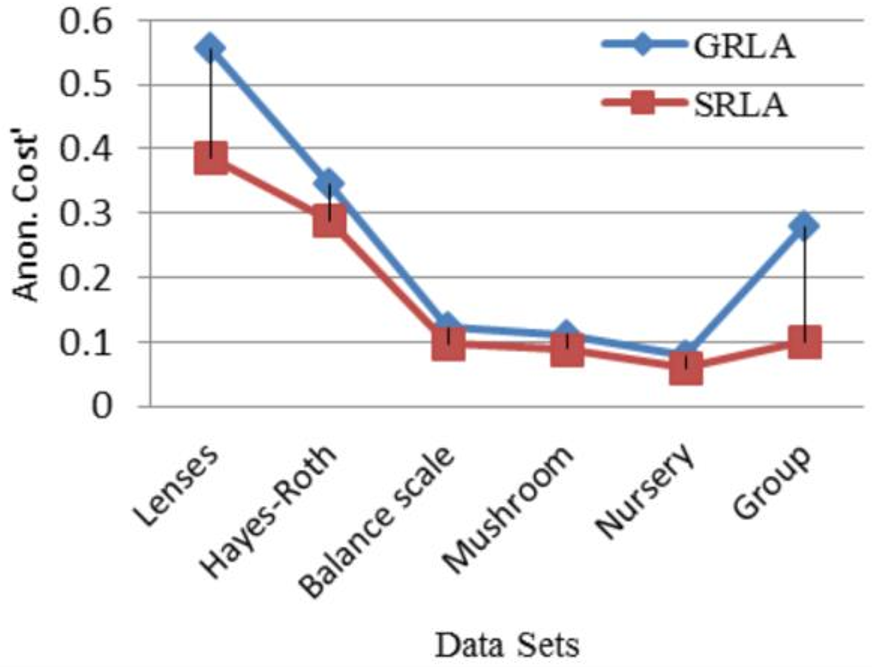
The authors tested their approach against the Greedy Rank-Label Anonymization (GRLA). The results across real-world datasets like Mushroom and Nursery were definitive.
- Disclosure Risk: In the Balance Scale dataset, the disclosure risk was 76.8% under the new attack model, proving that previous anonymization methods left citizens wide open to identification.
- Optimization: SRLA consistently produced a lower "Anonymization Cost" (Anon. Cost') than GRLA. This means that for the same level of privacy, SRLA keeps more of the original data's useful patterns (utility).
Critical Insight & Future Outlook
The genius of this paper lies in its recognition of the Privacy-Utility Trade-off specifically for hypergraphs. By using the Havel-Hakimi algorithm to check "realizability," the authors ensure that the anonymized mathematical sequences can actually be turned back into a valid graph structure.
Limitations
- Dataset Sensitivity: The authors used UCI machine learning datasets (like Lenses) as proxies because real-world medical or governance datasets are often locked away.
- Static Nature: The current model handles static snapshots; however, social media and e-governance data are dynamic and streaming.
Conclusion
SRLA represents a significant step forward for digital governments. It proves that we can analyze complex community structures without sacrificing the individual privacy of the citizens. As we move towards more AI-driven governance, hypergraph-based privacy will likely become the standard for handling high-dimensional sociological data.