
HeteRS: Mastering the Online-to-Offline Recommendation Loop in Social Networks
A general graph-based model for recommendation in event-based social networks
The paper introduces HeteRS, a unified graph-based recommendation framework for Event-Based Social Networks (EBSNs) that handles group, tag, and event recommendations. It utilizes a Heterogeneous Graph with Multivariate Markov Chains (MMC) and an automated parameter learning scheme to optimize influence weights between different entity types.
TL;DR
Recommending content in Event-Based Social Networks (EBSN) like Meetup is notoriously difficult due to the mix of online group dynamics and offline event participation. HeteRS is a general-purpose framework that uses a Heterogeneous Graph and Multivariate Markov Chains to solve three distinct tasks—recommending groups, tags, and events—within a single model. By automatically learning the "influence weights" of different social connections, it achieves a significant performance leap over specialized state-of-the-art models.
The "Disconnected" Problem in EBSNs
Prior work in EBSN recommendation suffered from a fragmented approach. Researchers would build a topic model for tag recommendation, a factorization model for group recommendation, and a simple user-graph diffusion for event attendance. This "siloed" methodology ignored the rich, heterogeneous interplay where a user's interest in a "Sports" tag might be driven by a group they joined, which in turn was discovered through a football match they attended last Saturday.
The core technical challenge is influence weighting. In a graph containing users, events, and venues, how much should an event's location influence a user compared to the group's organizer? Traditional Random Walk with Restart (RWR) methods fail here because normalization steps wash out the physical meaning of edge weights.
Methodology: Heterogeneous Graphs Meet Temporal Intuition
HeteRS tackles this by constructing a multi-layered graph and defining transitions through a Multivariate Markov Chain (MMC).
1. Capturing Temporal Rhythms
The authors observed two critical temporal patterns in user behavior:
- Weekly Periodicity: Users tend to join events on a weekly cycle (e.g., every Tuesday). HeteRS introduces Session Nodes to link users to specific days of the week, effectively capturing their routine.
- Recency Bias: Recent events are better predictors of future interest. A decay function is applied to event-related edges to prioritize the "now."
2. The Learning Framework
Instead of manually guessing the influence of a "Tag" on a "User" (), HeteRS uses a learning scheme based on Bayesian Personalized Ranking (BPR). It treats the recommendation as a ranking problem, optimizing the transition parameters so that "joined" groups have higher proximities than "unjoined" ones.
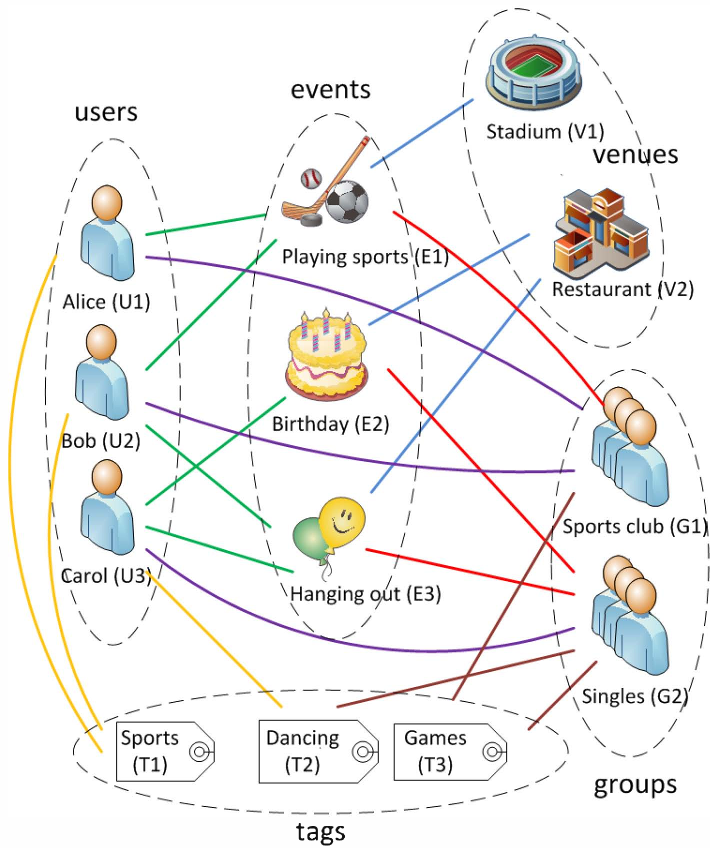 Fig 1: The heterogeneous structure connecting users, groups, events, and tags.
Experimental Breakthroughs
The model was tested on massive datasets from New York and California. The results were categorical:
- Group Recommendation: HeteRS beat PTARMIGAN by 34-39% in Precision and Recall.
- Tag Recommendation: It outperformed the PIT model by over 90%, proving that group tags are heavily influenced by the collective history of attendees, not just the group creator.
- Event Prediction: By incorporating the session nodes, the model predicted event attendance far more accurately than standard RWR.
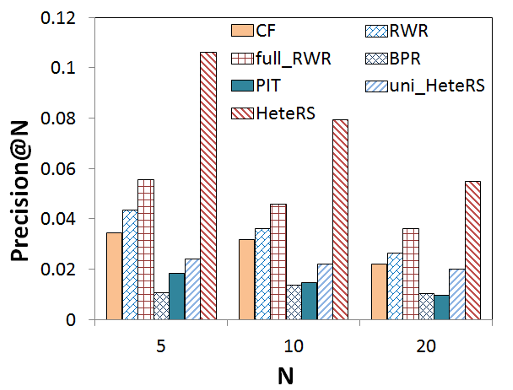 Fig 2: HeteRS (Top line) consistently outperforms CF, BPR, and specialized EBSN models.
Scalability through Local Propagation
Full graph iterations are slow. To solve this, the authors proposed an Approximation Algorithm that uses a preference threshold . Instead of updating every node in the graph, the algorithm performs "local propagation"—it only pushes probability to neighbors if the current node's score is high enough. This achieved a 3x to 10x speedup on the largest graphs while maintaining (or even improving) accuracy by filtering out distant, irrelevant nodes.
Critical Insight & Conclusion
The true value of HeteRS lies in its interpretability. By looking at the learned parameters, we see that in NYC, "Session Nodes" have the highest weight (0.44), confirming that NYC social life is highly periodical. In CA, this weight is lower, suggesting more spontaneous behavior.
Takeaway: If you are building a recommendation engine for any complex ecosystem, don't build separate models for different entities. Map them to a heterogeneous graph, use MMC to keep the weights meaningful, and let the data learn the influences.