
Decoding Trust: A Deep Dive into Graph-Based Evaluation in Social Networks
Understanding Graph-Based Trust Evaluation in Online Social Networks: Methodologies and Challenges
This paper provides a comprehensive survey of graph-based trust evaluation methodologies in Online Social Networks (OSNs), classifying existing models into graph-simplification and graph-analogy approaches. It identifies the "START" properties of trust (Subjective, Topic-dependent, Asymmetric, Risking betrayal, Time-sensitive) and categorizes SOTA achievements like TidalTrust, Appleseed, and GFTrust.
TL;DR
Trust is the invisible currency of Online Social Networks (OSNs). This seminal survey by Jiang et al. dissects how we can mathematically model this subjective human emotion using graph theory. By categorizing methods into Simplification (path-based) and Analogy (physical system emulations), the paper establishes a rigorous framework for predicting whether a user can be trusted based on their structural position in a "Web of Trust."
The "START" of Trust: Why It's a Computation Nightmare
Before diving into algorithms, we must understand the "physics" of trust. The authors define the START properties that make this task notoriously difficult:
- Subjective: My "high trust" isn't the same as yours.
- Topic-dependent: I trust my doctor with medicine, not with my car.
- Asymmetric: I may trust you, but you might not trust me.
- Risking betrayal: Every trust interaction involves a probability of loss.
- Time-sensitive: Relationships decay; old trust is often stale trust.
Methodology: The Two Schools of Thought
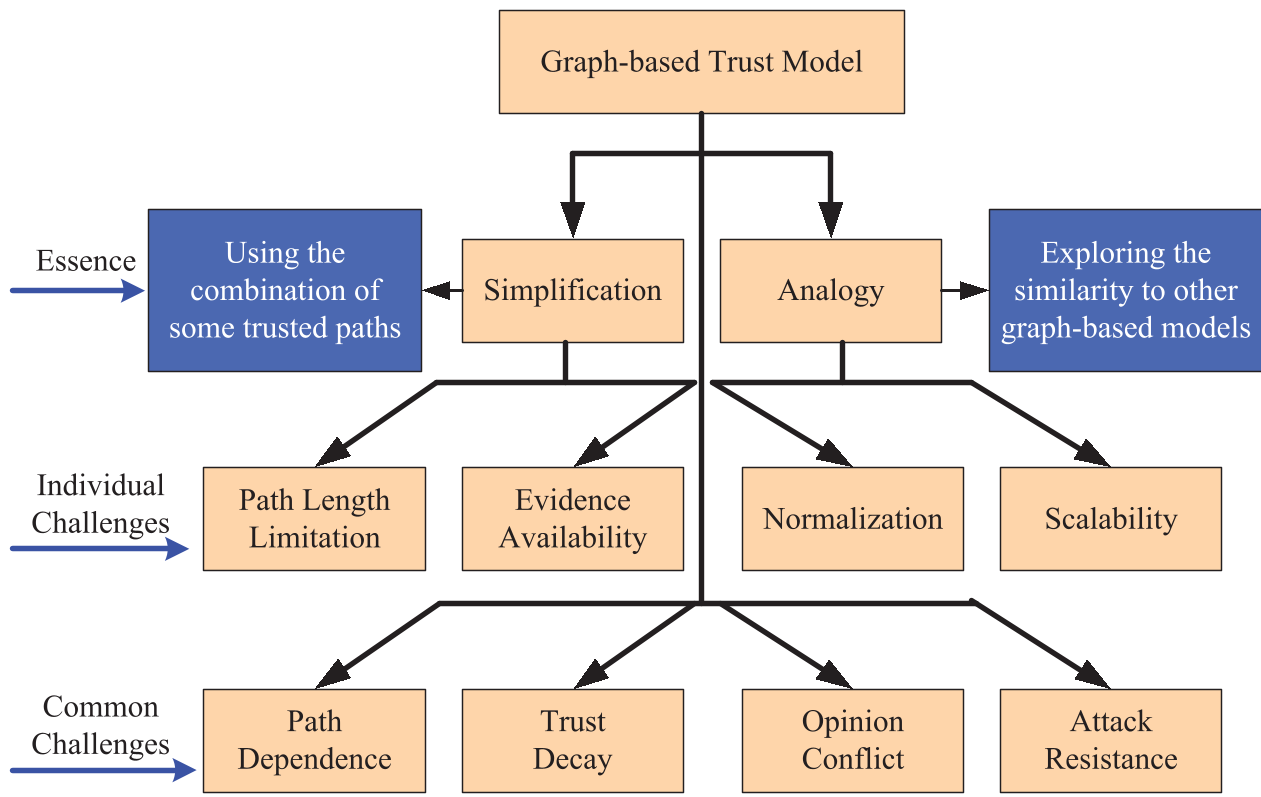
1. Graph Simplification (The Minimalists)
These models, such as TidalTrust and MoleTrust, treat the social graph like a retrieval task. They use Breadth-First Search (BFS) to find paths between a source (Trustor) and a target (Trustee).
- The Intuition: Shorter paths are more reliable.
- The Trade-off: By focusing only on the "shortest strongest" paths, these models often ignore valid evidence, leading to high "Information Loss."
2. Graph Analogy (The Physicists)
These models view the network as a physical system—a circuit or a sliding fluid.
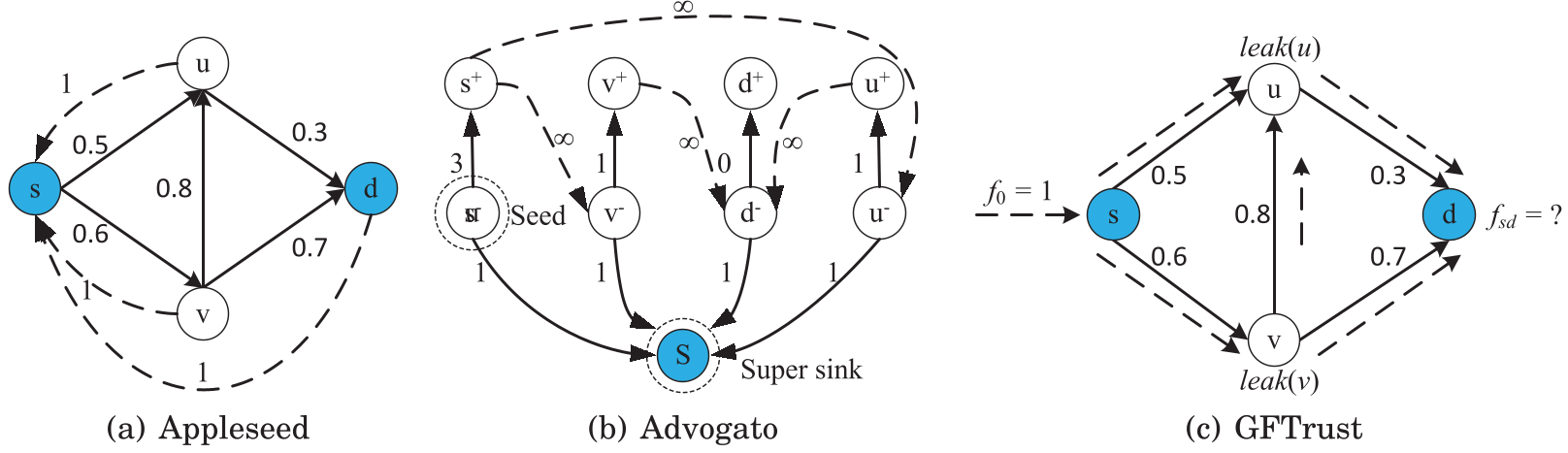
- RN-Trust: Maps trust to electrical resistance (). The more "parallel paths" between users, the lower the total resistance, and thus the higher the trust.
- Appleseed: Uses "Energy Spreading." You inject energy at the source, and it flows out to neighbors. The energy remaining at the target defines their trustworthiness.
- GFTrust: Models trust as a "Generalized Flow" where "flow leaks" (trust decays) as it traverses each hop.
Critical Challenges: The Battle Against Noise and Attacks
A central contribution of this survey is the identification of Common Challenges:
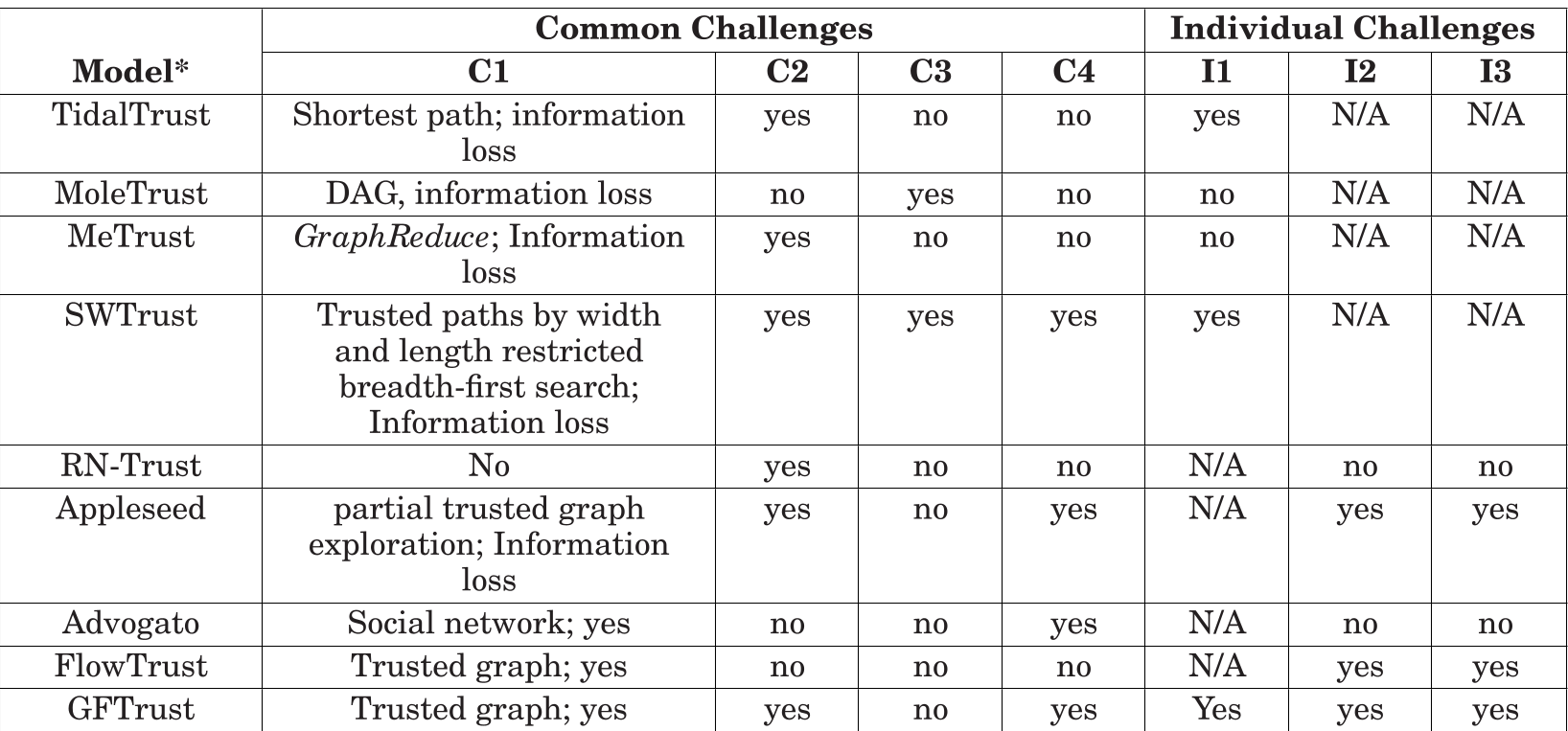
- Path Dependence: If two paths share a common edge, should that trust be counted twice? Models like GFTrust use capacity constraints to solve this, preventing "evidence inflation."
- Trust Decay: Trust isn't transitive like equality. If A trusts B, and B trusts C, A's trust in C is inherently weaker. Managing this "leakage" is vital for accuracy.
- Opinion Conflict: How do we handle a target like a controversial politician who has 1,000 "full trust" ratings and 1,000 "zero trust" ratings?
- Attack Resistance: Sybil attacks (creating fake identities) can easily bridge "trust paths." The authors argue that Flow-based models (like Advogato) are the most resilient because they limit the total "trust quota" a malicious node can distribute.
Experimental Insights
Through an empirical comparison across datasets like Epinions and FilmTrust, a few key winners emerge:
- Multi-path models outperform single-path ones. The "weighted average" of many friends' opinions is more robust than the single closest friend's opinion.
- Scalability remains a hurdle. While simplification models are fast (), complex analogy models can reach , necessitating the use of "Local Trusted Graphs" rather than processing the billions of nodes on Facebook.
Conclusion and The Road Ahead
The field is moving toward Hybrid Systems—using simplification to prune the massive social graph into a manageable "contextual subgraph," and then applying rigorous flow-based analogies to calculate precise, attack-resistant trust scores.
Future Work: The authors point to Privacy Preservation (calculating trust without revealing social ties) and Distrust Modelling ("The enemy of my enemy is my friend") as the next frontiers in social computing.