
Graph Compaction: Strategic Partitioning for Large-Scale Social Network Analysis
Graph compaction in analyzing large scale online social networks
The paper introduces two novel graph compaction algorithms, Weighted Depth First Search (WDFS) and Modularity Maximization (MM), designed to partition large-scale Online Social Networks (OSNs) for parallel processing. By leveraging intrinsic community structures, these methods achieve superior partitioning quality compared to SOTA tools like METIS.
TL;DR
Analyzing massive social networks requires distributed computing, but how you "cut" the graph determines performance. This paper moves away from rigid, equal-sized partitioning (like METIS) and proposes Graph Compaction—using the network's own community structure to create "super nodes." By employing WDFS and Modularity Maximization, the authors achieve up to a 27% reduction in graph cuts, significantly lowering inter-processor communication overhead.
The Motivation: Why Standard Partitioning Fails OSNs
In a distributed environment, the goal is to minimize communication between processors. This is equivalent to minimizing the "graph cut" (edges crossing between partitions).
Most state-of-the-art tools, such as METIS, attempt to create homogeneously sized partitions. However, real-world networks are inherently heterogeneous:
- Imbalanced Communities: Social clusters vary wildly in size; forcing them into equal buckets breaks natural "modules."
- Scalability: Iterative algorithms often struggle as node counts () explode.
- Communication Costs: If a natural cluster is split across two CPUs, the overhead of synchronization can negate the benefits of parallelism.
The authors' insight is simple: Let the graph's natural "compact" version (its community structure) dictate the partitions.
Methodology: Two Flavors of Compaction
The authors formally define the problem as an optimization task: find a compact graph with a limited number of "super nodes" that maximizes modularity ().
1. Weighted Depth First Search (WDFS)
This heuristic focuses on connectivity and dependency. It builds a spanning tree by prioritizing edges with lower weights during traversal.
- Phase 1: Generate a Directed Acyclic Graph (DAG) using WDFS.
- Phase 2: Use post-order traversal to "accumulate" leaf nodes into super nodes based on flexible constraints.
- Visual Logic: It prioritizes local connectivity to ensure that highly dependent nodes stay within the same partition.
2. Modularity Maximization (MM)
This is a more sophisticated approach aimed at optimizing the "quality" of clusters.
- It starts by absorbing unit-degree nodes into their parents.
- It then greedily merges nodes or super-nodes that provide the highest gain in the Modularity Index ().
- The algorithm uses a flexible constraint of for both the number and size of communities, allowing the graph to "breathe" according to its natural topology.
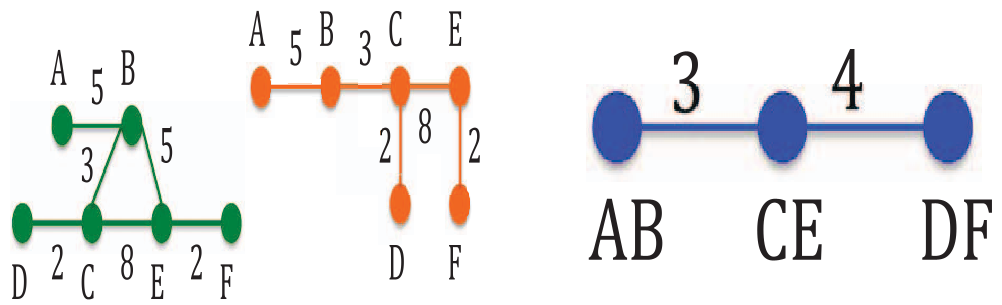 Figure 1: Illustration of the WDFS-based compaction process, from input graph to DAG, then to the final compact super-nodes.
Experimental Performance: Beating the Gold Standard
The researchers tested their approach on the NetScience and Twitter Mention datasets. The evaluation focused on two metrics: Modularity (structural quality) and Graph Cuts (communication efficiency).
Structural Quality
The MM-based compaction consistently achieved modularity scores above 0.5, whereas scores above 0.3 are generally considered indicative of significant community structure. Interestingly, as the number of super-nodes increases, the modularity eventually peaks and declines, highlighting the optimal "compact" scale for each network.
Efficiency vs. METIS
When compared to the industry standard METIS 4.0:
- WDFS reduced graph cuts by 2% to 11%.
- MM demonstrated a massive improvement, reducing cuts by 7% to 27%.
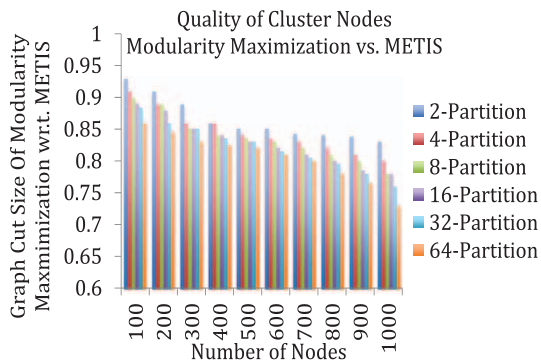 Figure 2: Reduction in graph cuts compared to METIS. MM-based compaction (green) shows significantly lower inter-partition communication requirements.
Critical Analysis & Conclusion
The core value of this work is the shift from computational balancing (making partitions equal) to topological balancing (making partitions natural).
Key Takeaways:
- Heterogeneity is a Feature: Embracing the varied sizes of social clusters leads to more efficient distributed execution.
- Complexity: While MM is more effective, it is computationally more expensive () than WDFS (). WDFS serves as a fast alternative for environments where communication latency is less critical.
Limitations: The paper largely focuses on static snapshots. In real-world OSNs, the "mention" graph evolves by the second. Future work would need to adapt these compaction steps for temporal graphs without recomputing the entire compaction from scratch.
Ultimately, this research proves that in the world of Big Data, understanding the "shape" of your data is just as important as the raw power of your processors.