
PNeo4j: Scaling the Social Graph through Intelligent Vertex Partitioning
Graph data partition models for online social networks
This paper introduces PNeo4j, a distributed extension of the Neo4j graph database designed to scale Online Social Networks (OSNs) via Vertex Partitioning. By implementing a "Dangling Edge" model, the system enables linear scalability across multiple servers while maintaining ACID compliance through a two-phase commit protocol.
TL;DR
The explosion of Online Social Networks (OSNs) demands graph databases that can scale beyond a single machine's RAM and Disk. PNeo4j is an architectural extension of Neo4j that implements Vertex Partitioning using a "Dangling Edge" model. It eliminates the physical limits on graph size and ensures that local operations remain as fast as a centralized system, shifting the bottleneck entirely to the inevitable network latency of cross-shard queries.
Background: Why Graphs Struggle to Scale
In the world of RDBMS or Key-Value stores, "sharding" is a well-understood problem. However, graphs are inherently interconnected. When you split a graph across servers, you inevitably cut through edges. Conventional wisdom offered three paths:
- Property Partitioning: Move heavy metadata to a KV store. (Limit: The graph structure still must fit on one node).
- Edge Partitioning: Split by edge types. (Limit: Some edge types will still be too large).
- Vertex Partitioning: The "holy grail" where each vertex lives on one server, allowing the graph to grow infinitely.
The authors of PNeo4j chose the third path, focusing on how to represent Crossing-Edges without destroying performance.
The "Dangling Edge" Insight
The core methodology of PNeo4j revolves around how it handles an edge where Vertex A is on Server 1 and Vertex B is on Server 2. While previous works suggested "Ghost Vertices" (placeholders), PNeo4j uses the Dangling Edge Model.
- Mechanism: The Vertex ID is turned into a Global ID (GID). The internal 64-bit ID space is partitioned: the first 16 bits identify the "Owner Partition."
- The Logic: If a traversal hits an edge pointing to a GID with a different partition prefix, the system knows exactly which server to contact without a central lookup table.
- Why it works: By avoiding ghost objects, the system reduces synchronization logic and storage bloat.
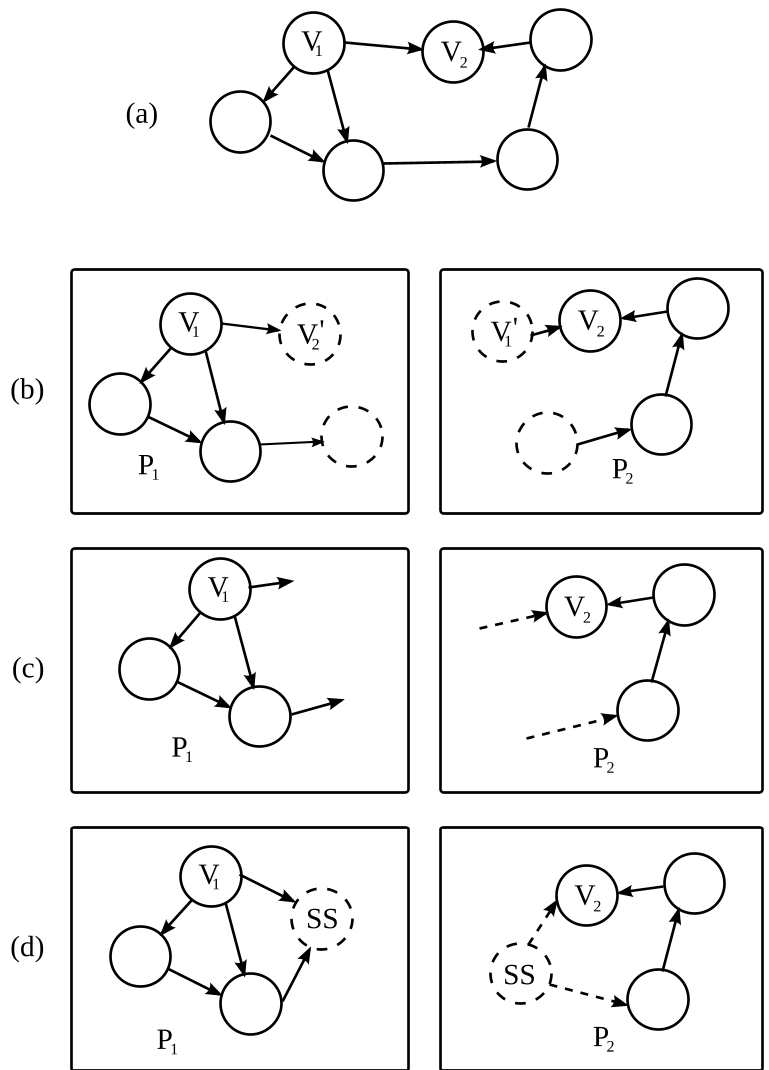 Above: Comparison of Ghost Vertex vs. Dangling Edge vs. Super Source/Sink models.
Architecture and Implementation
PNeo4j extends the Neo4j 1.3 architecture. Key implementation details include:
- Two-Phase Commit (2PC): To maintain ACID properties, the originating server acts as the coordinator for any transaction that touches multiple shards.
- Spatial Locality: The design assumes OSN queries (like "find friends of friends") exhibit high spatial locality. By keeping clusters of friends on the same partition, most queries never trigger a network call.
Performance: The Cost of Distance
The authors validated PNeo4j by running 1,000,000 traversals. The goal was to prove that partitioning doesn't slow down the local database engine.
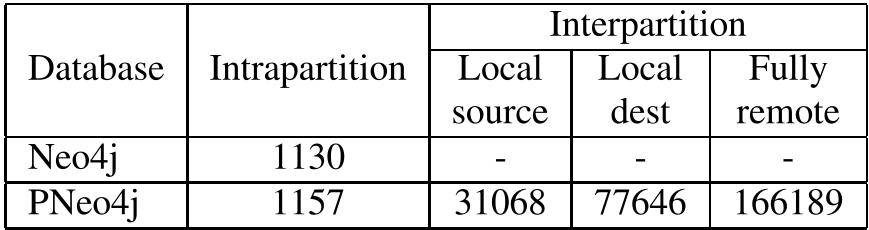
Key Findings:
- Local Performance: PNeo4j (1157ms) is nearly identical to vanilla Neo4j (1130ms). This is a massive win, as it proves the "distributed tax" is only paid when data is actually distributed.
- Network Bottleneck: Inter-partition traversals are orders of magnitude slower (31k to 166k ms). This confirms that in distributed graph systems, Min-Cut partitioning algorithms (which minimize crossing edges) are the most critical factor for real-world speed.
Critical Analysis & Future Outlook
PNeo4j proves that the technical overhead of a partitioned graph database can be minimized. However, the current prototype has a significant limitation: Centralized Coordination. The originating server handles all logic. If a query spans many nodes, the network traffic is proportional to the number of remote vertices.
Future Directions:
- Computation Shipping: Instead of fetching remote data to the local server, the system should ship the "traversal logic" to the remote server (similar to Pregel's vertex-centric model).
- Dynamic Repartitioning: As social circles evolve, the system needs to move vertices between shards to maintain locality without breaking Global IDs.
In conclusion, PNeo4j provides the blueprint for a shared-nothing graph architecture that respects the native speed of graph traversals while breaking the single-server storage wall.