
Graph Models for Social Relations: Engineering Analytical Clarity in Anthropology
Graph Models For Social Relations
This paper explores the application of Graph Theory as a formal analytical framework for modeling social relations and anthropological structures. By reviewing the collaborative work of Per Hage and Frank Harary, the authors demonstrate how graph models can categorize and solve complex sociocultural problems such as kinship, resource exchange, and communication hierarchies.
TL;DR
This article examines the transformative impact of Graph Theory on anthropology, primarily through the legacy of Per Hage and Frank Harary. It argues that moving from "pictures" to "theorems" allows social scientists to achieve a level of cross-cultural comparison and predictability previously obscured by qualitative descriptions.
Background: Beyond Qualitative Descriptions
Historically, anthropologists have used diagrams to represent social ties, but often without the mathematical rigor needed to derive new insights. The core motivation for this research is to resolve two major issues:
- Weak Generalizations: Cultural phenomena are often hidden by vague summaries.
- Abstraction Mismatch: Comparison between cultures fails because they are analyzed at different levels of depth.
By adopting Graph Theory, a problem of structure is first modeled as a graph (nodes and edges), then solved using the vast library of existing mathematical theorems.
Methodology: The Four Pillars of Graph Application
The authors identify four critical ways that graph models revolutionize the study of social structures:
1. Classification (Bipartite Graphs)
In Melanesian societies, "dual organization" splits a tribe into two halves for initiation or marriage. The paper identifies this as a Bipartite Graph.
- Insight: Because bigraphs require all cycles to be of even length, this theorem implies a specific, restricted structure for exchange that must be followed within the tribe.
2. Qualification (Centrality & Betweenness)
On the Caroline Islands, survival depends on sea-lane networks. The scholars applied Centrality and Betweenness metrics:
- Distance: Islands with the shortest total path to others were economically vital.
- Betweenness: Islands that lay on the highest proportion of "geodesics" (shortest paths) between other pairs exerted political dominance and controlled regional voyages.
 Figure 1: Traditional representations of clan structures (A) and their transition into mathematical group/graph notations (B).
3. Simulation (Markov Chains)
The famous Kula Ring—involving 20 island communities exchanging arm shells and necklaces—was modeled as two decoupled Markov chains. This allows researchers to estimate the probability of flow for valuables, shifting from observation to mathematical prediction.
4. Enumeration (Kinship Atoms)
By using the operation of sex duality in graphs, researchers can systematically change the sex of each node to enumerate every possible combination of kinship relations (consanguinity and affinity) in a concise, algebraic form.
Experiments & Case Study: The Kariera Clan
The paper debates the value of "Explanatory Models" versus "Predictive Models." Using the Kariera tribe as an example, the authors illustrate how different clans can be mapped to different vertices.
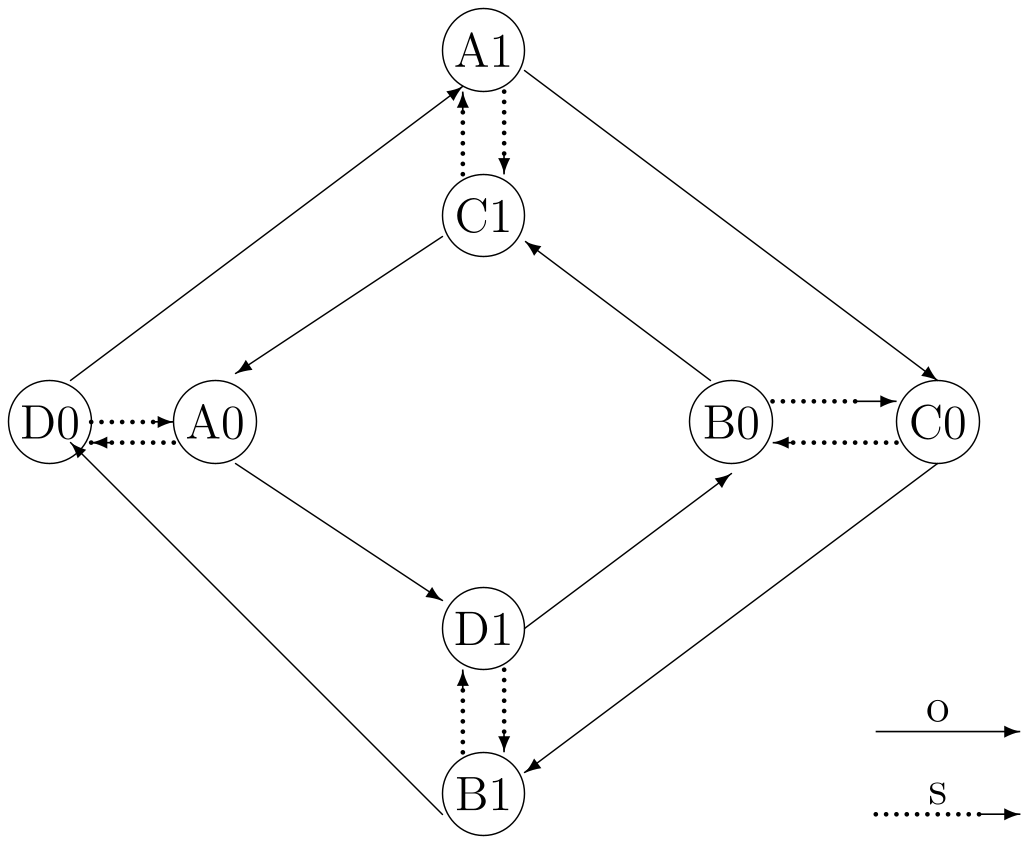 Figure 2: Representation of Kariera subclans. S indicates subclans of same-sex children, while O indicates opposite-sex children.
Key Takeaway from the Experiment: A model may not always "predict" the next marriage, but it reveals whether two social systems are homomorphic (structurally similar). If two representations of the same tribe lack a homomorphism, it reveals a fundamental misunderstanding of the kinship rules being applied.
Critical Analysis & Conclusion
While contemporary anthropology has shifted toward post-structuralism and deconstruction, this paper argues for a return to structural clarity.
- The Problem of Disciplinary Amnesia: The authors warn that ignoring the accumulated ethnographic record in favor of "themes of the moment" (like post-colonialism) prevents cumulative scientific progress.
- Falsifiability: By using graph theorems, social theories become falsifiable. If a theorem states a property must follow from a condition, and the empirical data contradicts it, the theory is proven wrong—a necessity for any scientific discipline.
In conclusion, the work of Hage and Harary stands as an "island of clarity," proving that social relations are not just cultural narratives, but structured systems that obey the cold, hard logic of graph theory.