
This paper presents two explicit counterexamples to Jain's second unit vector flow conjecture regarding $S^2$ nz5-flows. By constructing specific finite subsets of points on a 2D unit sphere, the author proves that a labeling using only values from ${\pm 1, \pm 2, \pm 3, \pm 4}$ is impossible, thereby necessitating at least a 6-flow ($\pm 5$).
TL;DR
In a significant blow to a proposed geometric bridge toward solving Tutte’s 5-Flow Conjecture, Nikolay Ulyanov has disproven Jain’s second conjecture on unit vector flows. By identifying specific subsets of points on the unit sphere—using an expanded icosidodecahedron and square-root arithmetic—the author demonstrates via SAT solvers and Lean 4 verification that a 5-flow labeling is mathematically impossible for these configurations.
The High Stakes of Geometric Flows
For decades, Tutte’s 5-Flow Conjecture (every bridgeless graph has a nowhere-zero 5-flow) has remained one of the "holy grails" of graph theory. K. Jain proposed a fascinating geometric approach: if every bridgeless graph can be mapped to unit vectors on a sphere (Conjecture 1.1) and if the sphere itself admits a specialized 5-flow labeling (Conjecture 1.2), then Tutte’s conjecture would follow as a logical consequence.
By disproving the latter, Ulyanov effectively disconnects this specific geometric shortcut from the broader proof of Tutte's conjecture.
Problem & Motivation: The Rigidity of the Sphere
The core of Jain’s second conjecture was the belief that the sphere $S^2$ is "flexible" enough to accommodate a discrete labeling $q: S^2 \rightarrow {\pm 1, \pm 2, \pm 3, \pm 4}$ where:
- Antipodal Symmetry: $q(-p) = -q(p)$
- Great Circle Equilibrium: Any three points equidistant on a great circle sum to zero.
While this works for simple configurations like the Petersen Graph (mapped via the vertices of an icosidodecahedron), the author suspected that more complex point interactions would eventually force the need for a larger value (like $\pm 5$), which would technically constitute a 6-flow.
Methodology: SAT Solvers meets Polyhedral Geometry
The author’s approach combines classical solid geometry with modern computational verification.
1. The 50-Point Expansion
Starting with the icosidodecahedron (30 points), the author added points by intersecting small circles derived from existing vertex pairs. This creates a dense network of 40 great-circle triples.
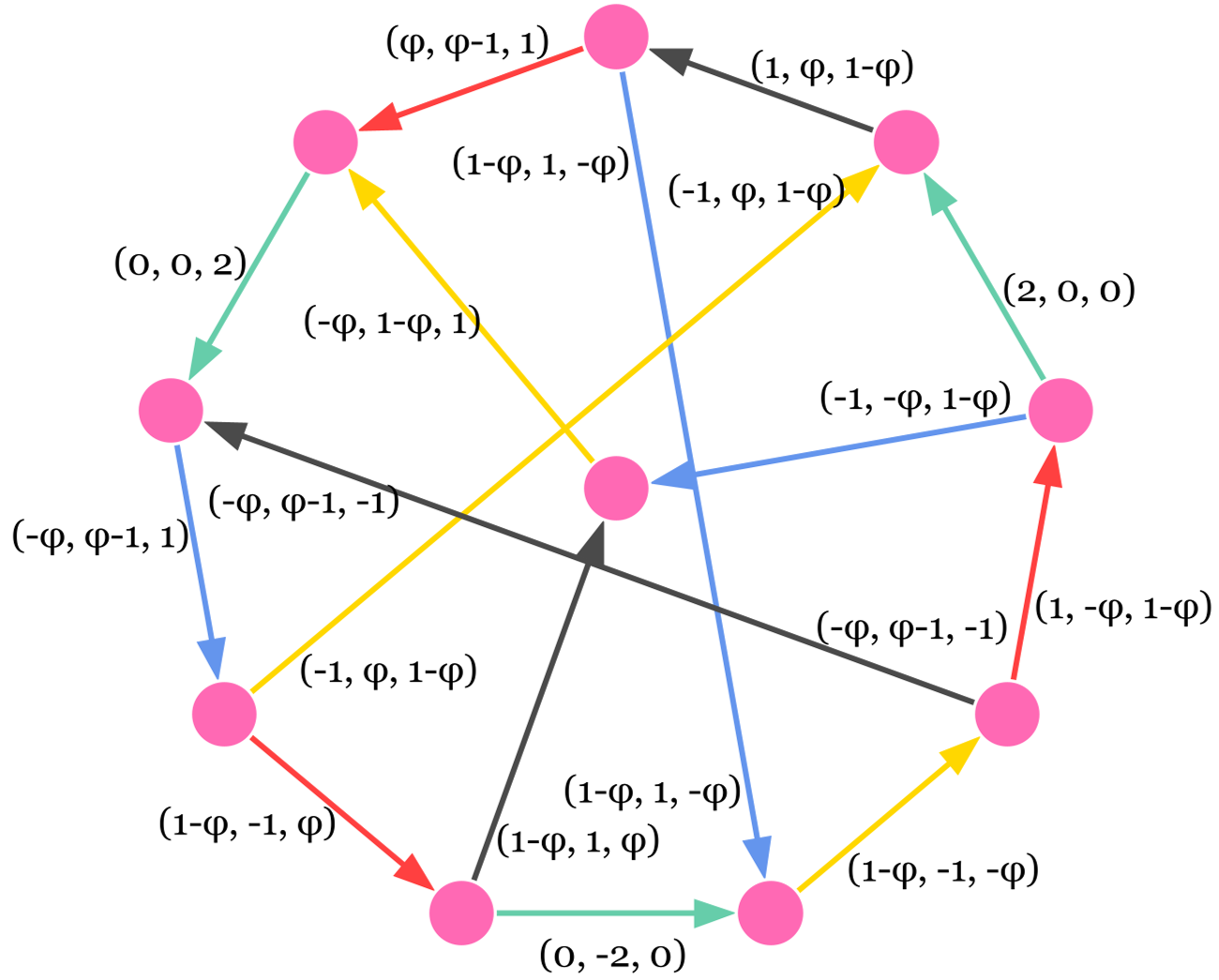 Figure: The initial icosidodecahedron mapping, which serves as the basis for the first counterexample.
2. Computational Verification (The SAT Phase)
To prove no valid labeling exists, the author translated the constraints into a Boolean Satisfiability (SAT) problem.
- Variables: 8 Boolean variables per point (representing the 8 allowed values).
- Constraints: "Exactly-one" value per point, antipodal consistency, and the triple-sum rule.
For both the 50-point set and a secondary 36-point set (derived from square-root arithmetic), the SAT solvers returned UNSAT, meaning no combination of values from ${\pm 1, \pm 2, \pm 3, \pm 4}$ could satisfy the rules.
Results: The Necessity of "5"
The experiments confirmed that while a 5-flow fails, a 6-flow (allowing values up to $\pm 5$) succeeds.
| Construction | Points | Triples | Result | | :--- | :--- | :--- | :--- | | Expanded Icosidodecahedron | 50 | 40 | Requires $\pm 5$ (Disproves Conj) | | Square-Root Arithmetic Set | 36 | 13 | Requires $\pm 5$ (Disproves Conj) |
The author even took the extra step of formal verification using Lean 4 (specifically the bv_decide tactic), ensuring the results are not mere artifacts of floating-point errors.
Critical Analysis & Future Outlook
The "Geometric Flow" program isn't necessarily dead, but it must be refined.
Takeaways:
- Finite vs. Infinite: The conjecture fails for the sphere as a whole because these finite subsets exist.
- The "5 vs 6" Gap: Curiously, the author found that while 5 is insufficient, 6 always seems to suffice for the sets tested. Is there a "Universal 6-flow" for the sphere?
- Search for Algebraic Subsets: Future work (hinted at in the paper) will look for specific subsets of the sphere that do allow 5-flows and can still host mappings of all bridgeless graphs.
This paper serves as a vital "sanity check" in extremal graph theory, reminding us that geometric intuition must always be validated by the cold, hard logic of discrete constraints.