
The Physics of Participation: Maximizing Social Sensing via (r, s)-Cores
Graph-Theoretic Approach for Increasing Participation in Social Sensing
The paper introduces the concept of the (r, s)-core to model user participation in social sensing networks under heterogeneous conditions. It proposes graph-theoretic strategies, including anchor node selection and node relabeling, to maximize participation and mitigate the cascading "unraveling" effect where users leave the network due to insufficient information sharing from peers.
TL;DR
Social sensing succeeds only if enough users participate to provide a complete picture of the environment. This paper moves beyond simple connectivity metrics to propose the (r, s)-core, a model that accounts for the fact that users have different sensing "labels" (capabilities). By strategically placing "anchor nodes" or redistributing sensing tasks, we can prevent the network from "unraveling" and maximize collective intelligence.
Background: Why Networks Unravel
In participatory sensing—like Waze for traffic or OpenStreetMap for geography—users are both consumers and producers. If your friends stop sharing data, the app becomes useless to you, so you leave. This creates a cascading effect.
Previous research focused on the k-core, where you stay if you have active neighbors. But this is too simple. In reality, you don't just need any neighbors; you need neighbors who provide the info you lack. If you are sensing "Temperature" but need "Humidity" and "Wind Speed" to complete your report, it doesn't matter if you have 100 neighbors if none of them sense Humidity.
Methodology: The (r, s)-Core Framework
The researchers introduce a more nuanced engagement rule. Each node is assigned labels from a total set (where ). A node stays active only if the union of its own labels and its neighbors' labels covers all possibilities.
1. The Anchoring Strategy
Since finding the optimal set of users to incentivize is NP-hard (proven via a reduction from the Set Cover Problem), the authors propose two main heuristics:
- Greedy Selection: Iteratively pick the node that, if anchored, causes the largest increase in the total core size.
- Noisy Best Response: A stochastic approach that swaps anchors to escape local optima, similar to simulated annealing.
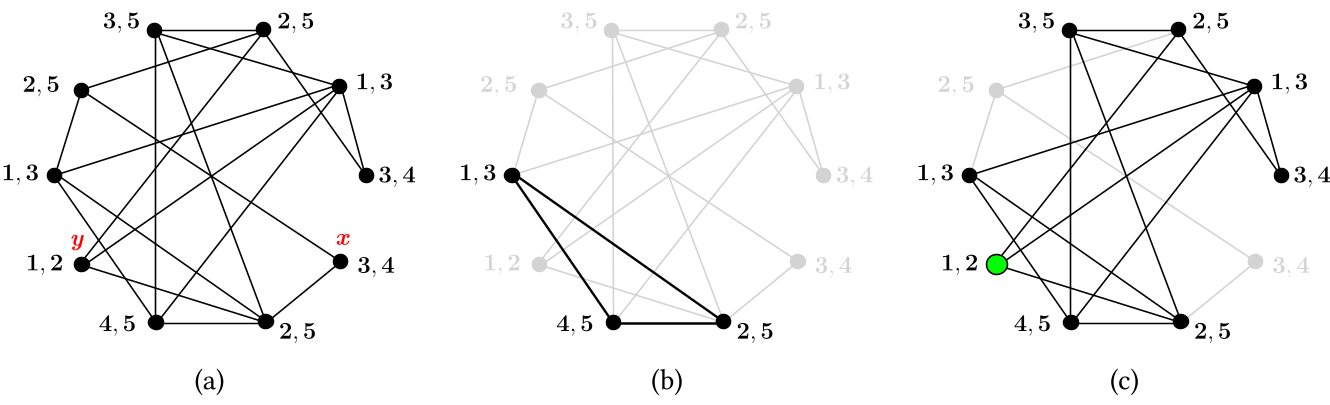 Figure 1: (a) Initial network; (b) The collapsed (5,2)-core; (c) High participation restored by adding a single green anchor node.
2. The Relabeling Strategy
If you can't add anchors, can you change what people sense? The authors propose a "Score" for each node's label set. If a node provides a label that no one else in its neighborhood provides, its score is high. By "re-labeling" nodes to maximize these scores, the entire network becomes more resilient.
Key Results: From 0 to 100
The impact of strategic anchoring is most visible in the "phase transition" of participation. Using a real-world dataset of 4,039 Facebook users, the researchers demonstrated that:
- Strategic vs. Random: Randomly incentivizing users does almost nothing to stop unraveling. However, algorithms 1 and 2 find "linchpin" nodes that trigger massive cascades of participation.
- Label Density: As the ratio of increases (users get more capable devices), the network becomes naturally more robust.
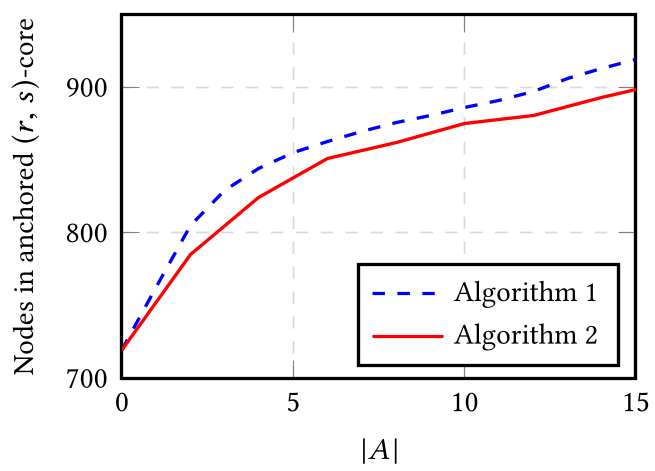 Figure 5: Anchored core size relative to the number of anchors. Note the steep growth provided by the Greedy and Noisy strategies compared to baseline expectations.
Critical Insight
The brilliance of this work lies in recognizing that participation is a structural property of the information, not just the people. By framing social sensing as a graph-theoretic covering problem, it provides a rigorous toolkit for platform designers to manage user churn.
Limitations: The current model assumes a static network. In real-world scenarios, edges (friendships/interactions) are dynamic, and the reward for being an "anchor" might need to be adjusted over time as the network evolves.
Future Outlook
This work paves the way for "Adversarial Social Sensing" research—how can a competitor break an (r, s)-core with minimal effort? Understanding the defense (anchoring) is the first step toward building truly robust crowdsourced ecosystems.