
From Spanning Trees to Chordal Graphs: Preserving Biological Signals in Massive Correlation Networks
Analysis of Incrementally Generated Clusters in Biological Networks Using Graph-Theoretic Filters and Ontology Enrichment
The paper introduces an incremental graph-filtering approach designed to analyze large biological correlation networks by navigating the spectrum between Spanning Trees and Chordal subgraphs. Using gene expression data from yeast and human datasets, the authors demonstrate that their iterative filtering method reduces noise while preserving significant biological clusters and substructures.
TL;DR
Biological networks are often too large and noisy for direct mining. This paper proposes an incremental filtering algorithm that bridges the gap between ultra-sparse Spanning Trees and dense Chordal subgraphs. By iteratively adding triangle motifs, the researchers successfully reduced network noise while maintaining and even uncovering new biologically significant gene clusters verified by Gene Ontology (GO).
Background: The Noise Problem in Systems Biology
In the era of high-throughput sequencing, we can build massive networks where nodes are genes and edges represent expression correlations. However, these networks are problematic for two reasons:
- Computational Complexity: Human gene networks can have millions of edges ().
- Biological Noise: Many correlations are false positives that don't represent real regulatory relationships.
Existing filters are often "all or nothing." A Spanning Tree keeps the skeleton (good for identifying essential hubs) but destroys clusters. A Chordal Filter keeps dense communities but might retain too much noise. The authors ask: Is there a "sweet spot" in the middle?
Methodology: The Incremental Spectrum
The core innovation is an iterative algorithm that moves along a structural spectrum.
1. The Starting Point: BFS Spanning Tree
The process begins with a Breadth-First Search (BFS) tree. BFS is chosen over Kruskal’s because it has been shown to better preserve biological hubs—the "essential" genes that keep a cell alive.
2. The Iterative Step: Adding Triangles
In each iteration, the algorithm looks at a node's neighbors. If those neighbors were connected in the original noisy network, it adds that edge back. This specifically nurtures the triangle motif, a key hallmark of co-regulated biological modules.
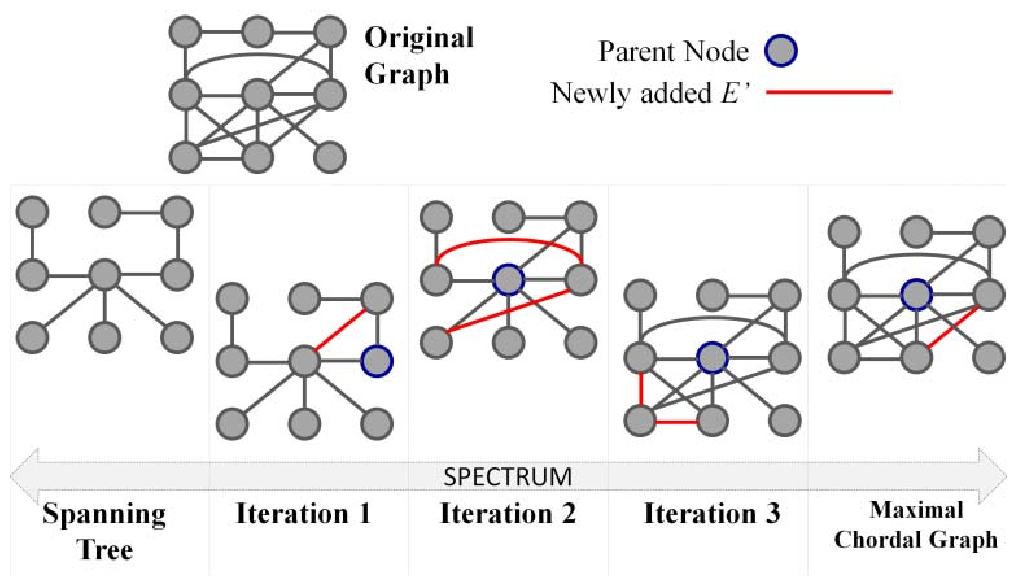 Fig 1: The iterative algorithm starts sparse and adds edges to form chordal structures.
3. Verification: Ontology Enrichment
To prove these filtered networks aren't just "pretty graphs" but biologically real, the authors used a custom Closeness Score based on Gene Ontology (GO) trees. This measures how functionally related the genes in a cluster actually are.
Experimental Insights
The team tested their approach on Yeast and Human (Diabetes) datasets.
Cluster Preservation vs. Discovery
The results were striking: the iterative networks managed to conserve almost all valid clusters from the original network while filtering out the surrounding "hairball" of noise. Furthermore, by cleaning the network, the algorithm uncovered new significant clusters that were previously obscured.
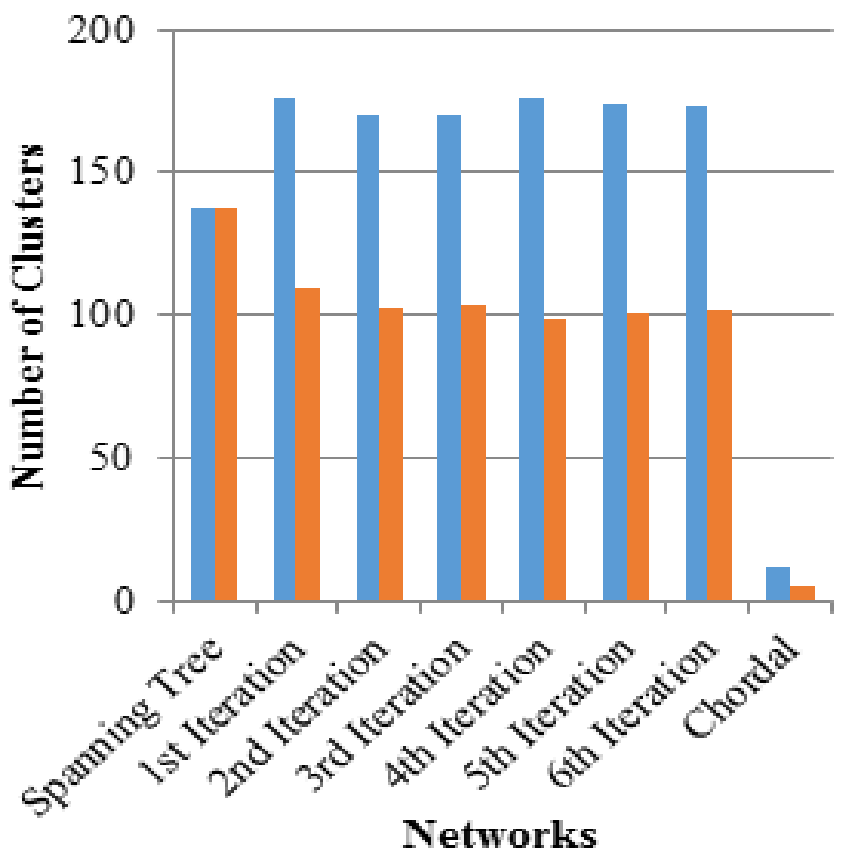 Fig 2: Novel clusters uncovered by the filters. Blue indicates biologically significant (enriched) clusters, showing that the filters are not creating random structures.
The Hub Paradox
While the filters excelled at clusters, the "hub" analysis (identifying essential genes) was more complex. The iterative process tended to smooth out the Scale-Free properties of the network—meaning the "hubs" became less distinct from "non-hubs." This suggests that while chordal filters are elite for finding functional modules, we might still need spanning trees to identify lethal master-regulator genes.
Critical Analysis & Future Directions
The paper successfully demonstrates that structural graph theory can be used as a proxy for biological relevance. By focusing on chordal subgraphs, we gain the benefit of "Perfect Graphs," where complex problems like Maximum Clique Discovery become computationally feasible (polynomial time).
Limitations:
- The loss of scale-free properties is a concern for researchers specifically interested in network topology and robustness.
- The human dataset was hampered by incomplete "essential gene" databases, making the hub analysis inconclusive for complex organisms.
The Takeaway: For bioinformaticians dealing with "hairball" networks, switching from a single-filter approach to an incremental spectral filter allows for a tunable trade-off between hub preservation and cluster discovery.
Conclusion
This work sets a foundation for domain-specific filters. Rather than treating all edges as equal, we can use the iterative addition of motifs (like triangles or 4-node loops) to distill a noisy correlation graph into its functional biological essence.