
From Six to Four: Re-verifying the Small World Theory in the Age of Facebook
Using graph theory to re-verify the small world theory in an online social network word
This paper re-evaluates the "Small World Theory" using modern Graph Theory on the Facebook platform. By analyzing a dataset of over 150,000 users in Taiwan, the authors propose that the traditional "Six Degrees of Separation" has shrunk to approximately four degrees in the digital age.
TL;DR
Is the world truly getting smaller? While Stanley Milgram’s 1967 experiment suggested we are all six steps away from any stranger, new research utilizing a massive Facebook dataset and graph theory proves that the "Six Degrees of Separation" has officially shrunk. By analyzing over 150,000 users, researchers found that we are now, on average, only four degrees apart.
The Evolution of Social Distance
For decades, the "Six Degrees of Separation" was a cultural staple—the idea that any two people on Earth could be connected through a chain of five intermediaries. However, Milgram's original experiment had its critics, citing small sample sizes and the physical limitations of sending letters.
With the advent of platforms like Facebook, social structures have undergone a fundamental transformation. The authors of this study argue that the massive influence of the internet and the sheer number of digital relationships (far exceeding the traditional "Dunbar's Number" of 150) necessitate a re-verification of this classic theory.
Methodology: The "We R So Close" System
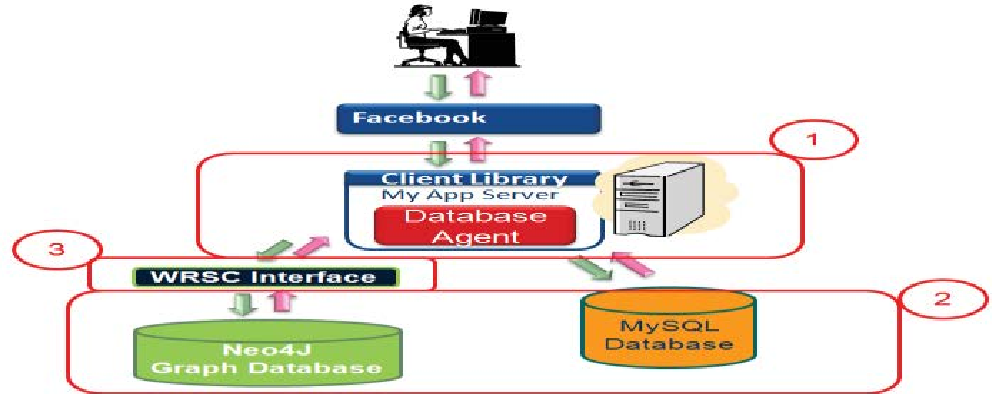
To test this, the researchers built an integrated system called "We R So Close" (WRSC). The architecture is a sophisticated blend of social application and graph analytics:
- Data Collection: A Facebook iFrame application gathered user information including education and profession.
- Graph Engine: The system utilized Neo4j, a graph database, to store nodes (users) and edges (friendships). Unlike traditional SQL databases, Neo4j allows for near-instant computation of the shortest paths between any two individuals.
- Hybrid Architecture: A "Database Agent" coordinated data flow between MySQL (for logs) and Neo4j (for relationship mapping).
Key Findings: Our World is Now a "Four-Degree" World
The study processed data from 150,000 users, covering approximately 70% of the Facebook population in the target region (Taiwan).
1. The Shrinking Path
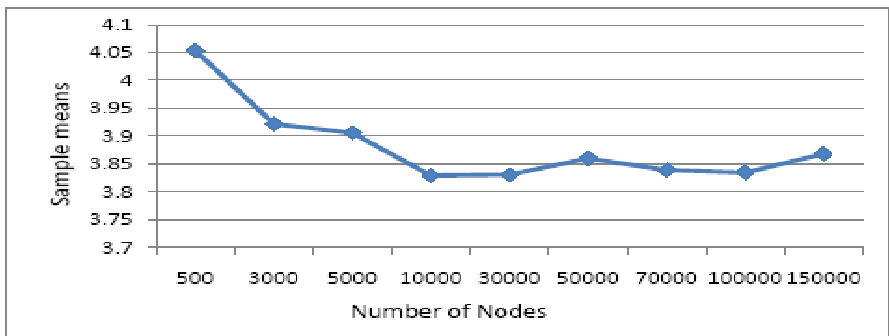
The results were startling. As the population size in the database grew, the average degree of separation reached a plateau between 3.82 and 3.86. This suggests that in a modern social network, you are usually just three intermediaries away from anyone else.
2. High Clustering (The "Friend of a Friend" Effect)
The researchers found a clustering coefficient of 0.427, meaning roughly 40% of your friends also know each other. This high clustering is a hallmark of "Small World" networks, distinguishing them from random networks where the clustering would be significantly lower.
3. The Power of "High-Degree" Nodes
What makes the world so small? The authors performed an ablation study by removing "Influencers" (nodes with >1000 friends). When these high-degree nodes were removed, the average path length increased significantly. These "Super-connectors" act as the bridges of the internet, drastically reducing the hop count between disparate social groups.
Deep Insight: Rare Features Don't Mean Long Distances
One of the most impressive parts of the research was the "Advanced Analysis" on rare professions. You might think reaching a "Nuclear Physicist" or a "Deep Sea Diver" would take many more steps than reaching a "clerk."
Surprisingly, the study found that even for the rarest 0.1% of professions, the average degree of separation remained between 3 and 4. Social networks are so dense that even niche professional silos are only a few clicks away.
Conclusion and Future Outlook
The transition from Six Degrees to Four Degrees isn't just a mathematical curiosity; it has profound implications for:
- Information Virality: Content can spread faster and more efficiently than ever before.
- Networking Services: Future platforms can use these "short paths" to connect talent with opportunity more accurately.
While this study focused on the Taiwanese Facebook ecosystem, the authors posit that this "Four Degrees" rule likely applies globally. As we become more digitally intertwined, the distance between us continues to collapse, proving that it is indeed a very small world.
Takeaway: If you want to find someone, they are likely just three intermediates away. The challenge is no longer the distance, but identifying the right path.