
GTNs: Transmuting Graph Structure for End-to-End Representation Learning
Graph Transformer Networks
This paper introduces Graph Transformer Networks (GTNs), a novel framework for representation learning on heterogeneous graphs. Unlike traditional GNNs that operate on fixed structures, GTNs automatically learn to generate new graph structures (meta-paths) and optimize node embeddings in an end-to-end fashion, achieving SOTA results on DBLP, ACM, and IMDB benchmarks.
TL;DR
Graph Transformer Networks (GTNs) address the rigidity of traditional GNNs by learning to generate the most useful graph structures (meta-paths) for a specific task. By treating the graph adjacency matrix as a learnable parameter through soft selection and matrix composition, GTNs outperform models that rely on expert-defined rules, setting new benchmarks for node classification on heterogeneous graphs.
The "Fixed Graph" Fallacy
In the world of Graph Neural Networks (GNNs), we often treat the input graph as "ground truth." Whether it's a citation network or a social graph, we assume the provided edges are the only ones that matter. However, this is problematic for two reasons:
- Heterogeneity: Real-world graphs (like IMDB or DBLP) have different types of nodes (Authors, Papers, Directors) and edges. Standard GCNs flatten this richness into a homogeneous blur.
- Missing Links: The most predictive relationship might not be a direct edge, but a "multi-hop" connection (e.g., "Authors who publish in the same Conference").
Prior works like HAN (Heterogeneous Graph Attention Network) tried to solve this by using meta-paths. But there was a catch: humans had to manually define these paths. If you didn't pick the "right" sequence of relations, your model's performance capped out.
Methodology: The Graph Transformer Layer
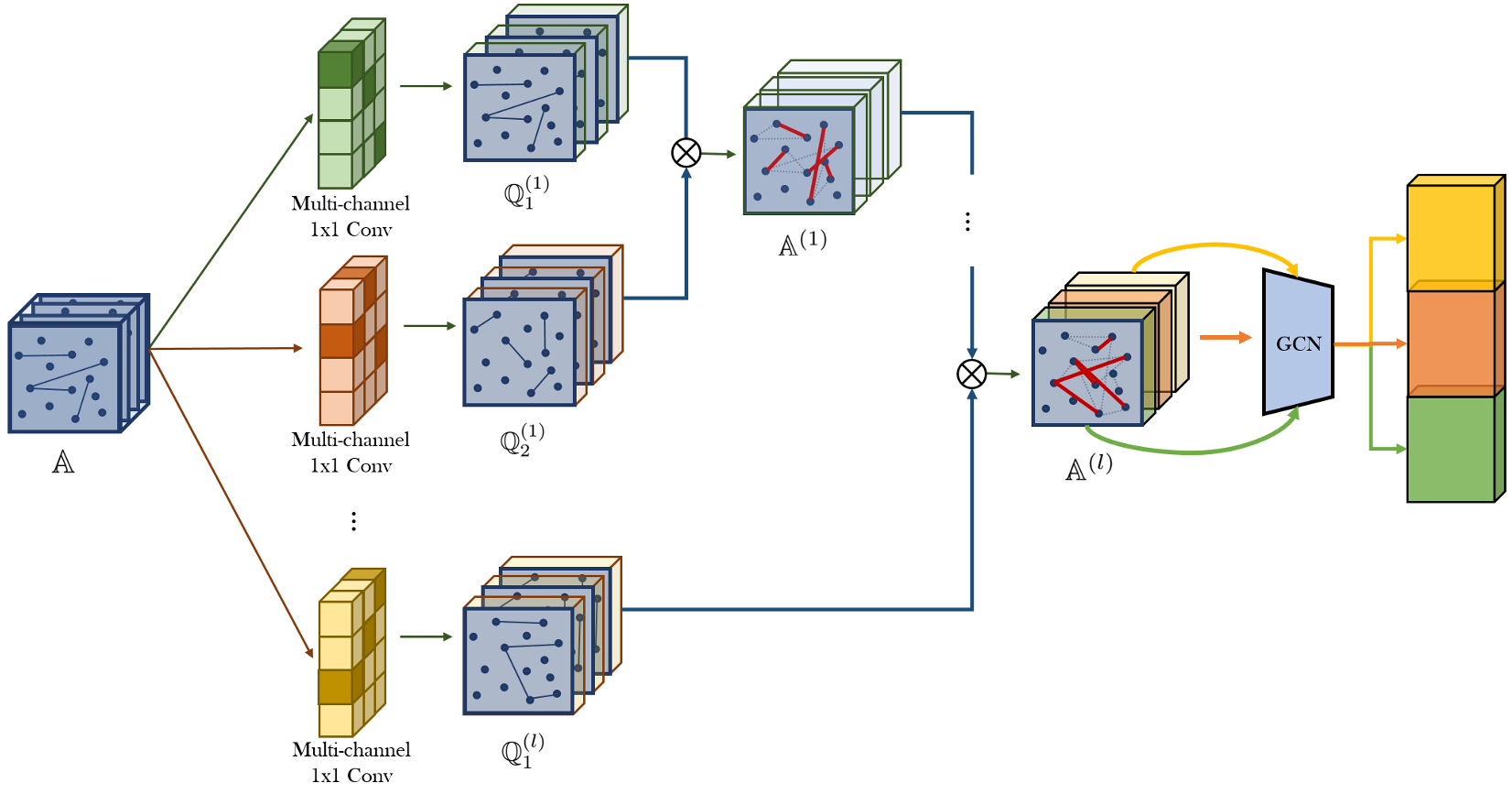
The authors propose a "Graph Transformer (GT) Layer" that acts as a graph analogue to the Spatial Transformer Network in CV. It doesn't just attend to neighbors; it rewrites the adjacency matrix.
1. Soft Selection of Edge Types
The GT layer takes a set of candidate adjacency matrices (one for each edge type). It applies a convolution (channel-wise attention) followed by a Softmax to "softly select" which edge types are important for the current step.
2. Composition via Matrix Multiplication
To create a meta-path, the layer performs matrix multiplication between two softly selected matrices ( and ). Mathematically, if represents "Author-Paper" and represents "Paper-Conference," then represents the meta-path "Author-Paper-Conference."
3. Stacking for Depth and Identity
By stacking GT layers, the model can learn meta-paths of length . Crucially, the authors include the Identity Matrix () in the candidate set. This allows the model to "skip" a composition step, effectively learning meta-paths of variable lengths—shorter than the maximum depth of the network.
Experimental Triumphs
The model was tested on three major heterogeneous datasets: DBLP, ACM, and IMDB.
| Dataset | GAT | HAN (Manual Meta-paths) | GTN (Ours) |
|---|---|---|---|
| DBLP | 93.71 | 92.83 | 94.18 |
| ACM | 92.33 | 90.96 | 92.68 |
| IMDB | 58.14 | 56.77 | 60.92 |
The results reveal a striking insight: GTN often learns better meta-paths than domestic experts. In DBLP, GTN identified CPCPA (Conference-Paper-Conference-Paper-Author) as a highly weighted path, a complex relation rarely used in manual configurations.
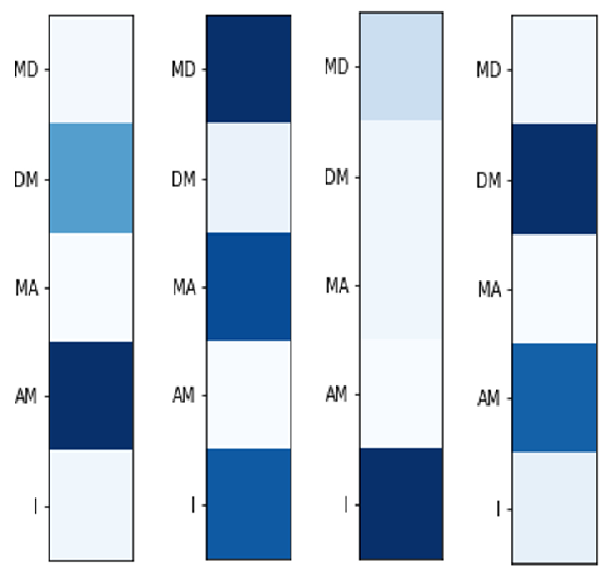 Figure: Attention scores show that for IMDB, the model relies more on the Identity matrix to maintain shorter, more effective meta-paths (like Movie-Director-Movie).
Critical Analysis & Takeaways
The brilliance of GTNs lies in their interpretability. By examining the attention weights in the GT layers, researchers can "see" which meta-paths the model synthesized. This turns the GNN from a black box into a discovery tool for relational patterns.
Limitations:
- Computational Complexity: Matrix multiplication of large, dense adjacency matrices is expensive. While the paper uses sparse operations, scaling to graphs with millions of nodes remains a challenge.
- Backbone Dependency: The paper primarily uses GCN as the final embedding aggregator; future work could explore more powerful aggregators like GIN.
Conclusion: Graph Transformer Networks prove that we shouldn't take graph topology as a given. In heterogeneous domains, the "best" graph is often a latent structure waiting to be learned.