
GST: Mastering Crowds through Graphical Social Topology in RGB-D Tracking
A Graphical Social Topology Model for RGB-D Multi-Person Tracking
The paper introduces a Graphical Social Topology (GST) model for Multi-Person Tracking (MPT) in both RGB and RGB-D domains. By jointly modeling group structures and individual states through a dynamic graph representation, it achieves SOTA performance on datasets like MOT15/16/17 and various RGB-D benchmarks.
TL;DR
Tracking multiple people in a crowded mall or busy street is a nightmare for standard algorithms because people constantly block each other (occlusion). This paper introduces Graphical Social Topology (GST)—a method that doesn't just look at individuals, but models how they move together as a "social unit." By treating group members as nodes in a graph, the tracker can "guess" where a hidden person is based on the movement of their friends.
The Problem: The Invisible Pedestrian
Most Multi-Object Tracking (MOT) systems focus on "The Appearance": What does this person look like? While effective in sparse scenes, this fails in crowds where:
- Severe Occlusion: A person might be 90% hidden behind someone else for seconds.
- Erratic Motion: Crowds have complex dynamics (merging, splitting, stopping).
- Data Loss: Traditional detectors often discard "noisy" data that actually contains occluded targets.
Prior works attempted "Grouping," but they were often static. They couldn't handle a group of three friends splitting into two, or a stranger briefly walking alongside a group.
Methodology: The Social Graph
The core innovation is the Graphical Social Topology (GST) model. It's essentially a "smart" graph that evolves in real-time.
1. Defining Social Affinity
The system calculates a Social Affinity Matrix (T) based on four pillars:
- Distance: Are they close enough to be talking/interacting?
- Time: Did they enter the camera's view together?
- Speed & Orientation: Are they walking toward the same goal at the same pace?
2. Group Management (The Evolution)
Unlike static clusters, GST uses a modular approach to group life-cycles:
- Birth: Identifying a new social unit based on learned patterns (e.g., "Star" or "Compact" topologies).
- Merge & Split: Using "Compactness" constraints to decide if two groups have truly joined or if a person has left a group.
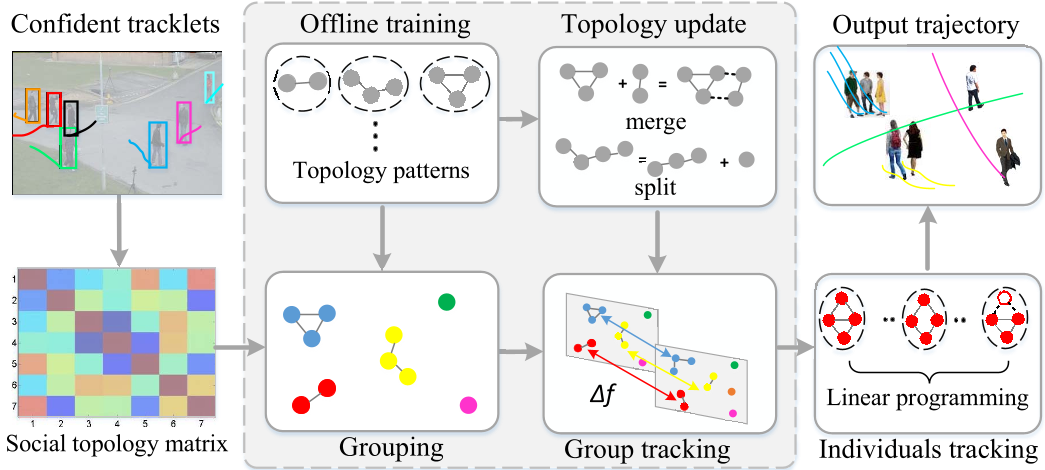 Figure 1: The GST tracking framework, showing the transition from RGB-D data to social topology modeling.
3. Virtual Nodes: Tracking the "Unseen"
When a group member disappears from the camera's view (total occlusion), GST doesn't give up. It creates a Virtual Node. Because the topology of the group is "Consistent," the system predicts the occluded person's position based on the relative offsets of the visible members.
Experimental Results: SOTA Performance
The researchers tested GST across a variety of environments, from university halls (Kinect) to outdoor traffic scenes (LIDAR/Stereo).
- Indoor (Kinect): GST improved the state-of-the-art MOTA (Multi-Object Tracking Accuracy) by 3%.
- Outdoor (LIPD/SDL): By leveraging Depth information within the GST model, they saw a 7% boost in Recall over RGB-only methods.
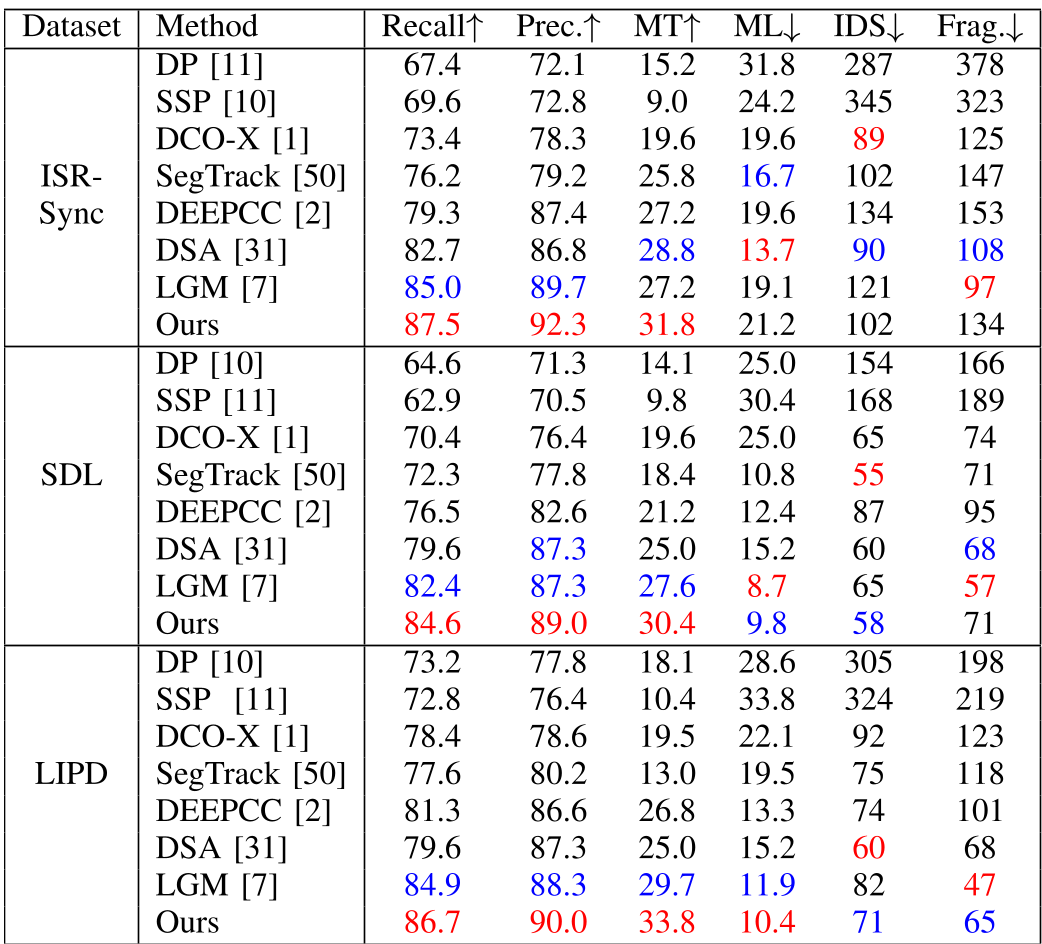 Table 1: Quantitative results showing GST outperforming baselines like DeepCC and LGM across multiple outdoor datasets.
The "Occlusion" Stress Test
In the PETS09 dataset (a famous tracking benchmark), GST successfully maintained ID consistency where even Re-Identification (ReID) methods sometimes failed. By "knowing" that person A is usually on the left of person B, the tracker avoids "ID Switches" when they emerge from behind a pillar.
Critical Insight: Why it Works
The beauty of GST lies in its Inductive Bias. It assumes humans are social animals. In a crowd, you are rarely a "randomly moving point"; you are usually part of a flow. By mathematically encoding this "flow" as a graph with properties of Compactness and Consistency, the tracker significantly reduces the search space for data association.
Conclusion & Future Work
GST proves that Social Context is not just a high-level behavioral concept, but a low-level tracking tool. While the current model relies on traditional feature extractors (HOGC/HOD), the authors suggest that replacing these with CNN-based appearance descriptors could make the system even more robust.
For the robotics industry, this model is a step toward robots that don't just "see" people, but "understand" the social structure of the crowds they navigate.