
GraphSE2: Solving the Privacy-Performance Paradox in Social Search
GraphSE$^2$: An Encrypted Graph Database for Privacy-Preserving Social Search
This paper introduces GraphSE2, the first encrypted graph database optimized for privacy-preserving social search. It leverages a combination of Oblivious Cross-Tags (OXT) and mixed MPC protocols (Additive Sharing + Garbled Circuits) to enable complex queries over a million-user social graph with practical latency.
TL;DR
GraphSE2 is a pioneering encrypted graph database designed specifically for Online Social Networks (OSNs). By decomposing complex queries into atomic cryptographic tasks and utilizing a distributed, sharded architecture, it allows users to perform "friend-of-friend" searches and personalized rankings over millions of encrypted records with sub-second latency.
The Motivation: Why Encrypting a Social Graph is Hard
Data breaches in OSNs (like Facebook or LinkedIn) are catastrophic because social data is highly relational. If you encrypt everything to prevent leaks, you break the very feature that makes social networks useful: Social Search.
Traditional social search isn't just about finding a keyword; it's about:
- Graph Traversal: Finding people connected to you.
- Set Operations: Finding friends of friends who also like a specific interest.
- Ranking/Scoring: Sorting those results by relevance or similarity.
Prior solutions were either too slow (Generic Garbled Circuits take minutes to sort small lists) or too limited (standard SSE only supports basic keyword matching).
Methodology: The "Decompose and Mix" Strategy
The core insight of the GraphSE2 authors is that no single cryptographic primitive is a silver bullet. Instead, they built a hybrid system using a 2-cluster, non-colluding server model.
1. Distributed Encrypted Graph Model
GraphSE2 shards the social graph across multiple servers. It uses OXT (Oblivious Cross-Tags), a specialized Searchable Symmetric Encryption (SSE) protocol, to handle "Index Access" and "Set Operations" (AND, OR, Difference) in parallel.
2. Hybrid MPC for Scoring
To handle the "Ranking" part of social search—where items need to be scored and sorted—the system switches gears:
- Additive Secret Sharing: Used for high-speed arithmetic (adding up scores) without interaction.
- Yao’s Garbled Circuits (GC): Used specifically for sorting the results. Since GC is expensive, they only use it for the final ranking step after the candidate list has been pruned by the SSE search.
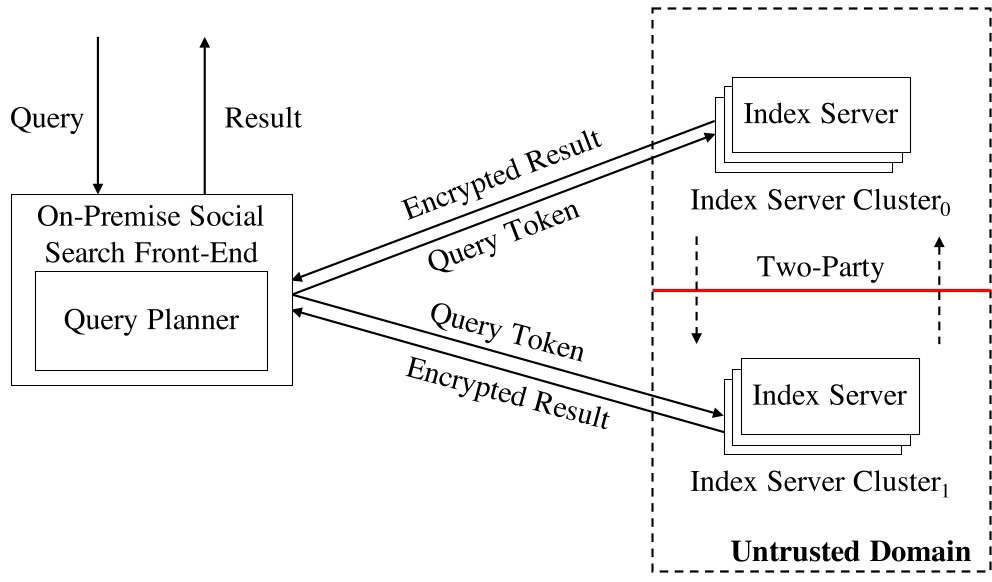 Figure 1: The GraphSE2 architecture featuring the Query Planner and two non-colluding Index Server Clusters (ISCs).
Key Implementation Detail: The 'Apply' Operator
One of the most impressive features is the implementation of the apply operator (inspired by Facebook’s Unicorn engine). It allows for multi-hop graph traversal (e.g., "Find friends of my friends who like Jazz"). GraphSE2 manages this by executing nested queries and using intermediate results to construct secondary queries, all while keeping the user IDs and relationships hidden from the cloud provider.
Experiments & SOTA Results
The authors tested GraphSE2 on a real-world YouTube dataset with 1.1 million nodes and 5 million edges.
- Latency: A typical "Boolean Query" (intersection of two friend lists) takes only 20ms.
- Throughput: Even with the overhead of Garbled Circuits for sorting, the system maintains nearly 50% of the throughput of a completely unencrypted baseline.
- Scalability: The system scales linearly. As you add more Index Servers, the processing time for massive posting lists stays manageable.
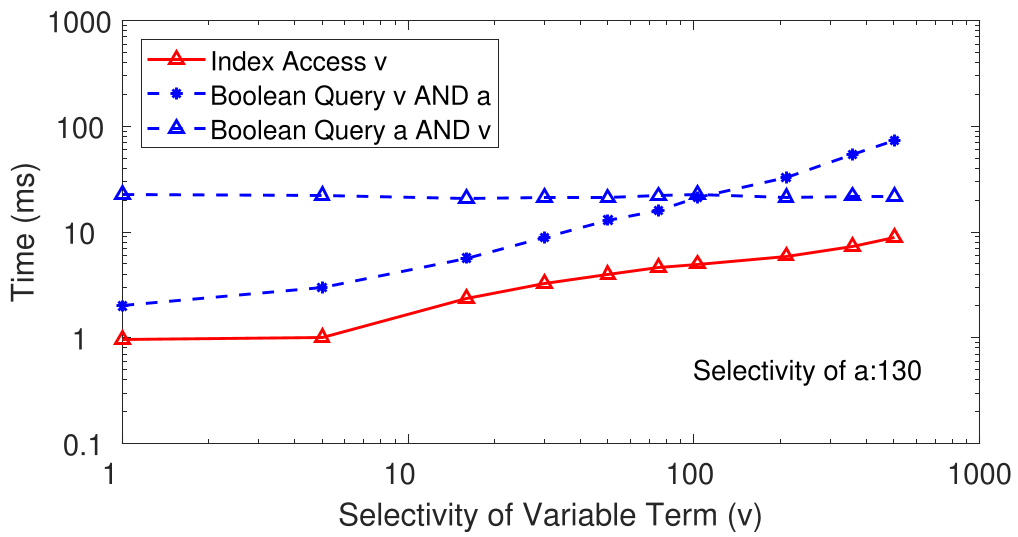 Figure 2: Query delay analysis showing the efficiency of Index Access and Boolean Queries.
Critical Insights & Future Outlook
GraphSE2 proves that we don't have to sacrifice OSN functionality for privacy. However, a few academic "elephants in the room" remain:
- Leakage Profiles: Like all SSE systems, GraphSE2 leaks "access patterns"—the server knows which encrypted records were accessed. While this is a standard trade-off for speed, future work could integrate "Oblivious RAM" (ORAM) to hide these patterns, though at a significant speed cost.
- The Non-Collusion Assumption: The security relies on the two server clusters not conspiring. In a public cloud context, this usually means using two different providers (e.g., AWS and Azure).
Conclusion: GraphSE2 is a masterclass in pragmatic security engineering. It moves away from the "theoretical perfection" of Fully Homomorphic Encryption toward a "function-specific encryption" model that can actually handle the scale of today's social web.