
Beyond the Tyranny of the Norm: Designing Information Systems for the Permaculture Movement
14153_Implications of Grassroots Sustainable Agriculture Community Values on the Design of Information Systems.
Summary
Problem
Method
Results
Takeaways
Abstract
This research presents a five-year ethnographic study of two grassroots permaculture communities, exploring how their core ethics—earth care, fair share, and people care—influence their interaction with information systems. It identifies a unique "ambivalent" relationship with technology and proposes design implications for sustainable, resilient food infrastructures.
## TL;DR
While most of the tech world is obsessed with "faster, newer, and more connected," a growing movement of grassroots agriculturalists is asking for exactly the opposite. This paper explores a five-year study into **permaculture communities**, revealing how their core ethics—earth care and fair share—demand a radical rethinking of HCI. Instead of ubiquitous computing, these users want **selective use, self-obviating tools, and systems that can survive a societal collapse.**
## The Motivation: When Tech Clashes with Values
The authors point to a fundamental friction in modern Information Systems (IS): designers often unwittingly embed values of consumerism and extractivism into their products. For a permaculture "permie," a smartphone is not just a tool; it is a bundle of coltan (mined at great human and ecological cost), non-renewable energy consumption, and a distraction from the physical environment.
The problem is **"reverse adaptation"**—where users are forced to change their sustainable lifestyles just to fit the "tyranny of the norm" in digital communication. This research seeks to bridge the gap by asking: *How do we design for a community that is fundamentally ambivalent about the existence of the technology itself?*
## Methodology: Mapping the "Permie" Mindset
The researchers engaged in **observant participation**, a deep-dive version of ethnography where the researcher becomes an active member of the community. They studied two groups: **Live Oak** and **Manzanita**.
### The Value Framework
The study identified three unexpected value sets that govern these communities:
1. **Technology Values**: Favoring "selective non-use." Participants often turned phones off or used legacy hardware to reduce e-waste and maintain face-to-face social bonds.
2. **Long-term Values**: A focus on **"Regenerative Design"**—the idea that infrastructure should function like an ecosystem, capable of evolving over generations.
3. **Resistance Values**: Many engage in **"quotidian insubordination"** (everyday resistance), such as guerrilla gardening or trading services to bypass capitalist financial sectors.
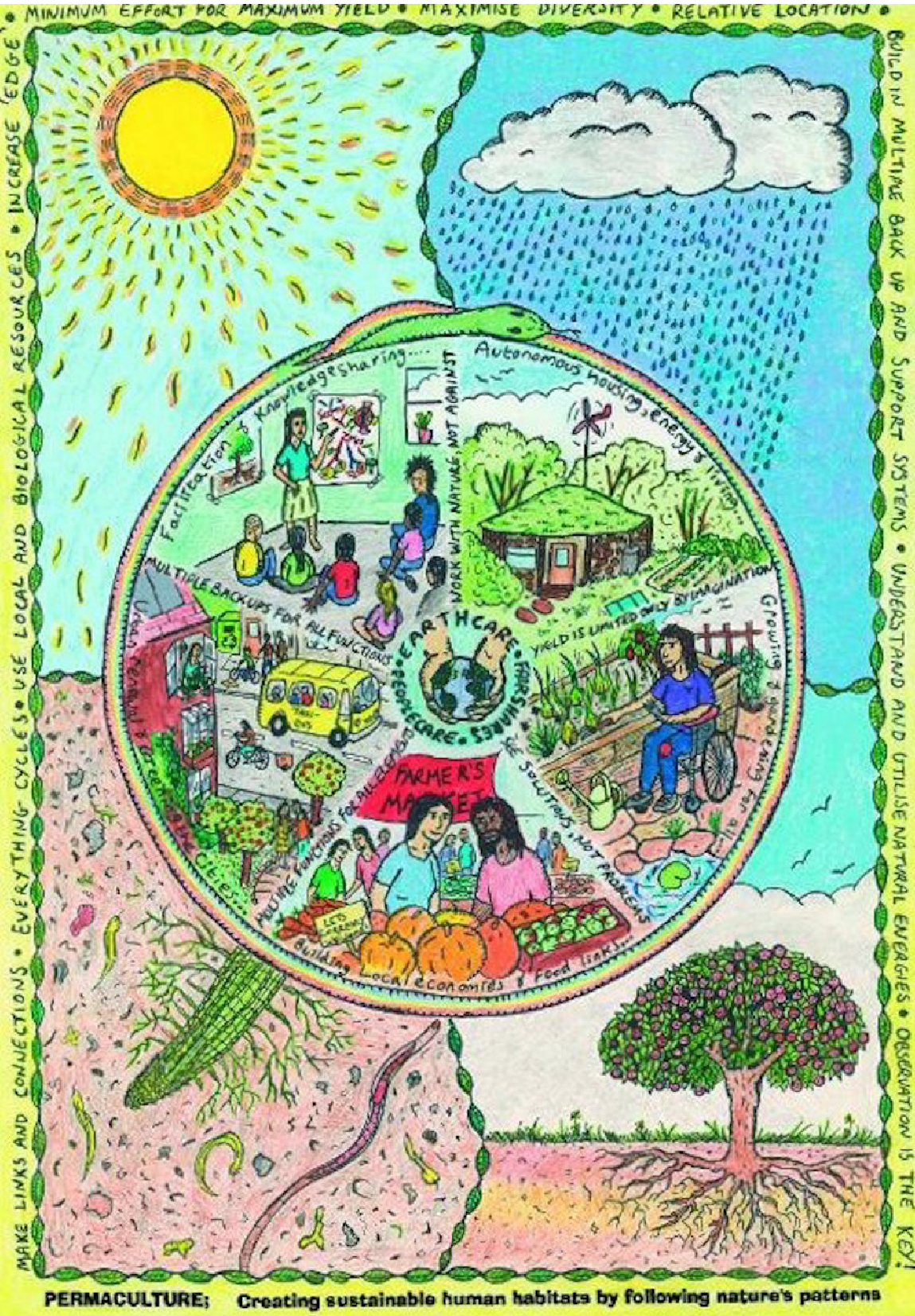
*Figure 1: The Permaculture Mandala, emphasizing the integration of nature, technology, and community.*
## Core Insights: Designing for "Limits"
The paper challenges the HCI community to move sustainable agriculture values into the mainstream. They suggest three radical shifts in design:
### 1. Sociotechnical Refactoring
Just as programmers refactor code to make it efficient, we should "refactor" sociotechnical systems to limit external inputs. A permaculture-friendly app shouldn't rely on massive cloud servers if a local, offline-first database would suffice.
### 2. Self-Obviating Systems
The ultimate goal of a tool for sustainability should be to **render itself unnecessary**. For example, a system that teaches people how to save seeds should eventually be replaced by the community's own shared oral and physical knowledge.
### 3. Anonymity and Resistance
Since some permaculture activities (like planting on fallow public land) are technically illegal "insubordinations," information systems must support **anonymity and privacy** to protect activists from institutional retaliation.

*Table: Key implications for IS design derived from community values.*
## Experiments & Conceptual Tools
The authors didn't just theorize; they conceptualized a **suite of tools** for the year 2045:
* **A Regenerative Plant Database**: Unlike a static Wikipedia, this tool uses an ontology derived from ecosystem services (how plants help each other) and is designed to work offline in remote fields.
* **Neighborhood Coordination Tool**: A platform for "zoophily" (animal pollination) coordination and localized trading, bypassing the established economic models.
## Conclusion: A Future of Scarcity and Resilience
The ethics of permaculture offer a "Grand Challenge" for the next generation of developers. As we face a future of resource limitations and potential climate disruption, the "permie" lifestyle—once seen as fringe—becomes a blueprint for **resilient computing**.
**Key Takeaway**: If a system cannot survive without high-speed internet, proprietary hardware, and constant power, it is not truly sustainable. The future of HCI may lie in building tools that are "open," "local," and "minimal," helping us transition from an industrial society to a regenerative one.
***
**Limitations**: The study is localized to high-income regions (USA), and the researchers acknowledge that "selective non-use" is a privilege not available to subsistence farmers in developing nations. Future work must bridge these socio-economic divides.