
Hyperbolic Forwarding: The Hidden Geometry of Mobile Social Networks
Greedy forwarding for mobile social networks embedded in hyperbolic spaces
This paper introduces a novel greedy forwarding algorithm for Mobile Social Networks (MSNs) by embedding nodes into a 2D hyperbolic space. By leveraging the topological similarity between hyperbolic geometry and scale-free networks, the method achieves high message delivery ratios with minimal overhead, providing a theoretical foundation for existing social-based heuristics like BUBBLE Rap.
TL;DR
This research tackles the challenge of message routing in Mobile Social Networks (MSNs) by moving away from flat Euclidean geometry. By embedding mobile users into a 2D Hyperbolic Space, the author demonstrates that a simple "greedy" algorithm—usually ineffective in standard networks—can achieve near-optimal performance. This approach provides the first strong theoretical intuition for why popular social-based routing protocols like BUBBLE Rap actually work.
Problem & Motivation
Routing messages between mobile devices (carried by humans) is notoriously difficult because connections are intermittent and unpredictable. Most existing protocols rely on contact history or social heuristics (like community membership).
The author's core insight is that mobile social networks are scale-free. In such networks, a few "hub" nodes have many connections, while most have few. Euclidean space (the flat world we see on maps) is too "small" to fit the exponential expansion of these networks. Hyperbolic space, however, expands exponentially, making it a natural fit for the hierarchical and scale-free nature of human social structures.
Methodology: Mapping the Social Universe
The methodology consists of three distinct phases:
1. The Hyperbolic Model
The paper adopts a model where nodes are distributed in a hyperbolic disk. The probability of two nodes connecting depends on their hyperbolic distance .
2. Maximum Likelihood Estimation (MLE)
To map real-world data (like the "Reality" trace) into this space, the author uses a Metropolis-Hastings algorithm. It treats the contact probabilities between people as a graph and searches for the optimal coordinates that make the observed contact history most likely under the hyperbolic model.
3. Greedy Forwarding
Once embedded, the routing is simple: when a node has a message, it looks at its current neighbors and passes the message to the one "closest" to the destination in the hyperbolic sense.
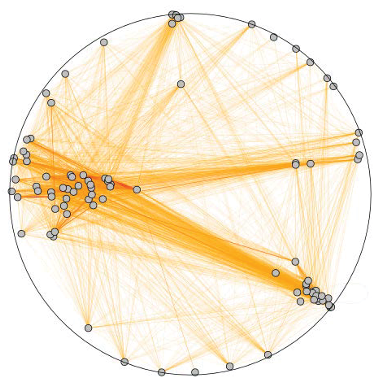 Figure 1: The Poincare disk model. Even though edges look different lengths, they represent equal distances in hyperbolic space, effectively allowing for "more room" at the periphery.
Experiments & Results
The author tested the algorithm using the Reality Mining dataset.
- Visualization: The embedding revealed distinct social communities. "Hot nodes" (people with high social centrality) were automatically pushed toward the center of the disk (), while less social individuals lived on the "rim."
- Efficiency: The forwarding path naturally moved from local popular nodes to global hubs, and then down to the destination's local community.
- Performance: As shown in the results, the success ratio significantly outperformed simple "Hold" strategies, reaching high delivery rates with a fraction of the overhead required by "Flooding."
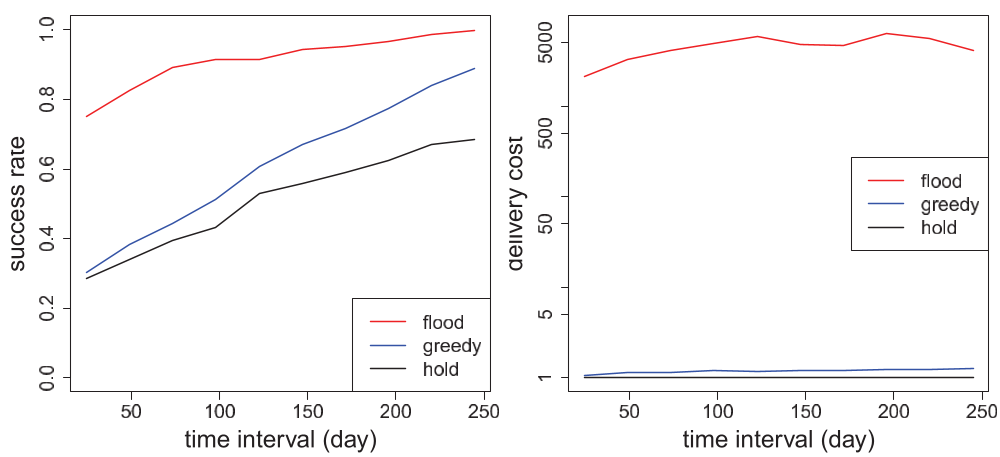 Figure 2: Performance comparison. The greedy hyperbolic approach balances high delivery success with low message duplication cost.
Critical Analysis & Conclusion
The true value of this work is theoretical unification. By showing that greedy forwarding works in hyperbolic space, the author explains the success of BUBBLE Rap. BUBBLE Rap uses "Centrality" and "Community"—these are essentially just proxies for the radial () and angular () coordinates in a hyperbolic plane.
Limitations:
- The MLE fitting process is computationally expensive, which might be difficult for resource-constrained mobile devices to perform in real-time.
- The model assumes a degree of stability in social structures that may not hold in highly volatile environments.
Future Outlook: This work opens the door for "Geometric Routing" in diverse fields, from content-centric networking to viral marketing analysis, proving that often, the best way to solve a network problem is to change the space you're looking at.