
Making the ‘Green Revolution’ Truly Green: The Molecular Blueprint for Sustainable Rice
Making the ‘Green Revolution’ Truly Green: Improving Crop Nitrogen Use Efficiency
This review highlights recent breakthroughs in rice Nitrogen Use Efficiency (NUE), specifically focusing on genes like GRF4, NRT1.1B, and OsTCP19. It details a paradigm shift from the fertilizer-heavy Green Revolution to a "Truly Green" agricultural model that integrates phytohormone signaling with nutrient management to achieve high yields with low nitrogen input.
TL;DR
The 20th-century Green Revolution saved billions from hunger but left a toxic legacy: an over-reliance on chemical fertilizers. This paper reviews the molecular breakthrough that explains why traditional high-yield rice has poor Nitrogen Use Efficiency (NUE) and outlines how genes like GRF4, NRT1.1B, and OsTCP19 can be used to engineer a "New Green Revolution" that delivers high yields with minimal environmental impact.
The "Not-So-Green" Paradox
The success of the original Green Revolution was built on the sd-1 gene, which creates semi-dwarf rice. While these shorter plants are resistant to lodging (falling over), they are physiologically "addicted" to nitrogen. The GA deficiency that keeps them short also makes them insensitive to nitrogen, requiring massive fertilizer inputs to achieve their yield potential. Breaking this link is the "Holy Grail" of modern agricultural science.
Methodology: Reconnecting Growth and Metabolism
The authors identify three pivotal genetic axes that re-wire the plant's internal signaling:
1. The GRF4-DELLA Balance
In traditional semi-dwarf varieties, the growth-suppressing DELLA protein accumulates, which inhibits GRF4 (Growth Regulating Factor 4). By increasing GRF4 abundance, researchers found they could "ignore" the inhibitory effects of DELLA, allowing the plant to absorb nitrogen and carbon efficiently while remaining short.
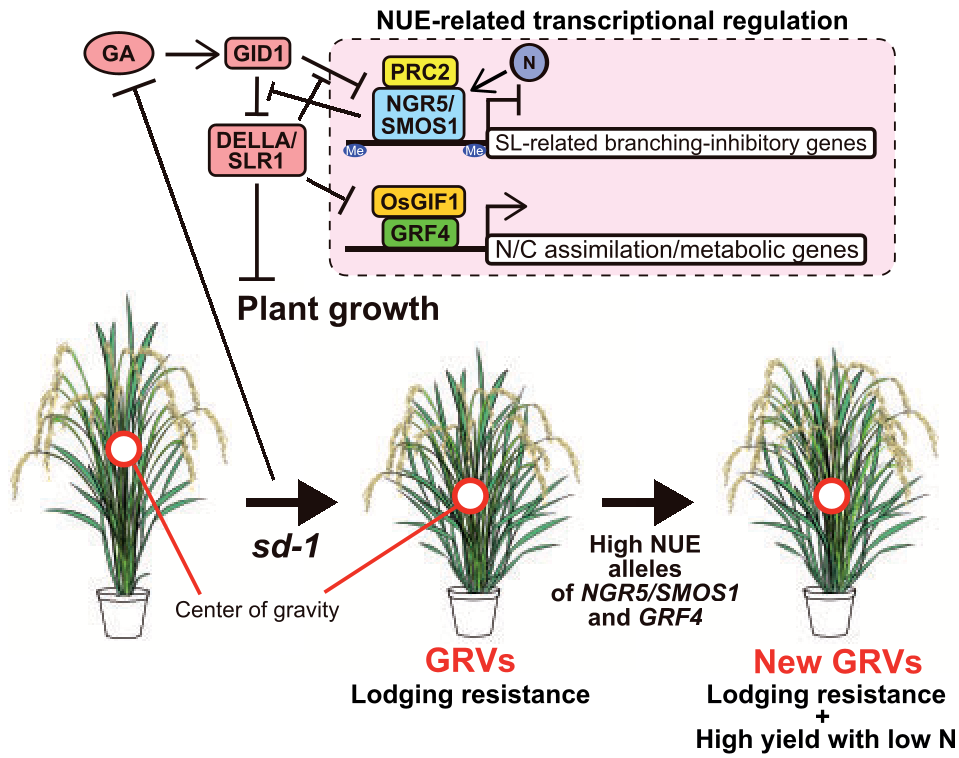 Fig 1. Schematic showing how new alleles like GRF4 and NGR5 interact with traditional semi-dwarf pathways to boost NUE.
2. The NRT1.1B Signaling Cascade
Beyond simple transport, NRT1.1B acts as a sensor. It initiates a molecular cascade (NRT1.1B-SPX4-NLP3) that coordinates how the plant responds to both nitrogen and phosphorus. This discovery is crucial because it explains the physiological divergence between indica (high NUE) and japonica (low NUE) rice sub-species.
3. Geographical Adaptation and OsTCP19
By looking at "landraces" (traditional varieties) from nitrogen-poor regions, researchers at Nagoya University discovered OsTCP19. This gene allows plants to sense soil fertility and adjust their "tillering" (branching) accordingly. Most modern varieties have lost the high-efficiency version (H-haplotype) of this gene due to decades of breeding in fertilizer-rich environments.
Experiments and Results: Quantifiable Gains
The results of manipulating these genetic pathways are staggering:
- Yield & NUE Boost: Introgressing the indica NRT1.1B allele into japonica rice increased values by ~30%.
- Early Maturation: Overexpression of NRT1.1A didn't just increase NUE by 50%; it shortened the maturation period by 18 days, allowing for more flexible crop rotations.
- Soil Adaptation: Plants with the OsTCP19 H-haplotype maintained high tiller numbers even in nitrogen-deficient soils, a trait vital for sustainable farming.
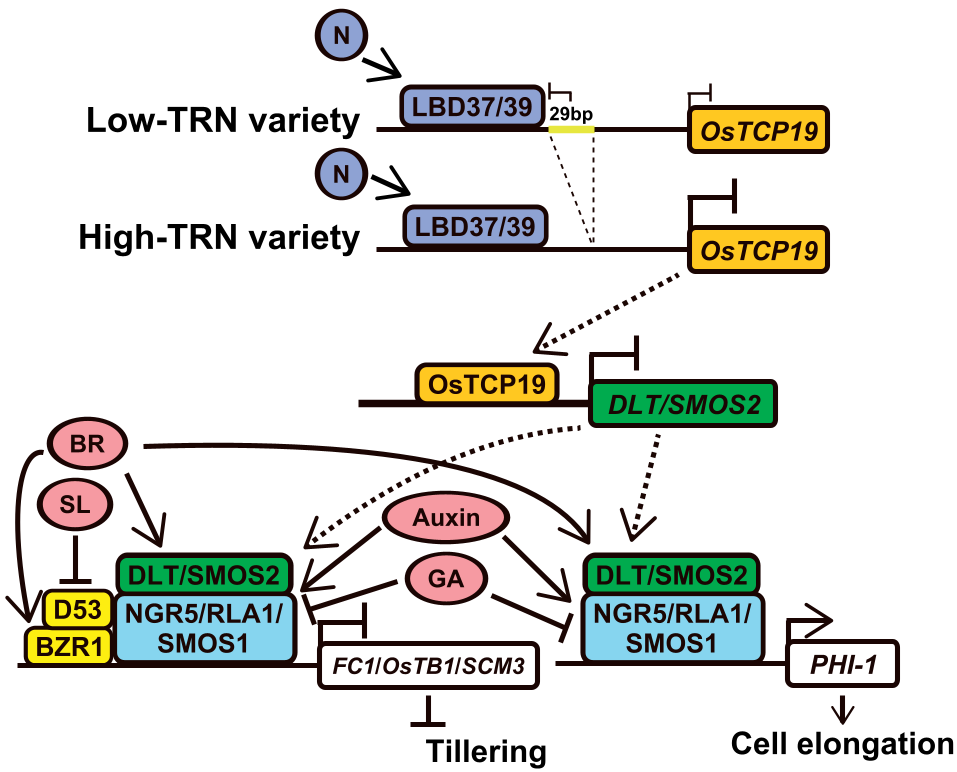 Fig 2. The complex crosstalk between nitrogen sensing and phytohormones like Brassinosteroids (BR) and Strigolactones (SL).
Critical Insight: Looking Back to Move Forward
The most profound takeaway from this review is the concept of "Genetic Erosion." In our quest for high yields during the 1960s, we accidentally discarded the genetic tools that allow rice to thrive in poor soils.
Future Outlook: The next generation of rice won't just be semi-dwarf; it will be "smart." By stacking (pyramiding) alleles like GRF4, NRT1.1B, and OsTCP19, we can create varieties that are inherently efficient. However, the challenge remains in translating these laboratory breakthroughs into stable field performance across diverse global climates.
Conclusion
To make the Green Revolution truly green, we must bridge the gap between plant physiology and genomic diversity. By cherishing the "old knowledge" found in wild landraces and applying "new knowledge" of molecular signaling, we can secure global food supplies without destroying our ecosystems.