
DELLA Proteins: The Multi-Tasking Architects of the Green Revolution
Green Revolution DELLA Proteins_ Functional Analysis and Regulatory Mechanisms(科研通-ablesci.com)
This review provides a comprehensive analysis of DELLA proteins—the "Green Revolution" genes—as master growth regulators in plants. It details the evolution of the GA-GID1-DELLA signaling module and elucidates how DELLAs function as transcriptional hubs by interacting with hundreds of transcription factors to coordinate growth, defense, and developmental transitions.
TL;DR
DELLA proteins, famous for their role in the Green Revolution, are far more than just "brakes" on plant growth. This deep-dive review reveals them as central transcriptional hubs that integrate hormonal signals with environmental stresses. By binding directly to histones and recruiting massive molecular machines like the Mediator complex and PRC2, DELLAs orchestrate a plant's decision to grow or defend.
Background: From Dwarfing Genes to Molecular Scaffolds
In the 1960s, semidwarf wheat and rice varieties saved millions from famine. Decades later, scientists discovered the secret was in the DELLA genes. Traditionally, the model was simple: Gibberellin (GA) is the "go" signal that triggers the destruction of DELLA "stop" proteins. However, this review by Alabadí and Sun (2025) shifts the paradigm, showing DELLAs as sophisticated regulatory processors that predate the GA signal itself.
The Problem: How to Lead Without a Voice?
One of the greatest mysteries of DELLA proteins was their ability to regulate thousands of genes despite lacking a DNA-binding domain. How does a protein control the genome if it cannot "read" the DNA?
The authors highlight a critical shift in our understanding: DELLAs don't work alone. They are "promiscuous" proteins, interacting with over 100 different transcription factors (TFs). They act as a bridge—or a barrier—between the DNA-bound TFs and the cell's transcription machinery.
Methodology: The New Structural Blueprint of DELLA
The review breaks down the DELLA protein into two vital "business ends":
- The DELLA Domain (N-terminus): Once thought only to be a degradation sensor, we now know it contains a transactivation motif. It recruits the MEDIATOR (MED15) complex to turn genes on.
- The GRAS Domain (C-terminus): This is the interaction engine. A breakthrough discovery discussed is the role of the PFYRE subdomain in binding Histone H2A. This allows DELLAs to "anchor" themselves to the nucleosome, stabilizing their presence on the chromatin.
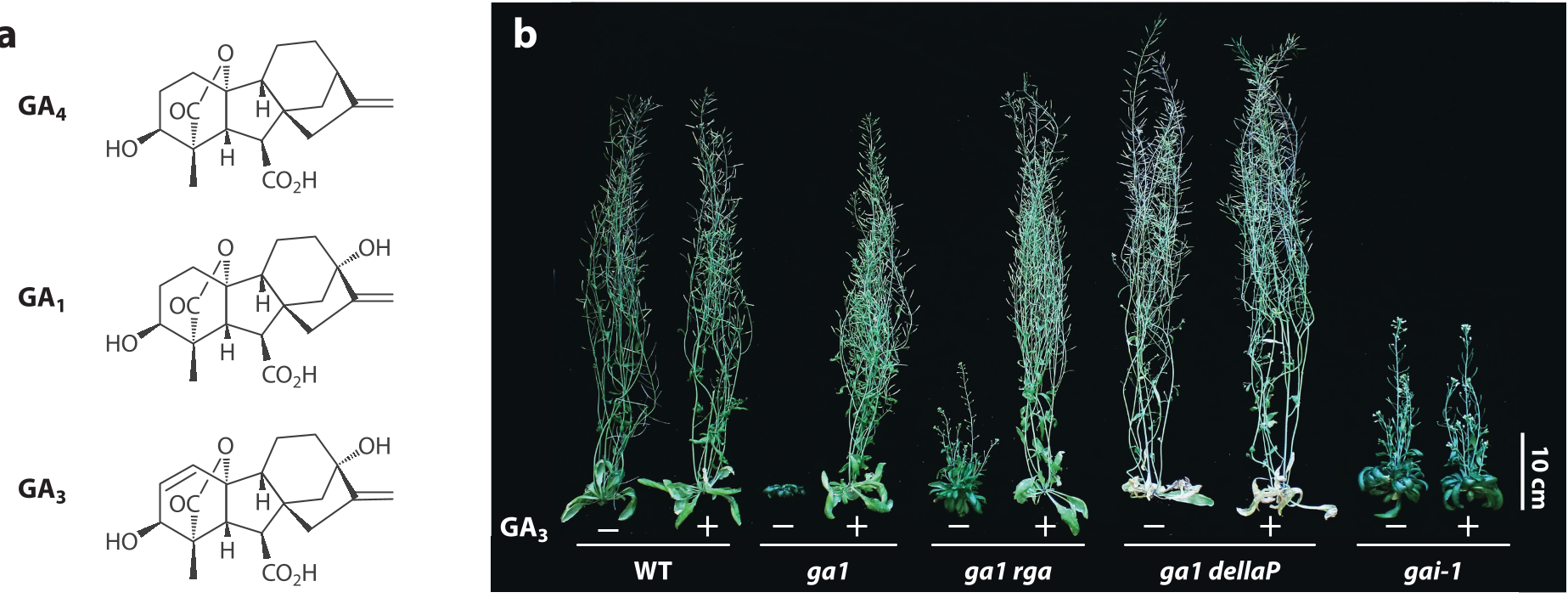 Figure 1: The canonical GA-GID1-DELLA regulatory module, showing how GA triggers the degradation of the growth repressor.
Beyond GA: Survival via Post-Translational Tweaks
If GA-triggered degradation were the only way to control DELLAs, plants would be quite rigid. The review explores "GA-independent" pathways that allow plants to adapt to immediate danger:
- Salt Stress: Triggers SUMOylation of DELLAs. This specific chemical tag stabilizes the protein, even when GA is present, effectively putting an emergency brake on growth to conserve energy for stress defense.
- The Sugar Switch: Two competing modifications—O-GlcNAcylation (the "off" switch) and O-fucosylation (the "on" switch)—compete for the same sites on the DELLA protein, allowing the plant to fine-tune growth based on its metabolic status.
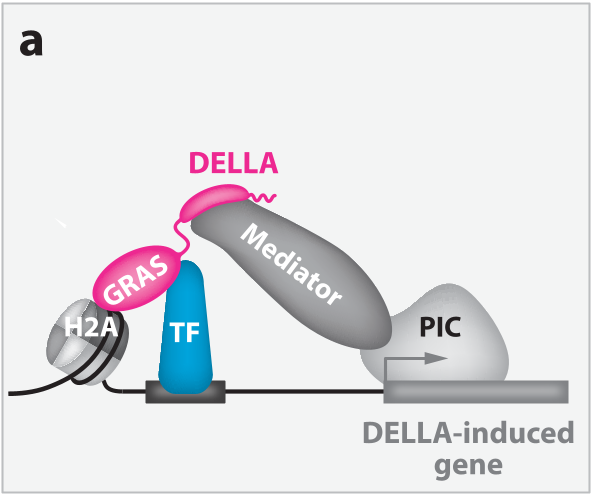 Figure 2: Diverse mechanisms of DELLA action on chromatin, including recruitment of the Mediator complex for activation and PRC2 for repression.
Evolution: A Pre-Existing Engine
Perhaps the most startling insight is that DELLAs existed before Gibberellin. In non-vascular plants like mosses (which don't have GA receptors), DELLAs already functioned as hubs. Evolution didn't "invent" DELLA to respond to GA; it "hijacked" an existing stress-response hub and linked it to the GA sensor to allow the rapid, height-based growth seen in vascular plants.
Conclusion and Future Outlook
The "Green Revolution" genes are still teaching us new tricks. By understanding the specific subdomains (like PFYRE) and the post-translational "switches" (like SUMOylation), we can move beyond simple dwarfing. The next generation of crops may feature "smart" DELLAs—proteins that allow growth during ideal conditions but automatically pivot to defense during drought or low nitrogen, without the need for constant chemical applications.
Key Takeaways for Researchers:
- Anchor Theory: Watch for the DELLA-H2A interaction as a primary target for modulating gene expression globally.
- Nongenomic Roles: DELLAs also influence the cell's "skeleton" (microtubules) directly in the cytoplasm, bypassing the nucleus entirely for rapid growth response.
- Spatial Resolution: The next frontier is single-cell omics to see how DELLAs act differently in a root tip versus a leaf primordium.