
ECADeG: Bridging Medical Research and Distributed Computing via Grid Middleware
A Grid Based Distributed Cooperative Environment for Health Care Research
This paper presents ECADeG, a layered middleware architecture designed to create distributed cooperative environments for healthcare research. Built upon the InteGrade desktop grid and Telex semantic platform, it enables multi-institutional data sharing, parallel query execution, and real-time collaborative document editing.
TL;DR
The ECADeG project introduces a robust, layered middleware architecture specifically designed for the healthcare domain. It enables researchers from different institutions to share data, perform intensive data mining on distributed databases, and collaborate in real-time. By combining the InteGrade opportunistic grid and the Telex replication engine, ECADeG solves the dual challenge of high-performance computing and consistent data sharing in a highly regulated environment.
Background: The Complexity of Medical Collaboration
Scientific research in healthcare is often hindered by "data silos." Each hospital operates as an independent trustee of patient information, making cross-institutional studies difficult. Furthermore, processing large-scale medical data requires significant computational power that individual research groups may lack.
Existing Collaborative Supported Cooperative Work (CSCW) systems often struggle with:
- Resource Scarcity: Lack of access to high-performance clusters.
- Consistency: Conflicts when multiple users edit the same research document or query.
- Legal Compliance: Strict privacy standards (like Brazil's SBIS/CFM) that traditional distributed systems aren't built for.
Methodology: The Layered Architecture
The core of ECADeG is its four-layer design, which abstracts the complexity of the underlying distributed hardware from the end-user.
1. The Execution Environment (InteGrade)
Instead of relying on expensive dedicated servers, ECADeG uses InteGrade, an "opportunistic" grid middleware. It harnesses the idle CPU cycles of existing desktop workstations across hospitals.
- Fault Tolerance: It uses task-level checkpointing to ensure that if a computer is turned off by a user, the research task can resume elsewhere without losing progress.
2. The Semantic Middleware (Telex)
For collaborative editing (e.g., writing a paper or building a complex database query together), ECADeG integrates Telex. Unlike simple locking mechanisms, Telex uses Optimistic Replication.
- Action-Constraint Graph (ACG): Telex represents user operations as nodes and dependencies as edges. It computes "sound schedules" to ensure all sites eventually reach the same state, even with high latency or intermittent connections.
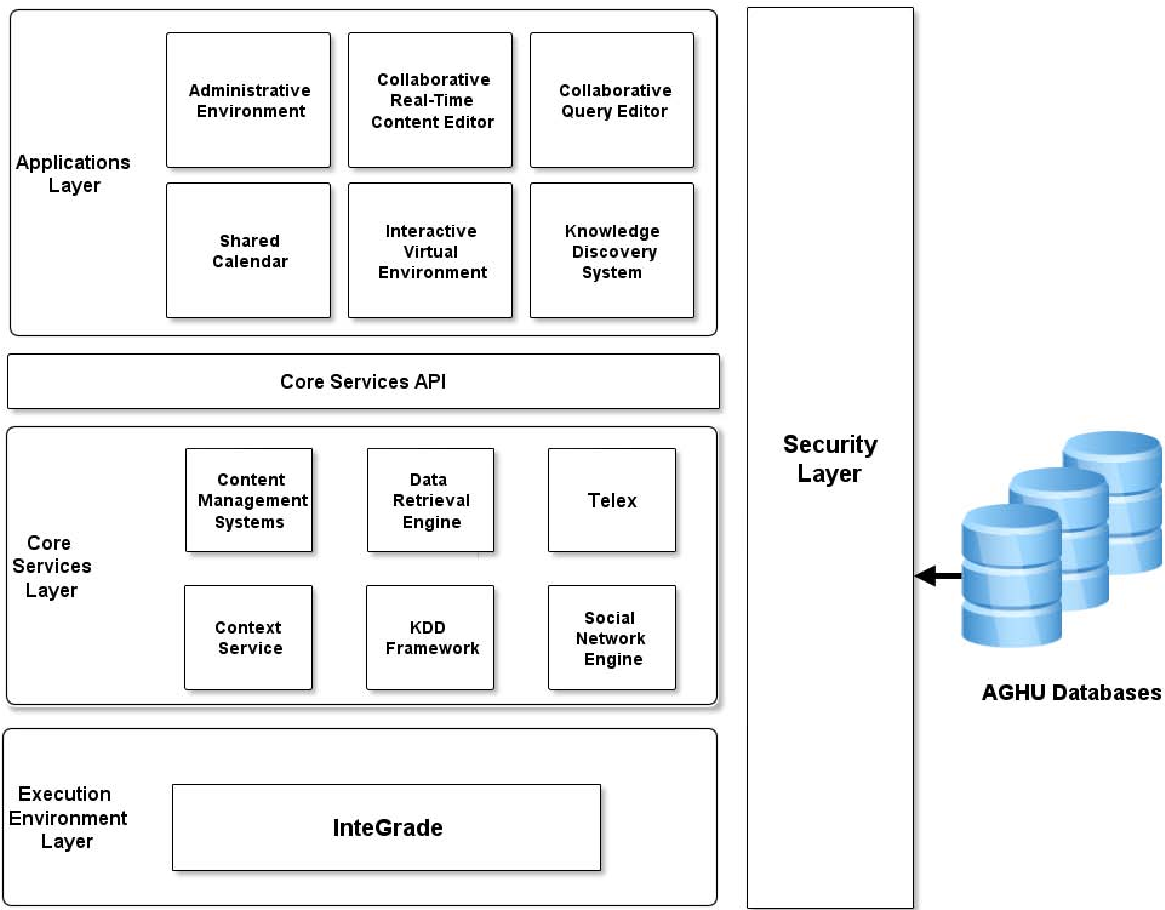 Figure 1: The layered architecture of ECADeG, showing the transversal Security Layer.
Key Components & Experimental Use Cases
The Core Services Layer acts as the engine room of the project:
- Data Retrieval Engine: This allows researchers to write a single SQL query that is transparently executed in parallel across multiple AGHU (University Hospital Management) databases.
- KDD Framework: A Knowledge Discovery in Databases tool that uses the grid to run data mining algorithms (Classification, Association) for identifying successful therapies or predicting disease outbreaks.
Real-world Scenario: Collaborative Querying
Imagine researchers in different cities using the Collaborative Query Editor (CQE). They build a visual query to find specific patient outcomes across five different hospitals. Telex ensures they see each other's changes in real-time without conflicts. Once finalized, the grid executes the query in parallel, merges the results, and hands them to the KDD framework for analysis.
Deep Insight: Why This Matters
The genius of ECADeG lies in its transversal Security Layer. In the medical field, tech is useless if it’s legally non-compliant. By integrating the CLASP (Comprehensive, Lightweight Application Security Process) from the start, the authors ensured that identity management, data anonymization, and auditing are baked into the architecture, not added as an afterthought.
Compared to previous works like WSDL-based search interfaces, ECADeG’s Data Retrieval Engine is far more transparent and scalable. It treats the distributed grid as a single global database, significantly lowering the barrier for medical professionals who are not computer scientists.
Conclusion and Future Outlook
ECADeG provides a blueprint for how "Desktop Grids"—often thought of as tools for projects like SETI@home—can be repurposed for highly specialized, secure, and collaborative professional domains.
Future Work: The team is currently refining privacy policy specifications based on formal statements and expanding the KDD framework to support more complex deep learning algorithms within the InteGrade environment. As healthcare moves toward "Big Data," architectures like ECADeG will be essential for turning siloed records into collaborative medical breakthroughs.