
GRID: Reclaiming Social Connection through Delay Tolerant Networking
GRID: a DTN based localized social networking and messaging application
This paper introduces GRID, a localized social networking and messaging application built on Delay Tolerant Networking (DTN) principles. The system enables opportunistic, decentralized communication and friend discovery directly between mobile devices via WLAN, bypassing the need for centralized Internet infrastructure.
TL;DR
GRID is a decentralized mobile application that brings social networking to the "Near-me area" (NAN) without requiring an Internet connection. By utilizing Delay Tolerant Networking (DTN) and a store-carry-forward architecture, it allows users to discover friends, message at close range, and relay data through peers opportunistically.
Background & Positioning
In the landscape of 2011 social media, the world was tethered to centralized servers (Facebook, Twitter). GRID, developed by researchers at Aalto University and IIT Kanpur, represents a shift toward Ad-hoc localized networks. It positions itself as a privacy-preserving alternative that utilizes the hardware already in our pockets—smartphones—to create an autonomous communication grid.
The Problem: The Centralization Paradox
Why does a message sent to someone in the same room need to travel to a data center thousands of miles away?
- Infrastructure Reliance: Traditional networks fail during outages or in remote areas.
- Privacy Risks: Centralized entities track every "poke" and status update.
- Inefficiency: Near-me area communication shouldn't require global Internet routing.
Methodology: The "Store-Carry-Forward" Intuition
The core innovation of GRID is its use of the DTN2 Bundle Protocol. Instead of a persistent end-to-end connection, GRID treats every phone as a data carrier.
Architecture Breakdown
- Decentralized Identity: It uses the device's phonebook. Your EID (Endpoint Identifier) is derived from your phone number, eliminating the need for a central "Check-in" or login server.
- Opportunistic Routing: When two devices come within Wi-Fi range, they exchange a "handshake." If User A has a message for User B, but User B isn't there, User C (a common friend) can pick up the "bundle," store it in a fixed-size queue, and drop it off when they encounter User B later.
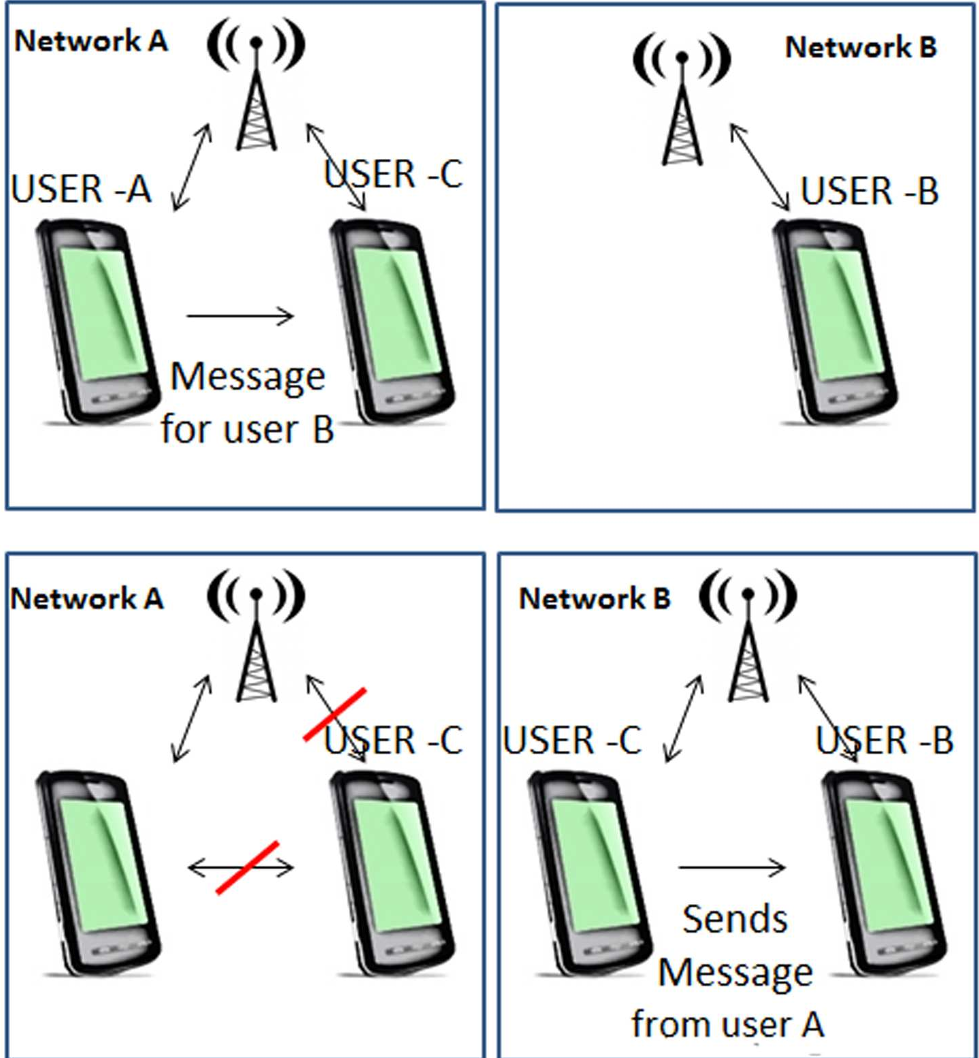 Figure 1: The relay mechanism where User C acts as a physical data mule between two disconnected networks.
Experiments and Practical Results
The authors demonstrated the system using Android 2.1 devices across separate Wi-Fi zones.
- Discovery: Users are automatically notified when friends (from their phone contacts) enter the immediate vicinity.
- Resilience: Even if the recipient is offline, the message persists in the network "mesh" for 2-4 hours, or until the routing queue (FIFO) is overwritten.
- UI/UX: The application provides a familiar social interface with tabs for "My Profile," "Friends," and "Messages," proving that complex networking backends can be masked by intuitive designs.

Critical Insight & Future Outlook
The brilliance of GRID lies in its Inductive Bias toward social trust; by assuming phonebook contacts are "friends," it simplifies the authentication problem of decentralized networks.
Limitations:
- Scalability: Simple flooding routing can lead to network congestion as the number of users grows.
- Security: While decentralized, the store-and-forward nature means peers carry your encrypted (or unencrypted) data, requiring robust local encryption.
Conclusion: GRID is a pioneer in the "Local-First" software movement. In an era where data sovereignty and "off-grid" capabilities are becoming increasingly valuable, the DTN-based approach used in GRID offers a compelling blueprint for resilient, human-centric communication.