
Grokking as Structural Collapse: The Physics of Intelligence Discovery
Grokking From Abstraction to Intelligence
This paper investigates "grokking" in modular arithmetic through the lens of structural parsimony, introducing a multi-modal analysis framework that tracks causal, spectral, and algorithmic complexity. The authors demonstrate that the transition from memorization to generalization is a "physical collapse" of redundant manifolds, achieving SOTA-level mechanistic interpretability by visualizing the evolution of a 48-layer Transformer into a parsimonious subgraph.
Executive Summary
TL;DR: Why do models suddenly "get it" after thousands of steps of overfitting? This paper argues that Grokking is the physical manifestation of Occam's Razor. By analyzing a 48-layer Transformer, the authors show that the model doesn't just "learn" a rule; it aggressively destroys its own redundant internal structures, collapsing from a high-entropy "memorizer" into a sparse, geometrically pure "calculator."
Background: This work sits at the intersection of Mechanistic Interpretability and Singular Learning Theory (SLT). It moves beyond merely describing which circuits fire to explaining the thermodynamic pressure that forces these circuits to emerge.
The Problem: The "Fruit Fly" of AI
Modular arithmetic (e.g., ) is the "fruit fly" of AI research—a controlled environment where we can observe the weirdest phenomenon in deep learning: Grokking.
Traditional views suggest the model slowly finds a better local minimum. However, the authors argue this is insufficient. They observe a "delayed generalization" where performance stays at 0% for ages despite 100% training accuracy, before "snapping" into place. The missing link was a global metric for structural evolution.
Methodology: The Three Pillars of Simplification
The authors didn't just look at loss curves; they performed a "longitudinal autopsy" of the model using three sophisticated lenses:
- Causal Mediation Analysis (CMA): Using "activation patching" to see which neurons are actually necessary.
- Spectral Localization: Mapping weights to the Fourier domain to see if the model "resonates" with the modular nature of the task.
- Algorithmic Complexity (BDM): A proxy for Kolmogorov Complexity, measuring how "compressible" the model's logic is.
The "Occam Gate" and the Singular Feature Machine (SFM)
To prove their point, they built a theoretical surrogate called the Singular Feature Machine. It features an Occam Gate—a thermodynamic threshold that annihilates any internal signal weaker than a specific "noise floor" (defined by ).
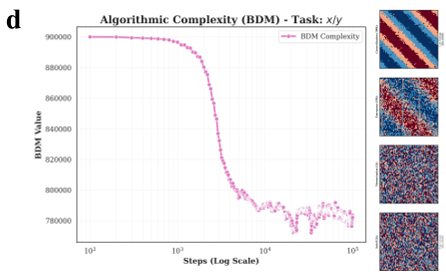 Figure: The global BDM complexity drops sharply as the model transitions from a "noisy" state to a "block-structured" one.
Key Insights: Manifold Collapse
The most striking visual evidence in the paper is the Manifold Collapse. Early in training, the embeddings are a disorganized mess. As grokking occurs, these points "crystallize" onto a perfect 1D ring in high-dimensional space.
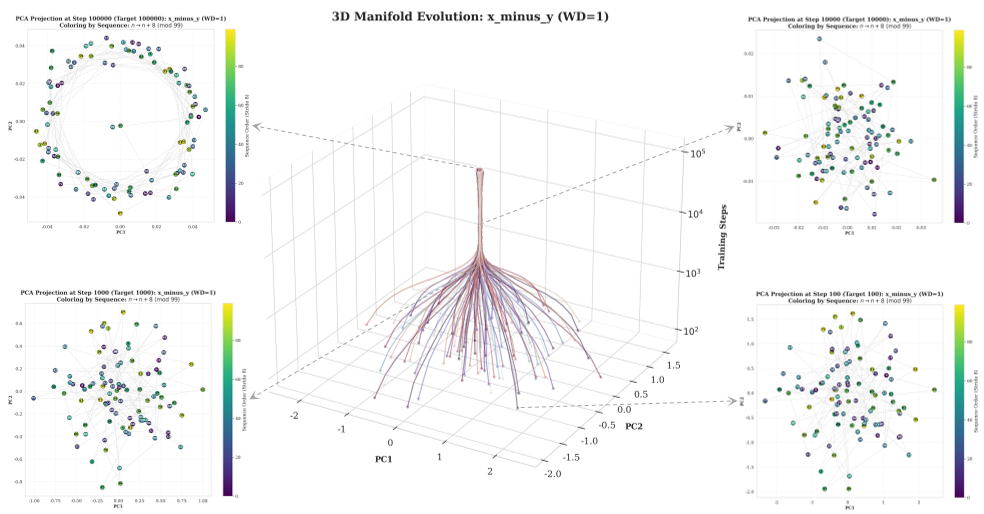 Figure: 3D PCA projections showing the embedding transition from a high-entropy cloud (Step 1k) to a 1D ring (Step 100k) isomorphic to the cyclic group .
The authors call this Spectral Alignment. The spectral energy concentrates into sparse Fourier modes, meaning the model has essentially "discovered" the Fourier Multiplication Algorithm (FMA).
The "Bypass" Hypothesis: Less is More
In a shocking demonstration of redundancy, the researchers found that in a 48-layer GPT-2 style model, the middle layers (approx. 16–31) eventually do nothing.
- Skip-Ablation: Disabling these middle layers had zero effect on accuracy.
- U-Shaped Importance: Only the very beginning (embedding) and very end (readout) were critical.
The model effectively "bypassed" its own depth to achieve the simplest possible algorithmic solution.
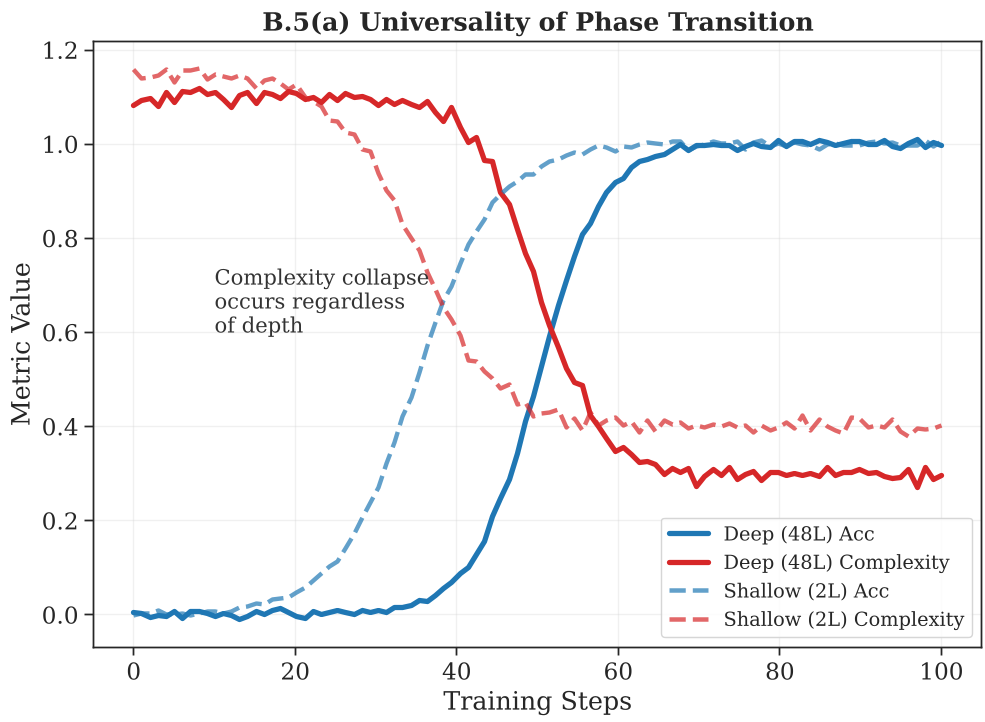 Figure: Causal importance shows a U-shaped profile, confirming that the central layers of the deep model are functionally silenced during generalization.
Critical Analysis & Conclusion
Takeaway
Grokking isn't just "finding a solution"—it is a phase transition of complexity. The system starts by "memorizing" (high complexity, low volume in the loss landscape) and then, through the pressure of optimization, collapses into a "generalized" state (low complexity, high volume).
Limitations
- Algorithm Specificity: The SFM surrogate is perfectly tuned for addition/subtraction. Multiplication/Division involve more complex group-theoretic reindexing (like discrete logs) which the paper touches on but doesn't fully map out.
- Language as Description: The "Phase Transition" language here is descriptive; whether SGD training strictly follows first-order thermodynamic transitions remains a theoretical challenge.
Future Outlook
This work suggests that to build better LLMs, we shouldn't just look for "better weights," but for structural parsimony. If we can identify when this "complexity collapse" starts, we might be able to trigger "emergence" in larger models much earlier, potentially saving massive amounts of compute.
Final Thought: Generalization is the byproduct of a model's struggle to be as lazy (simple) as possible.