
Scaling the Unscalable: An Iterative Crowdsourcing Approach to Medical Image Ground Truth
3850_Ground truth generation in medical imaging a crowdsourcing-based iterative approach.
The paper introduces an iterative, crowdsourcing-based approach to generate ground truth labels for a large-scale dataset of over 300,000 medical images. By combining expert knowledge, automated visual classification, and a multi-step verification loop via the Crowdflower platform, the authors establish a high-quality modality classification hierarchy.
TL;DR
Generating accurate ground truth for medical images usually requires high-priced MDs, making large-scale datasets (300k+ images) nearly impossible to label manually. This paper presents a workflow that combines expert seeds, automated classification, and crowd verification. By utilizing a "trustability" threshold and an iterative loop, the authors show that we can generate high-quality modality labels at a fraction of the cost and time of traditional methods.
The Scalability Bottleneck in Medical Imaging
In the era of deep learning and advanced retrieval, we are drowning in data but starving for labels. The ImageCLEF benchmark, for instance, contains hundreds of thousands of images from biomedical literature. The central dilemma is:
- MDs are accurate but expensive and scarce: You cannot ask a radiologist to label 300,000 images for a research project.
- The Crowd is cheap but noisy: General workers often lack the domain nuances (e.g., distinguishing CT from MRI or identifying specific microscopy types).
The authors' insight was to move away from a "one-and-done" labeling task toward an iterative feedback loop.
Methodology: The Human-AI Feedback Loop
The researchers didn't just throw images at the crowd. They designed a structured hierarchy of 34 categories and used a multi-phase approach:
- Expert Nucleus: 18 domain experts labeled 1,000 images to create a "Gold Standard."
- Machine Acceleration: A visual-words-based classifier was trained on this seed data to predict labels for the remaining 300,000 images.
- The Verification Loop: Instead of asking the crowd to choose a category (hard), they asked the crowd to validate the machine's prediction (easier/faster).
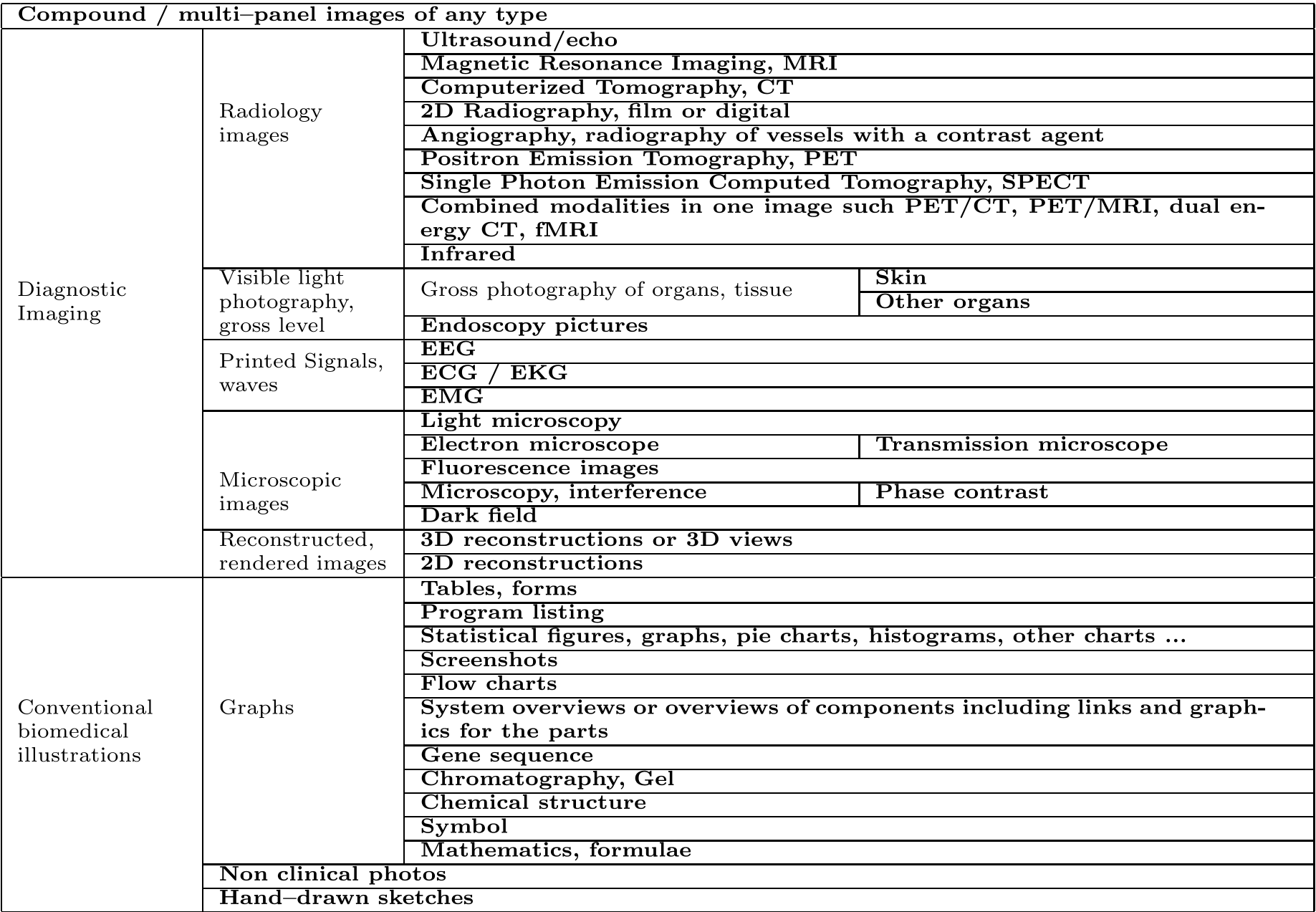 The complex hierarchy used for classification, ranging from Radiology to Conventional Biomedical Illustrations.
Experiments: MD vs. Experts vs. The Crowd
The study compared three distinct tiers of annotators:
- The MD: High speed (85 imgs/hr), absolute confidence, and gold-standard accuracy.
- Known Experts: High agreement with the MD (88-100% on broad categories) but slower than the MD.
- Open Crowdsource: Slower individual speeds (25 imgs/hr) and lower accuracy on fine-grained diagnostic subcategories, but massive parallel throughput.
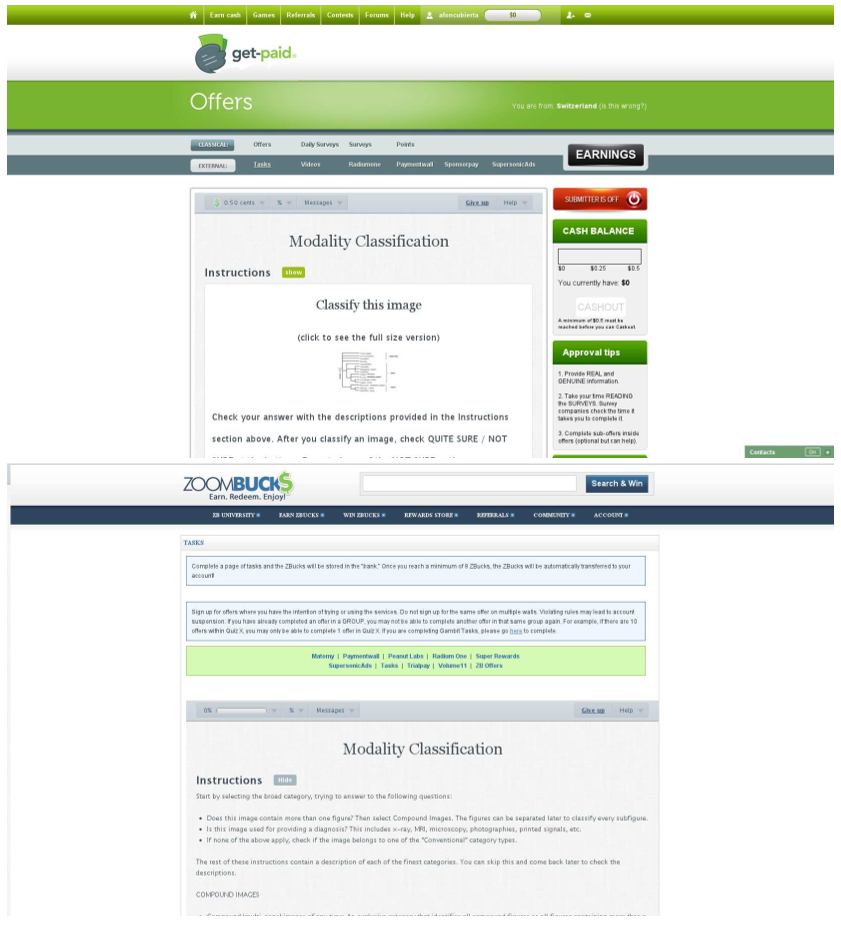 The task interface used to standardise labeling and verification across different worker groups.
Key Result: The Power of Trustability
One of the paper's critical findings is how to handle "noise." By using hidden gold images (images where the answer is already known), the authors could calculate a "trust score."
- Trusted judgments accomplished in one week: 10,463
- Non-trusted (rejected) judgments: 15,706
This 1.5:1 ratio of noise to signal highlights why raw crowdsourcing fails and why the authors' quality control threshold (70% accuracy) is vital.
Results & Deep Insights
The iterative approach proved that verification is roughly twice as fast as initial annotation. Even though the initial machine classification only had 24% accuracy, the "reject" action from the crowd provided a quick way to filter the dataset for subsequent rounds of more focused human labeling.
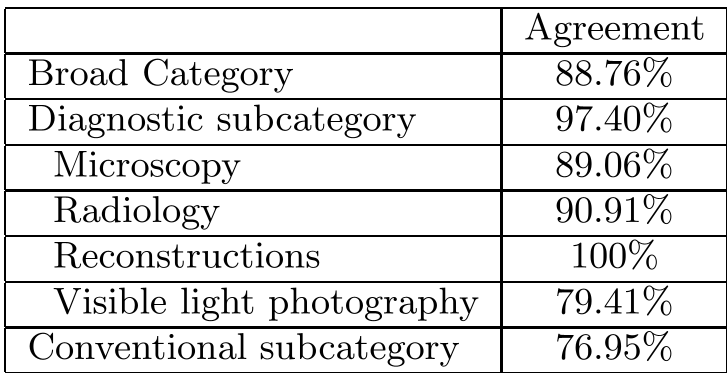 Agreement rates between the MD and the Crowd. While broad categories see high agreement (~88%), specialized areas like "Radiology" drop when the crowd isn't properly filtered.
Professional Conclusion
This paper serves as a blueprint for modern "Data-Centric AI." It acknowledges that while experts are the source of truth, the crowd is the engine of scale. The iterative loop—where the machine gets better as the crowd verifies its mistakes—is a precursor to the modern Active Learning pipelines we see in production today.
Limitations: The study notes that even domain experts don't always agree (subjectivity). Fine-grained diagnostic classification (like specific reconstruction types) remains a challenge for non-experts, suggesting that the crowd is best utilized for "filtering" and "broad classification" rather than final clinical diagnosis.