
Logic on the Manifold: Bridging Perception and Legal Discourse
How to Ground a Language for Legal Discourse in a Prototypical Perceptual Semantics
This paper introduces a novel framework for grounding the Language for Legal Discourse (LLD) in a prototypical perceptual semantics using the category of differential manifolds (Man). By integrating manifold learning and deep learning with categorical logic, the author proposes a computational theory of "coherence" in legal argument that moves beyond classical set-theoretic definitions.
TL;DR
L. Thorne McCarty proposes a radical shift in how we represent legal concepts: instead of treating them as rigid sets, we should view them as differential manifolds. By grounding the "Language for Legal Discourse" (LLD) in a perceptual semantics powered by manifold learning and deep learning, the paper provides a mathematical foundation for "coherence" in legal arguments—linking raw data to high-level legal theory through smooth, geometric mappings.
Background: The Mystery of Prototypes
In legal theory, concepts like "Control" or "Ownership" rarely have hard boundaries. They are defined by prototypes and deformations. For decades, a central mystery in cognitive science and legal AI has been how humans maintain "coherence" when concepts are fluid. This paper argues that the solution lies in the intersection of three domains:
- Probability: The density of real-world data.
- Geometry: The non-linear structures (manifolds) where data resides.
- Logic: The formal language used to reason about these structures.
The Core Mechanism: Differential Similarity
The methodology relies on the Manifold Hypothesis, which posits that high-dimensional data actually sits on a much lower-dimensional, non-linear subspace.
1. Probabilistic and Geometric Fusion
McCarty uses a diffusion process (Brownian motion with a drift term) to link probability to geometry. The key is a Riemannian metric interpreted as a measure of dissimilarity.
- Inuition: In regions with high data density (highly probable examples of a concept), "distance" or dissimilarity is small. In sparse regions, dissimilarity is large.
- Prototype Coding: A prototype is defined as the origin of an optimal, low-dimensional subspace.
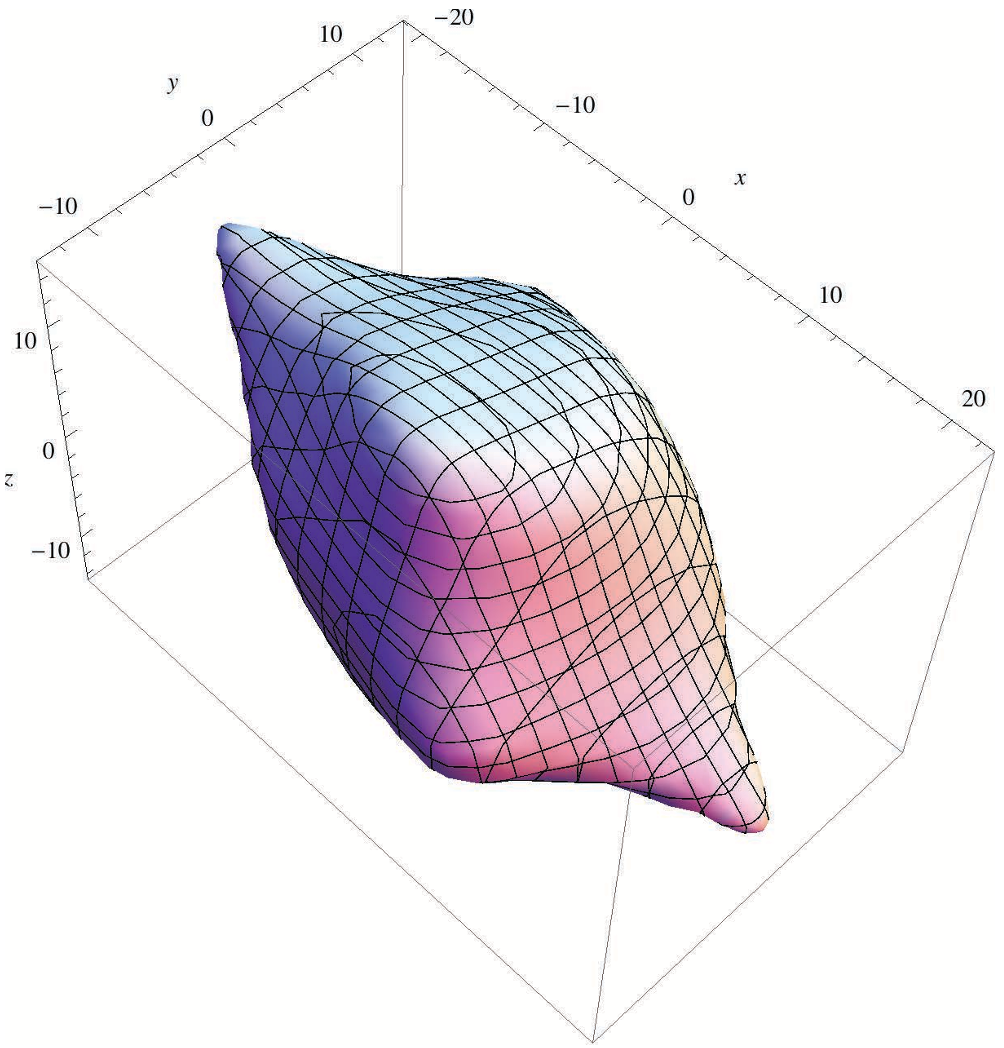 Figure 1: A Curvilinear Gaussian Potential representing the probability density of a concept.
2. Categorical Logic in the Category 'Man'
The most significant technical contribution is replacing the standard category Set (where objects are sets) with the category Man (where objects are differential manifolds).
- Subobjects as Submanifolds: In this logic, a sub-concept (like "Corporate Control") isn't just a subset; it must be a submanifold. This is a much stricter constraint, ensuring that logical relations are "smooth" and physically grounded.
- Quantifiers as Adjoints: Existential () and universal () quantifiers are implemented as adjoint functors of projection mappings between manifolds.
 Figure 2: Geodesic coordinate curves for prototypes, showing how local geometry defines concept boundaries.
A Theory of Legal Coherence
Why does this matter for a lawyer or a judge? McCarty suggest that "coherence" in a legal argument—the quality that makes an argument feel "right"—is equivalent to the existence of a smooth mapping between conceptual manifolds.
If a legal conclusion (e.g., "This transaction constitutes a taxable dividend") cannot be reached via a smooth transformation from the evidence manifold within the constraints of the logic, the argument is incoherent. The logic is constrained by geometry, the geometry by probability, and the probability by the actual distribution of societal and legal facts.
Critical Insight & Future Outlook
Most researchers try to make their systems less restrictive to handle complexity. McCarty takes the opposite view: The limitations of 'Man' are a feature, not a bug. By making the logic more restrictive (requiring smoothness), we create a knowledge representation that is actually learnable from data.
Limitations
- Infinite Dimensions: Implementing full implication () requires infinite-dimensional manifolds (mapping spaces), which adds significant computational overhead.
- Ontological Scope: Transitions from physical actions (rigid body motions) to abstract legal actions (contracts, permissions) still require more robust mapping functions.
Conclusion
This work represents a profound "perceptual turn" in AI and Law. By treating legal reasoning as a form of "navigating a manifold," it opens the door for Deep Learning models that are not just black boxes, but are grounded in the rigorous, categorical structure of legal discourse.