
Beyond Rationality: Formalizing Group Affect in Complex Decision-Making Systems
Group Affect in Complex Decision-Making: Theory and Formalisms from Psychology and Computer Science
This paper explores the formalization of group affect (moods, emotions, and feelings) in complex decision-making systems by bridging psychology, neuroscience, and computer science. It categorizes affective processes into individual, group, and emergent levels and compares three major computational models—the Psychological Model, IMPACT, and ASCRIBE—to demonstrate how social contagion and personality influence collective behavior.
TL;DR
This research challenges the "rational actor" myth by providing a rigorous framework for integrating affect into collective decision-making. By synthesizing psychology and computer science, the authors map out how individual emotions coalesce into group-level phenomena through bottom-up contagion and top-down contextual influences.
Contextual Positioning
In the landscape of Decision Science, this work acts as a bridge between Mass Psychology and Computational Multi-Agent Systems. While previous SOTA models often viewed crowds as homogeneous aggregates, this paper advocates for a more nuanced approach where individual personality and social ties dictate the flow of emotional contagion.
Problem & Motivation: The Irrationality Gap
Historically, decision-making was the domain of pure reason. However, the authors argue that human actions are driven by "somatic markers"—biological "gut feelings" that mark certain options as favorable or dangerous.
The core challenge lies in Emergence: How do the subjective, short-lived emotions of individuals (e.g., "I am frustrated") transform into objective group states (e.g., an aggressive crowd or a collaborative workforce)? Prior work often ignored the "recursive" nature of affect—the fact that a group’s mood can cycle back to reinforce or suppress individual feelings.
Methodology: The Common Global Structure
The researchers derive a common structure for affect integration, summarized across four dimensions:
- Individual Processes: Formalizing self-suggestion and emotional intelligence.
- Group Processes: Modeling the "mirroring" of cognitive and emotional states.
- Bottom-Up Emergence: The "sum of parts" approach where contagion spreads through local agent interaction.
- Top-Down Emergence: The "whole group" approach where the affective context (e.g., leadership style) constrains individual behavior.
Architectural Analysis
The authors contrast three pivotal models. The Psychological Model uses a numerical value to represent an agent's emotional state, balancing self-effects (frustration, suggestion) with mutual effects (imitation).
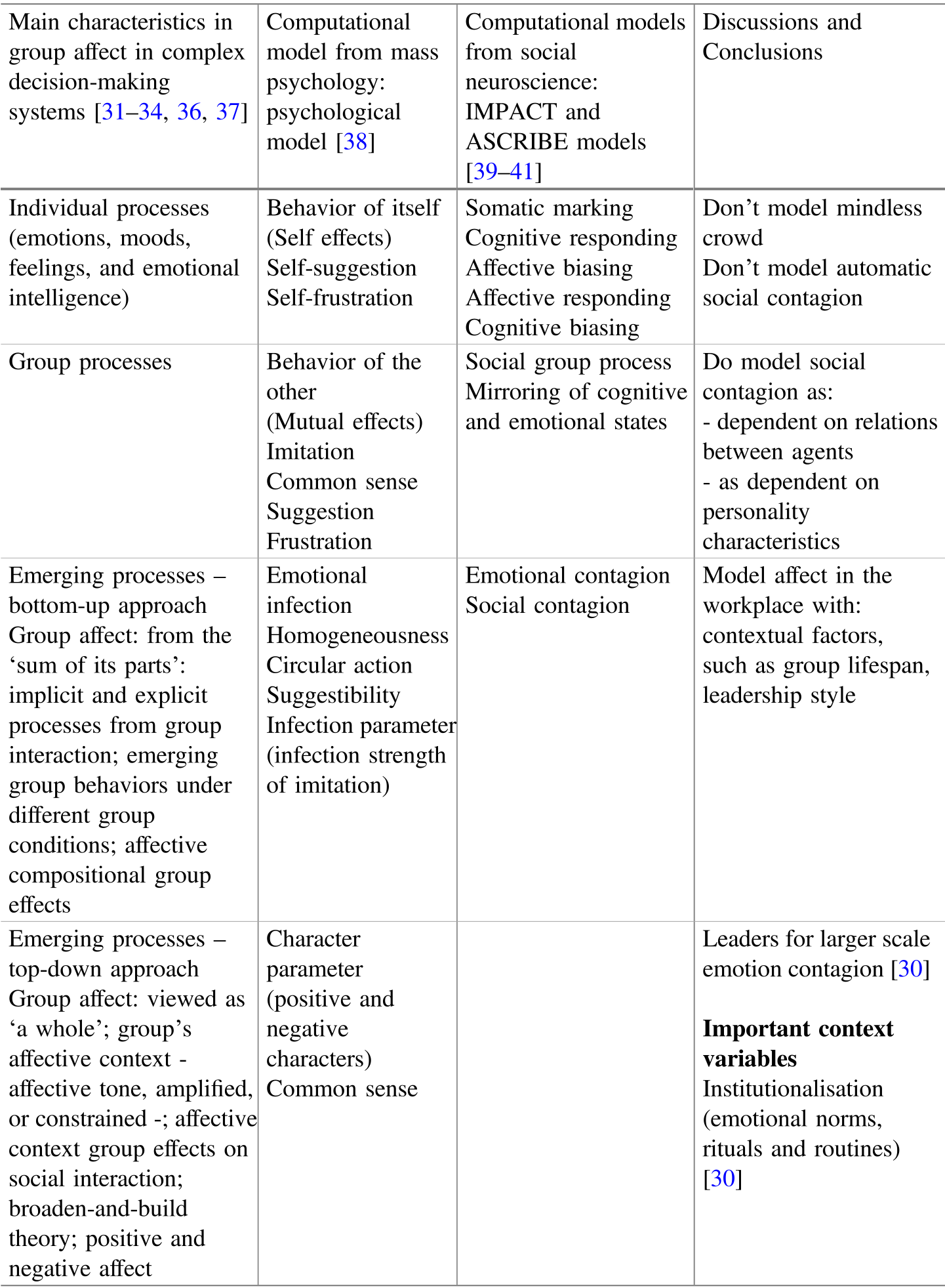
In contrast, the IMPACT and ASCRIBE models (social neuroscience perspective) utilize state-based architectures where agents possess Beliefs, Desires, and Intentions (BDI) that are biased by affective levels.
Experimental Insights & Models
The paper deep-dives into the mathematical representation of emotional contagion. In the ASCRIBE model, a parameter is used to simulate "upward and downward spirals," acknowledging that group affect is often more than just a linear sum of individual parts.
Key Breakthroughs:
- Avoiding the "Mindless Crowd" Pitfall: By modeling in-groups and out-groups, the models can accurately predict that information/emotion does not spread uniformly; it follows social pathways.
- Personality matters: Integrating "susceptibility" (how easily you catch an emotion) and "expressiveness" (how easily you share one) provides a higher resolution of crowd behavior in emergency simulations.
 (Note: Above Figure depicts the conceptual integration of affective and rational loops.)
Critical Analysis & Conclusion
Takeaway
The paper proves that the integration of Personality Factors and Dispositional Affect is the frontier of computational decision models. Modeling the "Why" of a decision now requires modeling the "Feel" of the agent.
Limitations
The current formalisms, while robust, still struggle with the temporal decay of primary vs. secondary emotions in high-velocity scenarios. The interaction between "Affective Learning" (how agents learn to manage group stress over time) remains under-explored.
Future Outlook
The authors point toward "Emotional Intelligence" as the next layer. Future systems won't just reflect emotions—they will actively regulate them to optimize group performance, whether in a robotic swarm or a human corporate team.