
Group-Based Personalized Location Recommendation: Efficient Spatial Filtering on Social Networks
Group-Based Personalized Location Recommendation on Social Networks
This paper introduces GPLR (Group-Based Personalized Location Recommendation), a system designed for Location-Based Social Networks (LBSNs). It utilizes a two-step hierarchical clustering and group-based filtering approach to provide high-quality, real-time venue recommendations by balancing recommendation accuracy with computational efficiency.
TL;DR
Researchers from Tsinghua University have developed GPLR, a recommendation framework that solves the dual challenge of quality and efficiency in Location-Based Social Networks (LBSNs). By clustering users into interest-based groups using a Weighted Category Hierarchy (WCH) and indexing locations with R-trees, the system provides personalized "top-k" suggestions in real-time, effectively bypassing the computational bottlenecks of traditional Collaborative Filtering.
Context & Motivation: The Sparsity Trap
Current LBSN recommendation systems (like those powering Foursquare or Yelp) struggle with two major hurdles:
- Data Sparsity: Most users have only visited a tiny fraction of total locations, making the user-location matrix nearly empty.
- Efficiency vs. Quality: Calculating similarities across millions of users and points of interest (POIs) is too slow for mobile apps, yet simplifying the model usually destroys personalization accuracy.
The authors' insight is focused on semantic abstraction: instead of comparing unique IDs of coffee shops, we should compare the category profiles (e.g., "Fast Food enthusiast" vs "Art Gallery lover") to group users first, then refine the search spatially.
Methodology: The Two-Step Approach
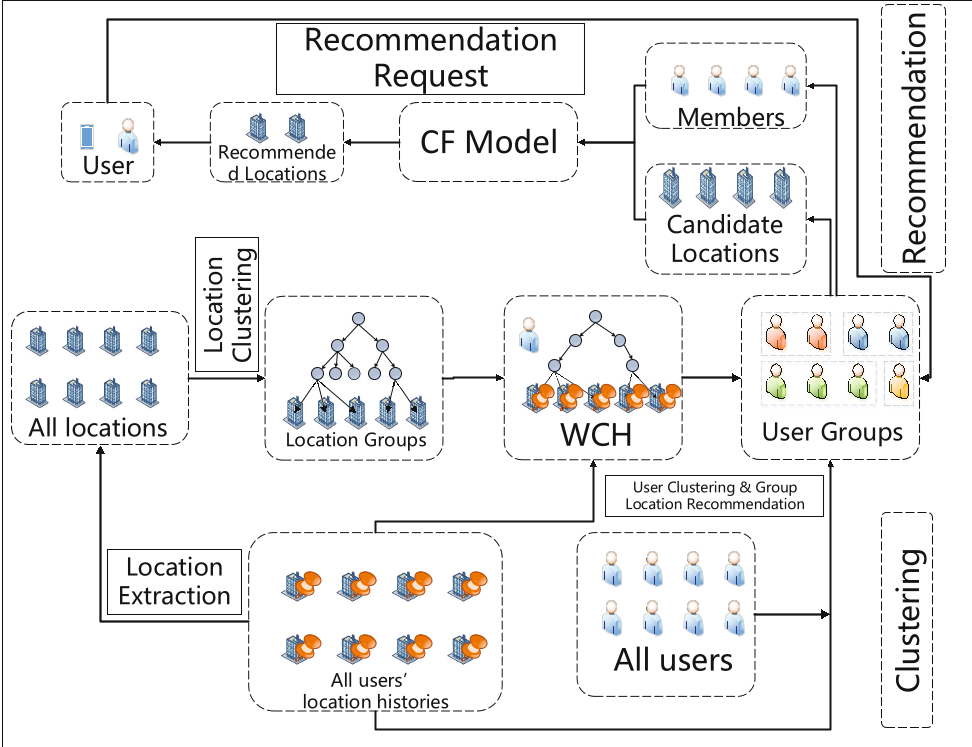
The system architecture, as illustrated below, bifurcates into offline clustering and online serving modules.
1. Analyzing Preferences with WCH
To avoid the "cold-start" problem where a user visits a new city, the authors create a Weighted Category Hierarchy (WCH).
- TF*IDF for Locations: Just as words are ranked in documents, location categories are ranked for users. If you visit "Sushi Bars" frequently but they are rare in the general population, "Sushi" becomes a high-weight feature in your profile.
- Hierarchical Mapping: Locations are mapped to a subtree of categories (e.g., KFC → Fast Food → Food). This generalizes user interests, allowing the system to understand that a user who likes "Italian Food" might enjoy a "Pizza Place" even if they've never visited one.
2. Group-Based Clustering & Selection
Instead of searching the entire city's database:
- K-Means Clustering: Users with similar WCH vectors are grouped.
- Group Candidate Locations: For each group, the system identifies "Authority" locations (high-quality POIs visited by group members).
- R-tree Indexing: Each group’s candidate locations are stored in an R-tree for lightning-fast spatial range queries.
Experimental Validation
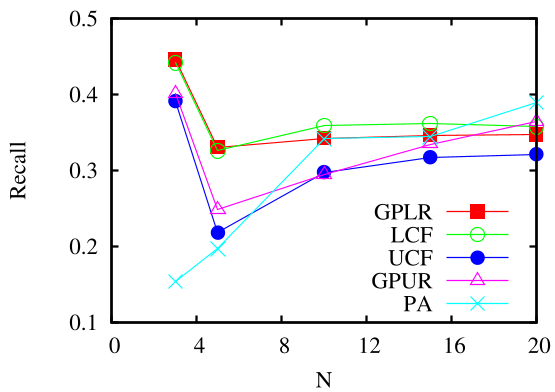
Using real-world Foursquare data from New York (NYC) and Los Angeles (LA), the authors compared GPLR and its user-based variant (GPUR) against traditional Collaborative Filtering (UCF/LCF).
Performance Metrics
The results confirm that the location-based variant (GPLR) consistently delivers higher precision than baselines.
- Scalability: Unlike UCF, which slows down dramatically as the user base grows, GPLR’s processing time remains relatively flat because it only computes similarities within a pre-filtered group of "relevant" candidates.
- The "Cold-Start" Solution: Because WCH relies on category profiles rather than specific location IDs, the system can recommend locations in LA to a tourist who has only ever checked in at venues in NYC.
Critical Analysis & Future Outlook
Strengths:
- Hybrid Intelligence: Successfully combines spatial indexing (R-tree) with semantic modeling (WCH).
- Computational Efficiency: The reduction of the search space via groups makes this viable for high-concurrency mobile applications.
Limitations:
- Group Dynamics: The current model assumes static groups; however, user interests are dynamic and may shift seasonally or based on time of day (e.g., morning coffee vs. evening bars).
- Diversity: Group-based methods risk creating "filter bubbles" where users are only shown what their immediate "cluster" likes, potentially missing out on serendipitous discoveries.
Future Directions: The logical next step for this research is the integration of Temporal Dynamics—modeling how a user's relevant "group" might change from a "Professional" cluster during work hours to a "Social/Nightlife" cluster during weekends.
Conclusion
GPLR represents a significant step toward making personalized LBSN recommendations both fast and accurate. By moving from raw ID-based similarity to category-based hierarchical grouping, the authors provide a framework that respects user preferences while remaining performant at scale.