
Bayesian Heuristics: Why Groups Rationalize their way toward Polarization
Group decision making and social learning
This paper explores "Bayesian Heuristics," a framework for social learning and group decision-making that bridges the gap between complex Bayesian inference and simple non-Bayesian rules. It demonstrates how agents can replicate initial rational experiences as long-term decision rules, achieving consensus via linear (DeGroot) or log-linear updates.
TL;DR
How do individuals in a social network aggregate information? While pure Bayesian logic is mathematically "optimal," it is computationally "impossible" for human agents. This paper introduces Bayesian Heuristics, arguing that agents perform a one-time rational calculation and then repeat it as a simple rule-of-thumb. Surprisingly, this "lazy" rationality explains why we see social phenomena like DeGroot consensus, centrality bias, and group polarization.
Problem & Motivation: The Complexity of "True" Rationality
In an ideal world, a Bayesian agent in a social network would track every neighbor's action, infer their private signals, and discount the "echo chamber" effect (where information loops back to them). However, as the authors note, this is PSPACE-hard.
Previous research has focused on two extremes:
- Strictly Bayesian: Mathematically elegant but requires agents to have god-like computational powers and global knowledge of the network topology.
- Heuristic (Non-Bayesian): Simple rules like the DeGroot Model (averaging neighbors' opinions), which are easy to use but often lack a deep theoretical "Why."
Rahimian and Jadbabaie bridge this gap by using Dual-Process Theory. Like Daniel Kahneman's Thinking, Fast and Slow, they suggest that agents use "Slow" (System 2) Bayesian thinking to learn how to decide, and then "Fast" (System 1) heuristics to actually execute those decisions.
Methodology: From Bayes Rule to Simple Heuristics
The core innovation is the Bayesian Heuristic Mapping ().
1. The "Initial Spark" (Time )
At the start, the agent is rational. They observe their neighbors' actions and update their belief using Bayes' Rule. This creates a functional mapping:
2. The Heuristic Takeover (Time )
Instead of re-calculating the entire history at every step, the agent simply re-applies the same function to the most recent data.
3. Architecture of Inference
The paper demonstrates that the mathematical shape of the signal determines the style of the heuristic:
- Exponential Family Signals/Normal Distributions: Yield Linear Averaging (recovering the DeGroot model).
- Finite State Spaces (Discrete Beliefs): Yield Log-Linear Updates (multiplicative belief pools).
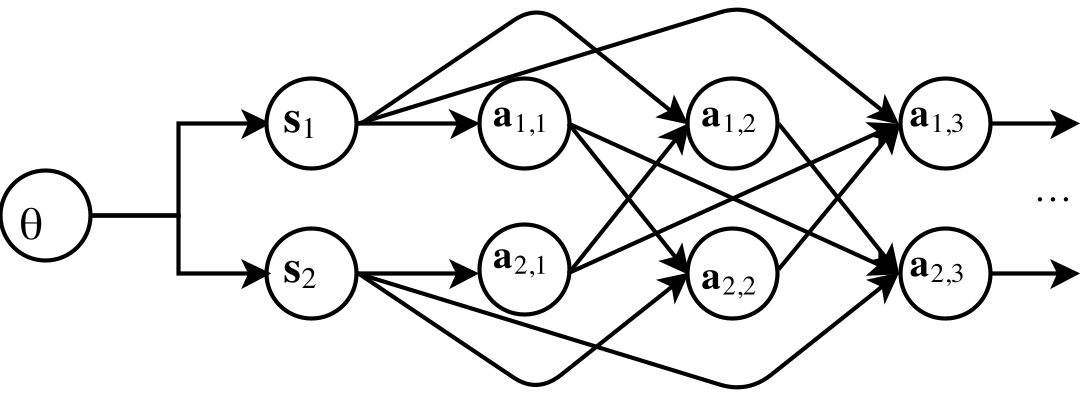 Fig 1: The flow of information where agent interactions refine knowledge about hidden private signals over time.
Experiments & Results: Is the Crowd Actually Wise?
The authors analyze whether these heuristics lead to "Efficient Information Aggregation."
The Centrality Trap
In many networks, the "central" person is not the smartest person. The paper shows that unless a network is degree-regular and balanced (where everyone listens and is heard by the same number of people), the group consensus will be biased toward the data held by central agents. This is a formalization of Persuasion Bias.
Group Polarization
A striking finding is that Log-Linear heuristics lead the group to become completely certain (100% belief) in a specific state, even if the aggregate evidence is actually weak.
- Optimal Bayesian: Would maintain a probability distribution (e.g., 70% State A, 30% State B).
- Bayesian Heuristic: Eventually shifts to 100% State A. This is "Groupthink" or "Polarization" in mathematical form.
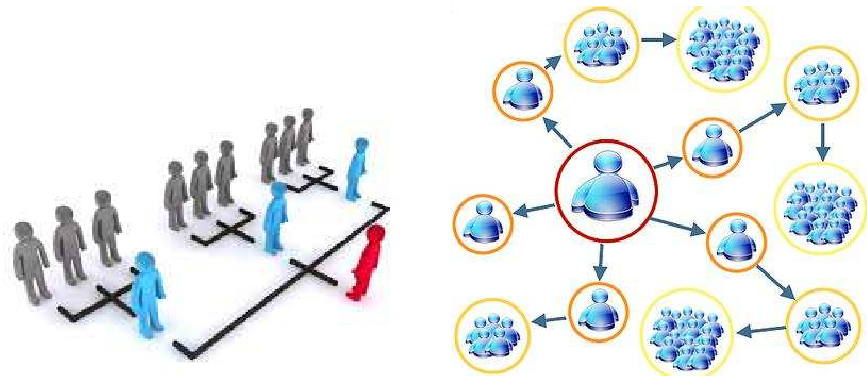 Fig 2: Visualization of how agents learn about deeper layers of the network (neighbors of neighbors) through repeated interaction.
Critical Insight & Conclusion
Takeaway
The "Wisdom of Crowds" is fragile. While groups can aggregate information, the use of heuristics—while biologically efficient—introduces systematic errors. The DeGroot model is not just a random guess at human behavior; it is what happens when Bayesians get "lazy" in a world of normal distributions.
Limitations
The model assumes agents are myopic (only care about the immediate reward). Real-world agents might be "strategic," withholding information to influence the group later. Additionally, the "Dual-Process" assumption (System 2 only active at ) is a simplification; in reality, agents might "wake up" and re-evaluate their heuristics periodically.
Future Work
This framework opens the door for designing Recommendation Engines and Social Media Algorithms that counteract "Data Incest" and polarization by identifying the mathematical origins of these heuristic biases.