
Group Dynamics: Why Traditional Epidemic Models Fail for "Incidental" Viral Topics
16517_Group dynamics in discussing incidental topics over online social networks.
This paper introduces an adaptive parametric model to predict the group dynamics of "incidental topics" on online social networks (OSNs). By analyzing data from LiveJournal and Sohu, the authors demonstrate that incidental topics follow a heavy-tailed distribution rather than traditional epidemic patterns, achieving superior prediction accuracy compared to the standard SIR model.
TL;DR
Not all viral trends spread like a virus. New research from Xi’an Jiaotong University reveals that "incidental topics"—sudden events like disasters or product launches—don't follow the 1-to-1 social spreading pattern assumed by traditional SIR models. Instead, they exhibit heavy-tailed dynamics driven by external media. The authors propose a new adaptive model that predicts group sizes with under 8% error, vastly outperforming classical epidemic simulations.
Background: The Social Hop Fallacy
In the study of Online Social Networks (OSNs), we often assume that information travels like a flu: I tell my friend, and my friend tells their friend. This is the foundation of the SIR (Susceptible-Infected-Removed) model.
However, the authors point out a critical flaw: for incidental popular topics (e.g., the Haiti Earthquake), the social relationship isn't the primary bridge. By measuring the "minimal distance" between group members, they found that over 80% of users are more than one hop away from each other.
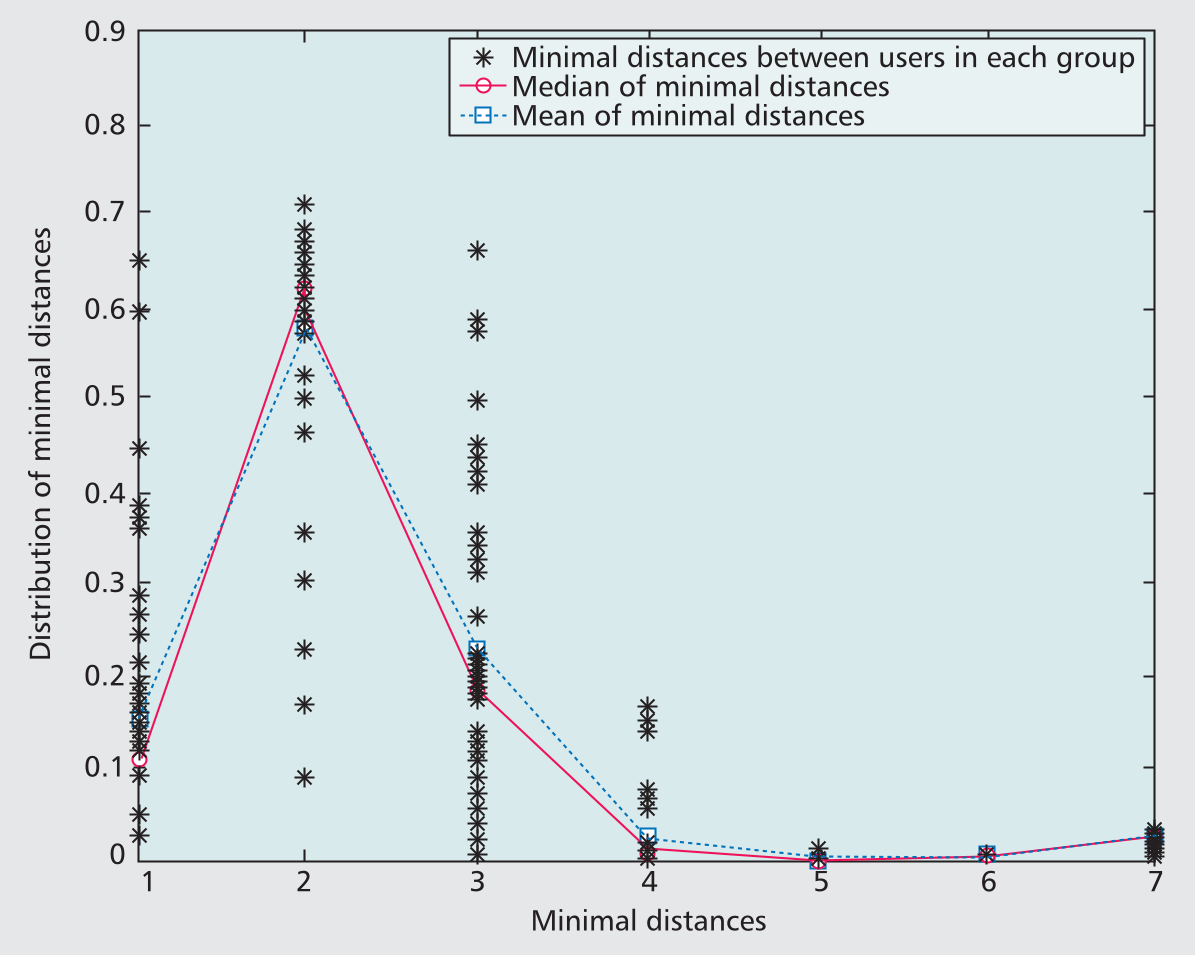 Figure 1: Distribution of minimal distances. If information spread only via friends, the 1-hop proportion would be dominant (far left), but the data shows users are socially isolated from one another.
The Core Insight: Heavy-Tails and External Media
If users aren't getting the news from their friends, where is it coming from? The authors highlight the role of External Media (TV, News sites, etc.). The group size typically peaks roughly 2.5 hours after news coverage peaks.
More importantly, while the rise of a topic is explosive, its decay isn't exponential—it's heavy-tailed. This means the interest lingers longer than standard models predict, following a power-law-like distribution.
Methodology: The Adaptive Parametric Model
Instead of complex differential equations that require knowing "infection rates" (which are almost impossible to calculate in real-time), the authors use an adaptive Pareto distribution:
They derive a -step prediction equation that estimates future group size based on the current rate of change. The model "learns" from the most recent group sizes, updating its parameter to adjust to the specific decay curve of the topic.
Performance: Decimating the SIR Baseline
The researchers tested their model against 77 incidental topics across LiveJournal and Sohu. In a head-to-head comparison regarding the Haiti Earthquake discussion:
| Metrics | Actual Value | New Model (1-day) | SIR Model |
|---|---|---|---|
| Active Period (Days) | 22 | 21 | 54 |
| Total Users | 4,931 | 5,039 | 10,071 |
| Sum of Error Squares | N/A | 77,886 | 599,070 |
The SIR model fails spectacularly because it anticipates a much slower, symmetric decay, whereas the adaptive model captures the rapid drop-off and the long tail of the discussion.
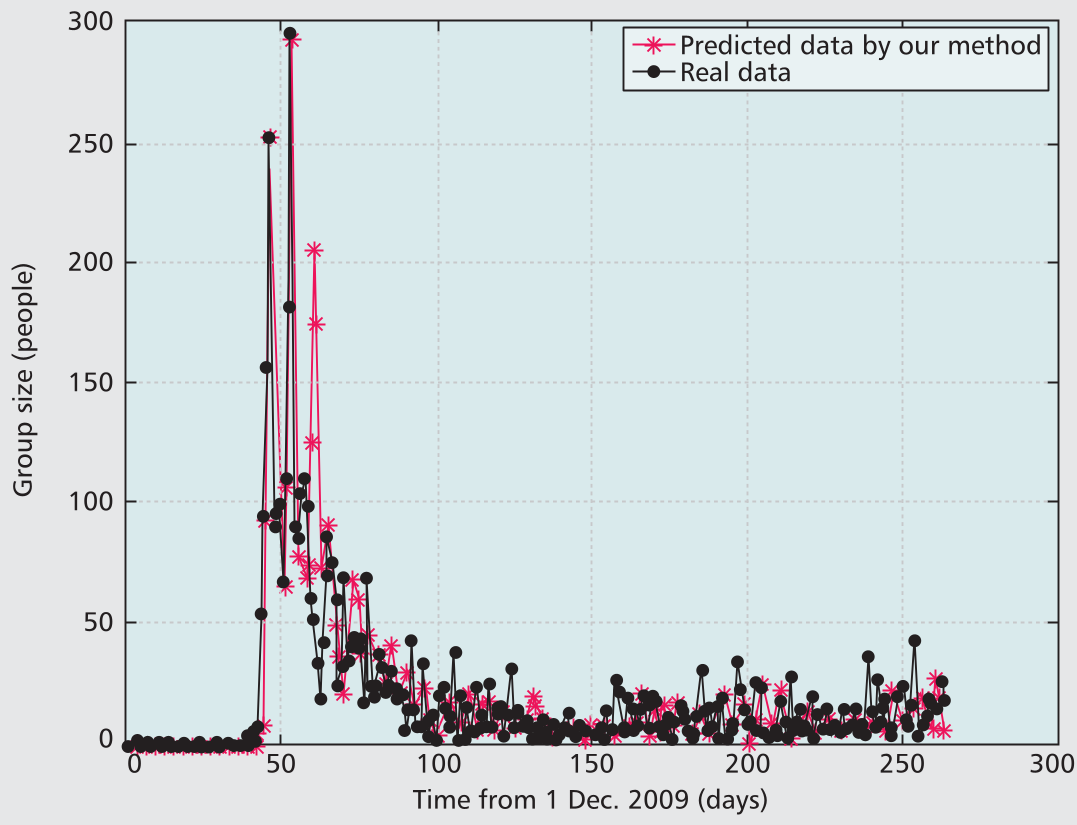 Figure 3: While our model (red) tracks the actual data (blue) closely, the SIR model (green) completely loses the trajectory.
Conclusion and Takeaways
The study shifts our understanding of "virality." For incidental events:
- Stop focusing solely on the "social graph": Most participants are socially disconnected; they are unified by interest and external stimuli, not friend-links.
- External News is the Catalyst: There is a strong 0th-order correlation between news volume and group size. To promote a topic, publicizing news is more effective than "seeding" influencers.
- The Two-Hop Strategy: Since so many users are 2 hops away, recommendations should extend beyond immediate friends to reach the "socially near" but disconnected clusters.
This work provides a robust framework for brands and governments to predict how long a crisis or a trend will remain "active" in the public consciousness.