
GED: Tracking Social Dynamics through Member Quality and Quantity
Group Evolution Discovery in Social Networks
This paper introduces GED (Group Evolution Discovery), a novel method for tracking the evolution of communities in temporal social networks. It uniquely incorporates both group size and member importance (Social Position) to identify seven distinct evolutionary events, outperforming existing baselines in flexibility and computational efficiency.
TL;DR
Social networks are not static; groups form, merge, and dissolve constantly. While most research focuses on who is in a group, the GED (Group Evolution Discovery) method argues that who matters is just as important. By combining community detection with social position centrality, GED provides a more accurate and scalable way to track group "life cycles" than previous SOTA methods.
Context: The Uncharted Territory of Group Dynamics
While identifying clusters in a single snapshot of a network is a mature field, tracking how these clusters morph over time is what the authors call "uncharted territory." Existing approaches often fail when groups overlap or when a network grows too large. Most importantly, they treat all members as equal—a "stagnant" group might actually be undergoing a radical shift if all its "leaders" have left, even if the total node count remains the same.
Methodology: Quality-Weighted Inclusion
The core innovation of the GED method is the Inclusion Measure . It calculates how much of Group 1 is "present" in Group 2 using two factors:
- Quantity: The fraction of nodes shared between the two groups.
- Quality: The fraction of the total Social Position (SP) weight shared.
If a group maintains its size but loses its most influential members (high SP), the inclusion value drops, signaling a potential evolution event that size-based methods would miss.
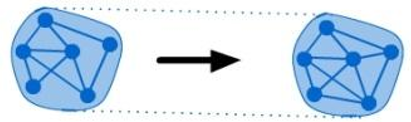
The method operates in three steps:
- Extract groups and calculate node centrality (Social Position) for each timeframe.
- Compute bidirectional inclusion for all group pairs in and .
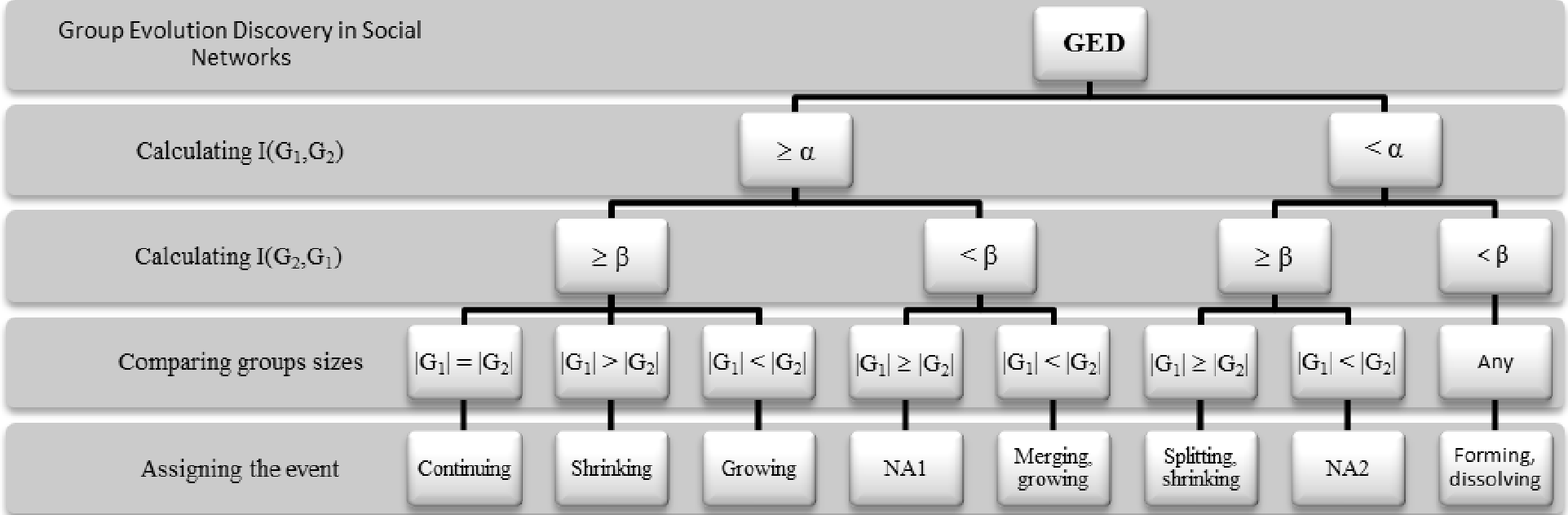
- Assign events using a specialized decision tree based on parameters and .
Experiments: Speed and Robustness
The authors tested GED against the Asur Method and Palla Method using a real-world email dataset from Wroclaw University of Technology.
- Versus Asur: Asur’s method produced anomalies (8% of cases) because it couldn't handle overlapping nodes—assigning a group to be "continuing" and "merging" simultaneously. GED resolved these conflicts through its inclusion thresholding.
- Versus Palla: Palla’s method, reliant on Clique Percolation (CPM) on merged graphs, suffered from computational explosion. It failed to process large timeframes even on high-end hardware. GED, being modular, allowed the use of faster algorithms like the Louvain method (Blondel et al.), making it significantly more scalable.
Performance Table Summary
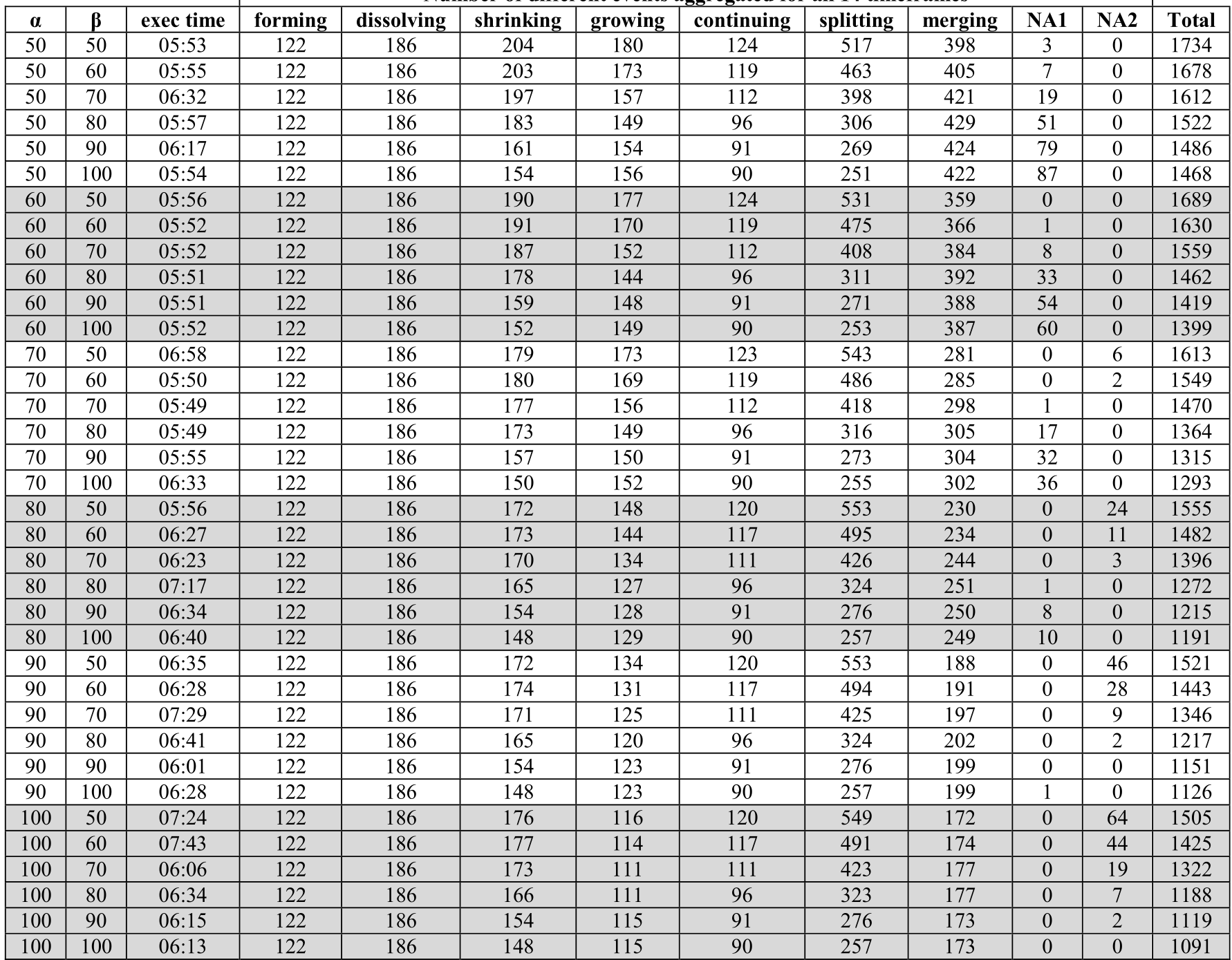
The following table demonstrates how adjusting and allows researchers to fine-tune the "strictness" of evolution detection:
Critical Insights & Future Work
The beauty of GED lies in its flexibility. It is "algorithm-agnostic"—you can swap out Social Position for PageRank or Betweenness, and you can swap the community detection algorithm to suit the network size.
Limitations: The authors noted rare cases (NA1, NA2) in the decision tree that currently lack a sociological interpretation. Additionally, the method currently looks at consecutive steps; identifying "dormant" groups that disappear and reappear later remains a challenge for future work.
Conclusion
GED effectively bridges the gap between static community detection and longitudinal social analysis. By formalizing group "Inclusion" through the lens of member importance, it provides a robust framework for understanding how social structures survive and transform in the digital age.