
GIM: Linking Identities Across Social Networks through the Power of Groups
Group Identity Matching Across Heterogeneous Social Networks
The paper introduces Group Identity Matching (GIM), a novel framework that shifts user identity linkage from matching individuals to matching units of groups across heterogeneous social networks. It integrates Behavior Learning, Behavior Transfer via Maximum Entropy (MaxEnt), and Relationship Transfer using Random Walks with Restarts (RWR) to outperform traditional single-user linkage methods.
TL;DR
Most identity linkage tools try to match individuals by their names or posts, but people change their "persona" across platforms. Group Identity Matching (GIM) solves this by matching entire groups at once. By combining Maximum Entropy behavior modeling with structural relationship transfer, GIM identifies latent connections that individual-centric models miss, boasting superior precision and linear scalability.
Problem: The "Mask" Problem in Social Networks
Identifying if "User A" on Twitter is the same as "User B" on Foursquare is a classic challenge. The core pain point is Behavioral Inconsistency. A user might tweet about politics but only use Foursquare to check into coffee shops.
- Existing Methods (UIL): Rely on literal attribute matching (names, bios).
- The Fail State: If a user has thin content or uses different aliases, traditional SOTA algorithms (like MOBIUS or Ulink) fail because they view the user in isolation.
The Insight: "Tell Me Who Your Friends Are..."
The authors argue that while your behavior might change, your community's behavior and the structure of your social circle remain relatively stable. GIM shifts the focus from "Is this person the same?" to "Is this community the same?"
Methodology: Behavior & Relationship Transfer
The GIM framework operates on a three-pillar architecture:
1. Behavior Learning (MaxEnt)
The model represents a group's behavior as a distribution . By using Maximum Entropy (MaxEnt), the authors find the most unbiased distribution that fits the observed group features. This captures the "vibe" of a community (e.g., a group interested in "Tech and Gaming").
2. Behavior Transfer
To bridge two different networks (e.g., source and target ), the algorithm doesn't just look for a match; it transfers knowledge. It regularizes the target weights to be close to the source weights , minimizing the distance .
3. Relationship Transfer (RWR)
Content isn't everything. GIM uses Random Walks with Restarts (RWR) to calculate a relatedness score . The constraint is simple: for a matching group to be valid, the individuals must not only act similarly but also be topologically "close" in the social graph.

Performance & Scaling
The authors didn't just propose a model; they optimized it for the real world:
- Newton-Raphson Optimization: Speeds up the iterative scaling process.
- Pruning Strategy: Discards candidate nodes that won't improve the objective function, preventing unnecessary computation.
Experimental Results
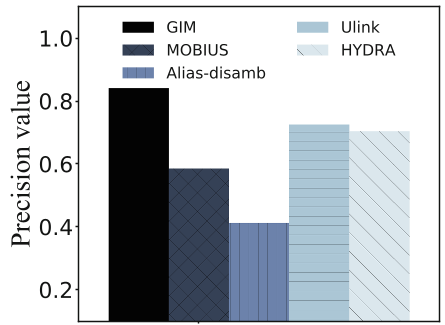
Tested on a massive dataset of Singapore-based users (160k Twitter users, 76k Foursquare users), GIM consistently outperformed HYDRA and MOBIUS.
- Precision: GIM maintains high precision even when users have different relationships across networks.
- Efficiency: Unlike global matching algorithms, GIM's local-search nature means its running time is independent of the total graph size, scaling linearly with the node's average degree.
Critical Analysis & Conclusion
Takeaway: GIM proves that the "collective identity" of a social group is a much more robust anchor for linkage than individual behavior.
Limitations:
- The model assumes the existence of some "seed" users or initial communities.
- The accuracy peaks at a group size of roughly 25; beyond that, "community drift" occurs, and precision drops as the group becomes too heterogeneous.
Future Outlook: This group-centric approach is highly applicable to fraud detection and cross-platform marketing, where identifying clusters of coordinated behavior is more valuable than tracking a single anonymous account.