
AdaWalk: Decoding the "Social DNA" of Personality through Group-Level Networks
Group-level personality detection based on text generated networks
The paper introduces AdaWalk, a novel unsupervised Network Representation Learning (NRL) framework for group-level personality detection using the Big Five (OCEAN) model. By constructing a text-generated similarity network rather than treating users as independent samples, it achieves state-of-the-art results across five heterogeneous datasets.
TL;DR
Personality detection has long been bottlenecked by the high cost of psychological labeling and the tendency of models to treat users in isolation. AdaWalk flips the script by using unsupervised Network Representation Learning (NRL) to analyze users within a "Text Generated Network." By focusing on how a user's language relates to their group, AdaWalk significantly outperforms traditional deep learning and linguistic methods, especially in data-sparse environments.
The "Independent Sample" Fallacy
Most modern AI personality predictors follow a simple supervised recipe: take a user's text, pass it through a CNN or LSTM, and predict a Big Five score. However, this ignores a fundamental psychological reality: Personality is not a vacuum. In social environments, the similarity between what we say and what our "neighbors" say is a strong indicator of who we are.
The authors identify three critical barriers:
- Annotation Scarcity: Deep learning needs labels; psychology doesn't have them in bulk.
- Scalability: Supervised models struggle to scale to the billions of un-labeled social media posts.
- Isolation: Ignoring the "group perspective" wastes valuable relational context.
Methodology: Building Social Networks from Text
Since social media platforms rarely release "follower/following" graphs alongside personality data for privacy reasons, the authors constructed a Text Generated Network.
1. Network Construction
Every user is a node. Edges are weighted by the TF-IDF similarity of their generated texts. This transforms a set of independent documents into a rich, tractable graph topology.
2. The AdaWalk Algorithm
Unlike standard Random Walk methods (like DeepWalk) that explore blindly, or node2vec which uses static hyperparameters (p and q), AdaWalk uses an Adaptive Kernel (K).
The kernel (calculable via Degree, Clustering Coefficient, or PageRank) allows the walk to decide on-the-fly whether to explore locally or globally:
- Local focus: If a node is part of a tight clique (high clustering), the walk stays close to capture fine-grained group influence.
- Global focus: If a node is a "bridge" (high PageRank/centrality), the walk explores further to capture diverse social influences.
 Figure 1: Conceptual visualization of text-similarity networks where edge thickness correlates with personality similarity.
Experiments & Results: Crushing the Baselines
The authors tested AdaWalk on 8 heterogeneous datasets (YouTube, Facebook, PAN, etc.) against 10+ famous methods, including deep learning (2CLSTMs) and traditional linguistic analysis (LIWC/Mairesse).
Key Performance Hits:
- Classification: On the SoCE dataset, AdaWalk hit a 97.74% Micro-F1, outperforming node2vec by a significant margin.
- Data Efficiency: When labeled data was reduced to just 10%, AdaWalk's performance remained stable while supervised models collapsed.
- Regression: In predicting continuous Big Five scores, AdaWalk consistently achieved the lowest Root Mean Square Error (RMSE) across all traits (Openness, Conscientiousness, etc.).
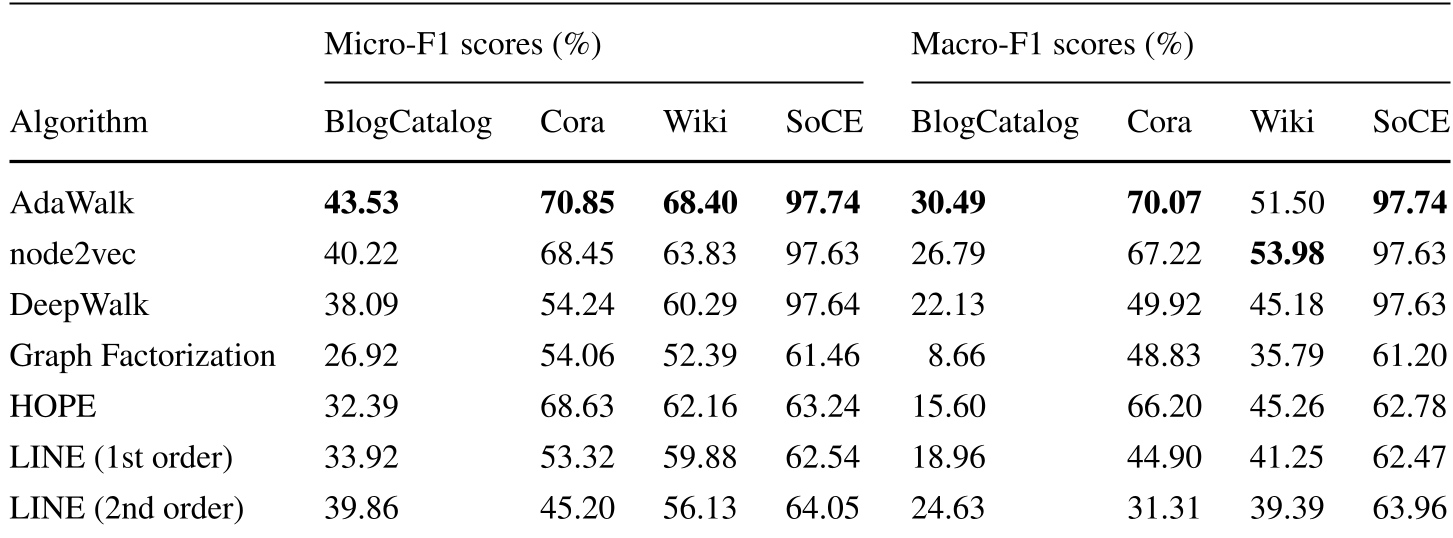 Table 1: Performance comparison showing AdaWalk leading in both Micro and Macro-F1 scores across multiple datasets.
Why It Works: The Unsupervised Advantage
The success of AdaWalk stems from its Inductive Bias. By assuming that personality is reflected in the comparative relationship between users rather than just the absolute content of their text, the model leverages the entire graph structure. Because the feature learning is unsupervised (Skip-Gram based on walks), it treats the vast un-labeled portion of the network as a teacher, learning the "manifold" of human expression before any labels are ever applied.
Critical Analysis & Conclusion
Takeaway
AdaWalk bridges the gap between traditional Social Network Analysis and modern NLP. It proves that the "group perspective" is not just a sociological theory but a mathematical shortcut to more accurate AI.
Limitations
The primary weakness lies in the initial network construction. Relying on TF-IDF for text similarity is computationally efficient but may miss deep semantic nuances that a Transformer-based embedding (like BERT) would capture.
Future Outlook
As we move into an era where privacy (GDPR/CCPA) makes user metadata harder to obtain, the ability to reconstruct social context from text alone via methods like AdaWalk will be essential for the next generation of recommendation engines and mental health screening tools.