
Beyond Co-authorship: Max-Flow and Multi-Relational Dynamics in Scientific Networks
Group and link analysis of multi-relational scientific social networks
This paper introduces a multi-relational framework for analyzing scientific social networks, moving beyond simple co-authorship to include projects, advisory roles, and technical production. It proposes a Max-flow-based clustering algorithm for community detection and the "Ströele Metric" for link prediction, outperforming the Katz metric in precision and recall across long-term temporal data.
TL;DR
Most analyses of scientific collaboration are reductive, looking only at who co-authored a paper. This paper argues that academia is a multi-relational ecosystem. By integrating data on projects, advisory work, and technical production, and applying a novel Max-flow-based clustering and the Ströele Metric for link prediction, the authors provide a more accurate lens for viewing how knowledge actually flows through a national scientific community.
Background: The Limitations of "Single-Link" Networks
In the landscape of Social Network Analysis (SNA), researchers typically treat scientific networks as homogeneous graphs. If Researcher A and B share a paper, there is an edge; if not, there isn't. However, this ignores the "hidden" infrastructure of academia:
- Project Co-participation: Researchers might work together for years without a joint publication.
- Advisory Roles: The mentor-mentee relationship represents a unique, vertical knowledge flow.
- Temporal Decay: A collaboration from 20 years ago does not carry the same weight as one from 2024.
The authors' insight is that by modeling these as a multi-relational weighted graph, we can better identify "Knowledge Brokers"—individuals who serve as critical bridges between disparate institutions.
Methodology: The Mechanics of Flow
The authors propose a structural pipeline that transforms raw curricula data (from the Brazilian Lattes platform) into a sophisticated social model.
1. Multi-Relational Weighting
They define four relationship types (): projects, publications, advisory, and technical work. The strength of a bond between researchers and is normalized by their individual productivity () to ensure that a single collaboration between low-output researchers is weighted as more significant than a single collaboration between two high-output "superstars."
2. Temporal Decay & Content Loss
To reflect the reality of fading connections, they introduce a temporal weight , where is the year of the relationship. Additionally, they account for Content Loss in indirect paths, assuming knowledge degrades by for every intermediary node it passes through.
3. Max-flow Clustering
Instead of using simple Euclidean distance, the similarity is defined as the Maximum Flow (using the Edmonds-Karp algorithm) between two nodes. This captures the total "communication capacity" between researchers across all possible paths in the multi-relational graph.
 Figure 1: The complete workflow from data extraction to group analysis and link prediction.
Link Prediction: The Ströele Metric
A core contribution is addressing the "Newbie Problem." Traditional path-based metrics like the Katz Metric favor highly connected "hubs." The proposed Ströele Metric normalizes the sum of weighted paths by the union of the neighbors of nodes and .
This normalization ensures that a new researcher with only a few—but very strategically placed—connections can still be identified as a likely future collaborator.
Experimental Results & Insights
The method was validated against the Brazilian Computer Science community (175 researchers). By comparing a simplified co-authorship graph with their multi-relational model, the authors demonstrated that the group structures shifted significantly, revealing communities that were previously invisible.
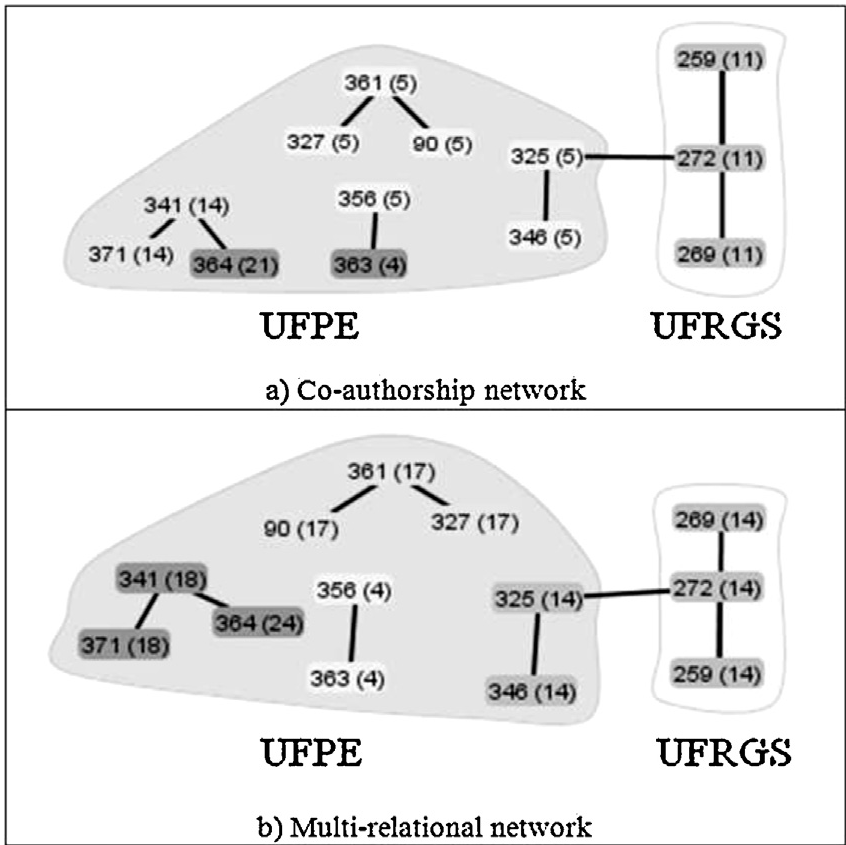 Figure 2: The identified research communities within and across Brazilian institutions.
Key Findings:
- Prediction Performance: In temporal link prediction (predicting links using data from ), the Ströele Metric outperformed Katz consistently. In 2010, the Recall of the Ströele Metric was 0.62 compared to 0.51 for Katz.
- Knowledge Brokers: The analysis successfully identified "External Central Connectors"—researchers who maintain more links outside their home institution than inside, acting as vital conduits for nationwide interdisciplinarity.
Critical Analysis & Future Outlook
While the study is robust for mid-sized networks, the authors admit that the computational cost of calculating all-pairs Max-flow and high-order paths in the Ströele Metric is high. To scale this to massive databases like DBLP (300k+ nodes), the paper suggests heuristics like the "Six Degrees of Separation" to limit path searches.
Takeaway: This work shifts the focus from who we know to how we are connected over time. For organizations and grant agencies, these metrics provide a much sharper tool for identifying untapped collaborative potential than simple publication counts.
References
- Liben-Nowell, D., Kleinberg, J., 2003. The link prediction problem for social networks.
- Newman, M.E.J., 2004. Detecting community structure in networks.
- Ströele, V., et al., 2013. Group and link analysis of multi-relational scientific social networks.