
SGP Query: Redefining Group Recommendations in Social Networks
Group Preference Queries for Location-Based Social Networks
This paper introduces the Spatial Group Preference (SGP) query for Location-Based Social Networks (LBSNs). It presents a new evaluation model and R-tree-based algorithms (PA and OPA) to find top-k POIs that maximize group satisfaction by balancing user locations, POI ratings, and cross-category preferences.
TL;DR
Choosing a meeting spot for a group of friends involves more than just finding the midpoint on a map. This paper proposes Spatial Group Preference (SGP) queries, a framework that selects the Top-k Points of Interest (POIs) by integrating geographic proximity, social ratings, and the specific category preferences of each group member. By using an optimized R-tree pruning strategy, the system provides high-quality recommendations even across millions of POIs.
Context: Why Distance is Not Enough
In the era of Location-Based Social Networks (LBSNs), the "Group Nearest Neighbor" (GNN) approach—finding a point that minimizes the total travel distance—is the industry standard. However, it ignores a crucial social reality: preferences vary. One friend might prioritize food quality (ratings), while another care about being near a cinema for an after-dinner movie.
Existing works often treat POI properties in isolation or ignore user-specific category weights. The SGP query bridges this gap by making the spatial search user-aware and context-aware.
The Core Innovation: Satisfaction Degree Model
The authors define a "Satisfaction Degree" () which is a weighted sum of two components:
- Distance Relevance (): Measures how central a POI is to the group members.
- Preference Relevance (): Measures the internal quality of the POI and the external utility provided by surrounding POIs that match the group's category interests.
The model even accounts for the "mutual influence" of POIs. For example, a cafe's score increases if there is a highly-rated park within a specific range , weighted by how much the group actually likes "parks."

Algorithm Efficiency: Pruning the Search Space
Calculating the satisfaction degree for every POI in a city is computationally expensive. The paper introduces three tiers of algorithms:
- Baseline Algorithm (BA): A naive R-tree traversal with no pruning.
- Pruning Algorithm (PA): Uses aRtrees (Aggregated R-trees) which store the maximum POI scores in each branch. If a branch's upper-bound satisfaction score is lower than the current -th best result, the entire branch is discarded.
- Optimized Pruning Algorithm (OPA): Recognizes that nearby candidate POIs often share the same neighbors. It processes sets of POIs within a leaf node together to minimize redundant tree traversals.
Experimental Insights
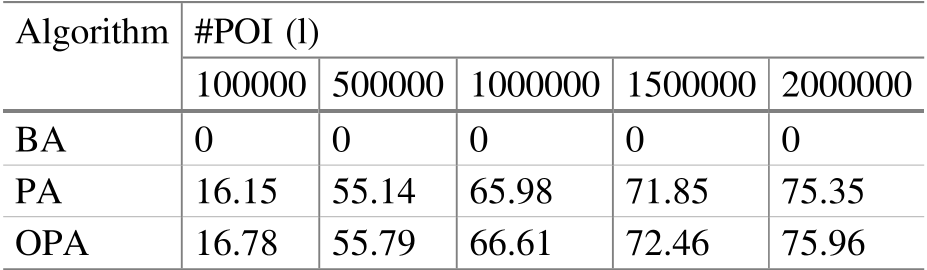
The study evaluated these algorithms on datasets ranging from 100,000 to 2,000,000 POIs.
- Scalability: While the baseline's runtime exploded as the dataset grew, the OPA remained remarkably stable, thanks to a pruning rate of ~75%.
- Impact of Categories: Interestingly, as the total number of global categories () increases, the query speed improves. This is because the density of POIs matching the specific "target category" decreases, allowing the algorithm to skip large sections of the spatial index.
Critical Analysis & Future Outlook
While the SGP query is a significant step toward "socially intelligent" spatial search, there are limitations:
- Euclidean vs. Road Network: The current model uses straight-line distance. In real-world urban environments, travel time on road networks can vary significantly from Euclidean distance.
- Dynamic Preferences: User preferences are often fixed in this model. Future work could incorporate temporal factors (e.g., preferring "breakfast" spots in the morning).
Conclusion: This work provides a robust mathematical and algorithmic foundation for group-based POI discovery. By shifting the focus from "closest" to "most satisfying," it aligns spatial database technology with the nuanced needs of modern social circles.