
GRS: Enhancing Social Network Group Recommendations via Noise-Aware Classification
Group Recommendation System for Facebook
The paper proposes a Group Recommendation System (GRS) for Facebook that leverages hierarchical clustering and decision tree algorithms. By analyzing user profile features, the system identifies the "core" identity of social network groups to provide accurate recommendations for users overwhelmed by the platform's group density.
TL;DR
With the explosion of social groups on platforms like Facebook, finding the "right" community has become a needle-in-a-haystack problem. This paper introduces the Group Recommendation System (GRS), which combines hierarchical clustering with decision trees. By filtering out "noise" members—those who don't fit a group's core profile—the system reaches an accuracy of 73%, proving that group identity is a measurable byproduct of its members' shared characteristics.
The "Group Fatigue" Problem
Online Social Networks (SNs) offer unparalleled flexibility, allowing any user to create a group for any cause. However, this flexibility breeds uncertainty. Taking the University of North Texas (UNT) network as a sample, the authors observed categories with over 500 individual groups.
The core challenge is Identity Dilution. Many groups are self-organized, but as they grow, they attract "noise"—members who join for peripheral reasons and whose profiles (Age, Gender, Political Views) do not align with the group's actual theme. Standard recommendation engines that treat all members equally often fail because they try to learn from these outliers.
Methodology: From Hierarchical Filtering to Decision Trees
The authors propose a two-stage engine to solve this:
1. Denoising via Hierarchical Clustering
Before training a classifier, the system must define what a group actually looks like.
- Feature Extraction: 15 distinct profile features (e.g., Wall counts, Relationship Status, Political View, Time Zone) are extracted.
- Similarity Inference: Using Euclidean distance and UPGMA (Unweighted Pair-Group Method using Arithmetic Averages), a hierarchical tree is built for each group.
- Clustering Coefficient (): The authors introduced a specific metric to find the "cutoff point." Only members within a certain normalized distance () from the group center where is maximized are kept.
2. The Classification Engine (Decision Tree)
Once the noise is removed, the remaining "core members" are used to build a Decision Tree. The tree uses binary recursive partitioning to find the best split (maximum homogeneity) across features.
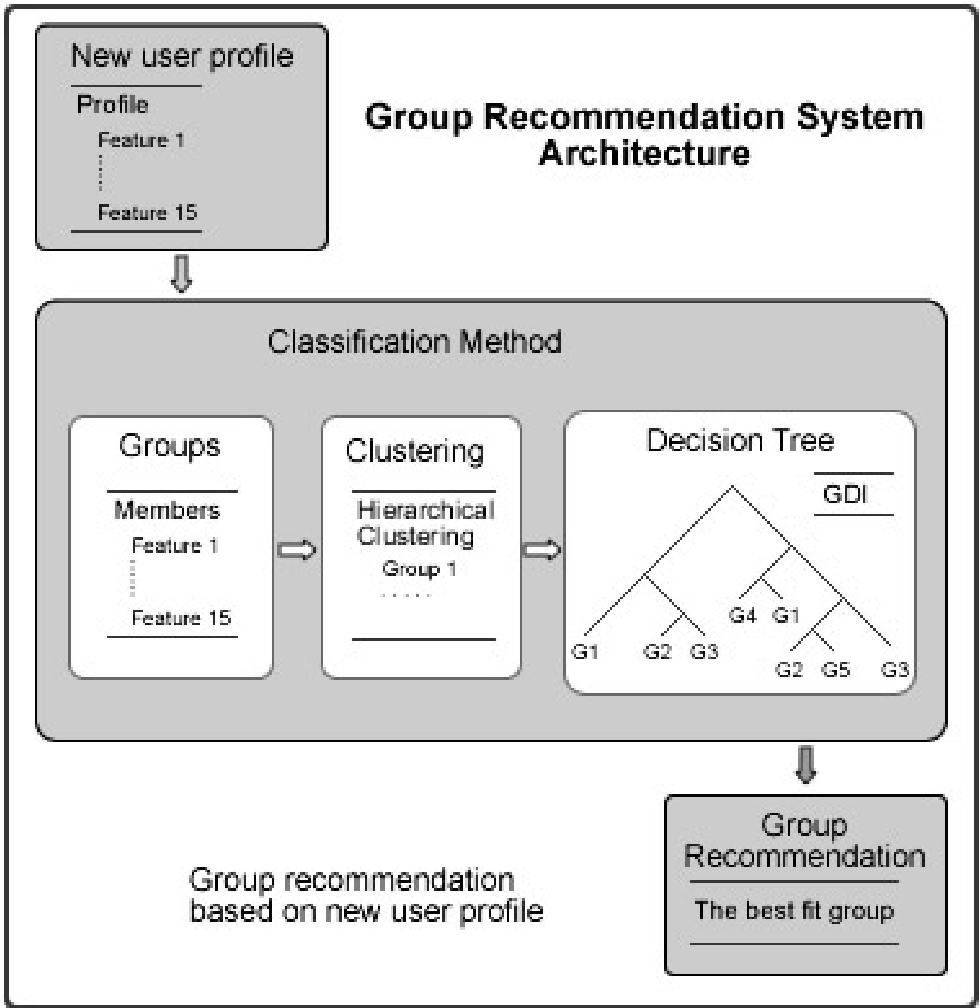 Figure 1: The GRS Architecture, showing the pipeline from profile extraction to final recommendation.
Experimental Insights
The study analyzed 17 distinct groups at UNT, ranging from Spanish learners to political campaigns against specific figures.
- Demographic Fingerprinting: The data revealed clear patterns. For instance, "Not Bush fan" (G17) was majority Female, Liberal, and aged 20–24. PC Gamers (G16) showed distinct political and gender skewness.
- Accuracy Boost: The results (Figure 4) demonstrate that removing the 343 "noise" members (32% of the accessed users) was crucial.
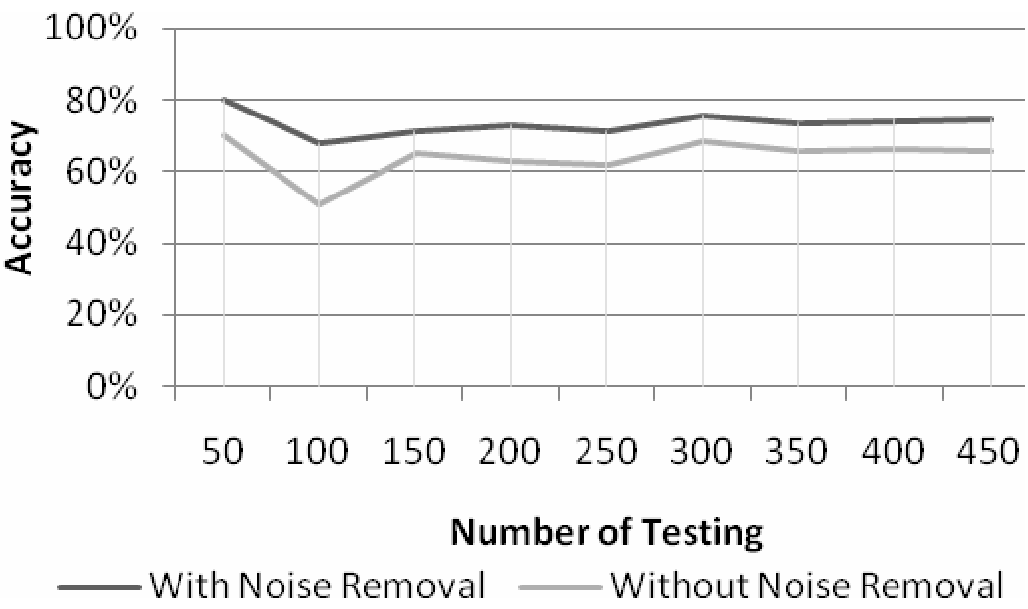 Figure 2: Performance comparison showing the 9% accuracy jump gained from noise removal.
Critical Analysis & Future Outlook
The GRS provides a solid foundation for Social Identity Theory in digital spaces. By demonstrating that 73% of recommendations can be accurately predicted just by profile alignment, it validates the idea that we are known by the company (or groups) we keep.
Limitations
- Data Privacy: The study relied on the 2007-era Facebook API where privacy was often "open by default." In today's GDPR/CCPA era, such deep profile scraping is no longer feasible.
- Dynamic Identity: Groups evolve. The decision tree is a snapshot; it may struggle with "chameleon" groups that change their purpose over time.
The Roadmap Ahead
The authors foresee this technology moving into Targeted Advertising and Intelligent Information Distribution. Instead of bombarding users with every post from every group, a GRS-aware system could prioritize content from groups where the user aligns most closely with the "core identity."
Takeaway for Researchers
If you are building recommendation engines for social platforms, do not assume all group members are equal. Identifying the "core" versus the "periphery" is the secret sauce to increasing model precision.