
HappyMovie: Bringing Social Intuition to Group Recommendations
Development of a group recommender application in a Social Network
This paper introduces ARISE and its instantiation HappyMovie, a group movie recommender system integrated into Facebook. It utilizes a Social Group Recommendation Method that aggregates individual preferences by weighting social factors like personality types and inter-personal trust (tie strength) to improve group satisfaction.
TL;DR
Recommending a movie to a group isn't just about finding a high average score; it's a social negotiation. This paper presents HappyMovie, a Facebook-integrated system that uses personality profiles and social "tie strength" to predict how a group will actually decide. By moving beyond simple math to social-cognitive modeling, the system achieves significantly higher user satisfaction than traditional SOTA methods.
The Problem: The "Democratic" Fallacy
Most group recommenders (like those for Netflix or Spotify) assume a "one person, one vote" logic. They use aggregation functions like Average or Least Misery. However, human groups don't work that way. A "Strong Personality" might dominate the choice, or a person might yield their preference to a "Close Friend."
Current systems fail because:
- They ignore Personality: A submissive user and an assertive user are treated identically.
- They ignore Social Ties: The influence of a best friend vs. a mere acquaintance is not weighted.
- They lack Memory: If you gave in to your friends last week, the system doesn't know it should prioritize your choice this week.
Methodology: Modeling the "Social Soul"
The core of the paper is the ARISE architecture, which powers the HappyMovie application. It relies on three innovative "Social Factors":
1. Personality Elicitation (TKI Metaphor)
Instead of a boring 30-question psychology test, authors used a "Movie Metaphor." Users identify with characters representing five conflict-handling modes (e.g., Competing, Collaborating, Avoiding). This maps users onto a scale of Assertiveness vs. Cooperativeness.
2. Physical & Digital Trust (Tie Strength)
By tapping into the Facebook API, the system calculates a trust value () based on:
- Intimacy: Overlapping photo tags.
- Intensity: Frequency of wall posts and messages.
- Duration: Number of mutual friends.
- Reciprocal Services: Common interests and profile similarities.
3. The DBR (Delegation-Based Rating) Formula
The magic happens in the DBR formula, which modifies an individual's rating based on their peers' influences:

The rating for an item is adjusted by the personality difference () and the trust () between group members. In essence, the system "delegates" part of a user's decision-making power to their more assertive or more trusted friends.
Experiments: Real Users, Real Results
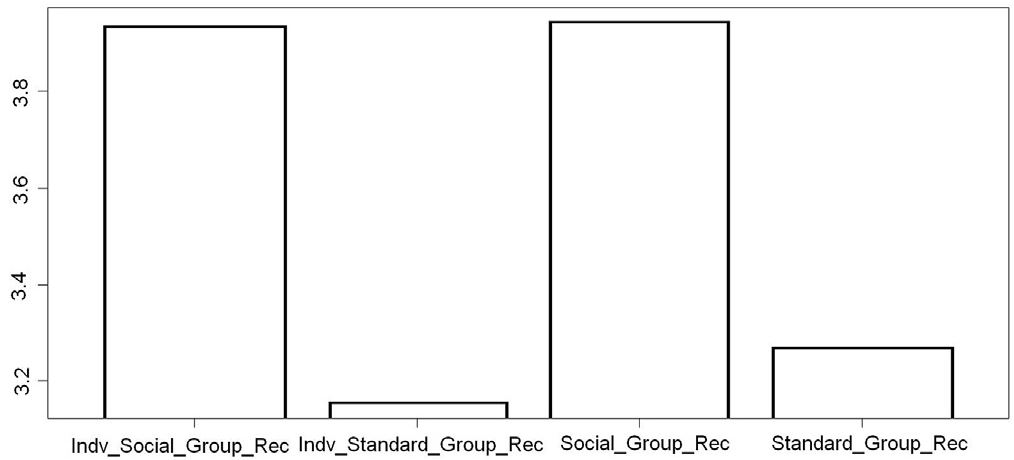
The authors tested HappyMovie with 60 real students grouped into trios. They compared their Social Recommender against a Standard Recommender (simple average).
Key Findings:
- Superior Satisfaction: Users consistently rated the "Social" recommendations higher than "Standard" ones.
- Gender & Personality Correlation: An interesting side-finding showed that in this specific sample, male users exhibited higher "selfish/assertive" scores, while female users tended toward "mild/cooperative" scores.
- The Power of Memory: By tracking "Global Satisfaction" over time, the system learned to compensate users who had "lost" in previous sessions. By the third outing, group satisfaction scores hit an impressive 4.56/5.0.
Critical Insight & Conclusion
The true value of this work lies in its hybrid nature. It isn't just a better algorithm; it's a better proxy for human behavior. By automating the extraction of social ties from Facebook, it solves the "cold start" problem of knowing group dynamics without asking users tedious questions.
Takeaway: Future AI assistants shouldn't just be "smart"; they need to be "socially aware." HappyMovie proves that when an algorithm understands the hierarchy and loyalty within a group, the "human" acceptance of its suggestions sky-rockets.
Limitations: The study was conducted on a relatively small, homogeneous sample (students in their 20s). Future work needs to see if these "social weights" hold true across different cultures and age groups where hierarchy might be defined by status rather than just personality.