
Group Segregation in Social Networks: A Strategic Calculus of Heterogeneity
Group Segregation in Social Networks
This paper presents an extension of the Jackson-Wolinsky strategic network formation model by incorporating agent heterogeneity through "types" and "tolerance." It identifies the strategic conditions under which group segregation emerges in social networks as a result of individual utility-maximizing behavior.
TL;DR
Why do social networks naturally splinter into "us vs. them" camps? This research team from Imperial College and the University of Warwick extends the classic Jackson-Wolinsky model to show that segregation isn't just a byproduct of high costs, but a stable equilibrium driven by individual "Value Heterogeneity" and "Tolerance." Even when agents benefit from their own kind, the presence of indirect connections can lead a group to shun its own members if they "associate" with the wrong types.
Motivation: Beyond the Homogeneous Bubble
Most traditional network formation models treat agents like carbon copies of one another—nodes with the same preferences and costs. However, reality—especially the digital reality of Facebook and Twitter—is rife with Group Segregation.
Existing literature often blamed segregation on Information Asymmetry (not knowing who is out there) or Cost Heterogeneity (it's too expensive to reach "the others"). This paper argues that even if everyone knows everyone and the costs are near zero, segregation remains a strategic "Pairwise Stable" outcome.
Methodology: Types, Decay, and Tolerance
The authors build on the Jackson-Wolinsky (JW) model, where utility () is the sum of benefits from direct and indirect connections, discounted by a decay factor , minus the cost of maintaining direct links.
1. Value Heterogeneity
Instead of for everyone, utility now depends on types: .
- Intuition: You prefer connecting to people with types closer to yours ().
- The Math: The model allows for "Gross Disutility"—where connecting to a certain type actually hurts your payoff.
2. Tolerance ()
This is the paper's secret sauce. Within the same group, individuals have different "Tolerance" levels.
- MAI (Minimum Absolute Intolerance): Agents who only gain utility from their own type.
- MAT (Minimum Absolute Tolerance): Agents willing to bridge the gap.
3. Model Architecture
The fundamental stability concept used is Pairwise Stability. A link exists if both and benefit (consent), but if even one agent is better off without it, the link is severed.
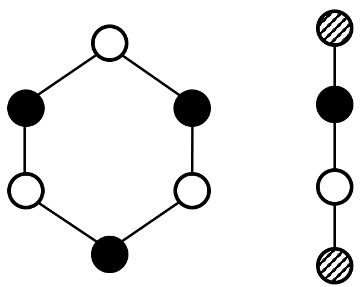 Figure 1: Comparison of cyclic (left) and acyclic (right) networks showing how types can be bridged or segregated.
Key Insights: Why Segregation is Endemic
The "Shunning" Effect
One of the most sophisticated findings is intra-group segregation. The model shows a scenario where a group (Type A) might shun one of its own members because that member is connected to Type B. If Type A agents find Type B connections toxic (Gross Disutility), the indirect "contamination" through their peer outweighs the benefit of the peer connection itself.
Theorem 3.6: Indirect Utility as a Bridge
In acyclic networks, if two agents who dislike each other's types are directly connected, there must be a third, more valuable type further down the line acting as an "anchor." Without this indirect "value," the link is strategically unsustainable.
Experimental Results: The Predictability of High Costs
The team ran 10,000 simulations per cost increment to see how networks evolve.
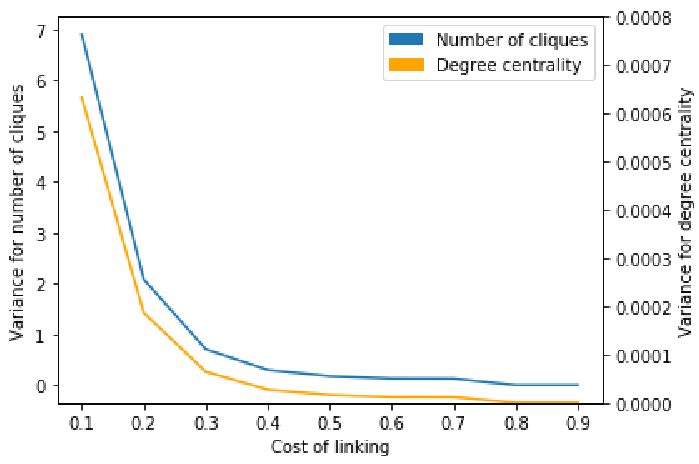 Figure 2: The variance in the number of cliques decreases as the cost of linking increases.
The Paradox of Cost:
- Low Cost: Pairwise stable networks are chaotic and diverse in structure. We can't predict what they look like.
- High Cost: While edges are fewer, the statistical features (clique count, degree centrality) become highly predictable. The variance drops sharply.
Segregation Trends
As costs rise, agents shift from "Inter-group" connections to "Intra-group" connections. Essentially, when it gets expensive to be social, people retreat to their own tribes to maximize utility-per-link.
Critical Analysis & Conclusion
This paper provides a micro-founded explanation for why "information bubbles" are so hard to pop. Segregation is not an accident; it is a stable equilibrium of private interests.
Limitations:
- The model assumes Perfect Information. In the real world, we rarely know the full topology of the internet.
- The "Types" are static. A more realistic model would allow types to change (opinion evolution) based on connections.
Future Outlook: The authors suggest a two-stage game where network formation is followed by "opinion diffusion." This would be the "Holy Grail" for understanding how fake news polarizes societies.
Takeaway: If you want to reduce segregation, don't just lower the "cost" of communication—you must change the "value" agents place on diverse connections or increase their "tolerance" parameter.